
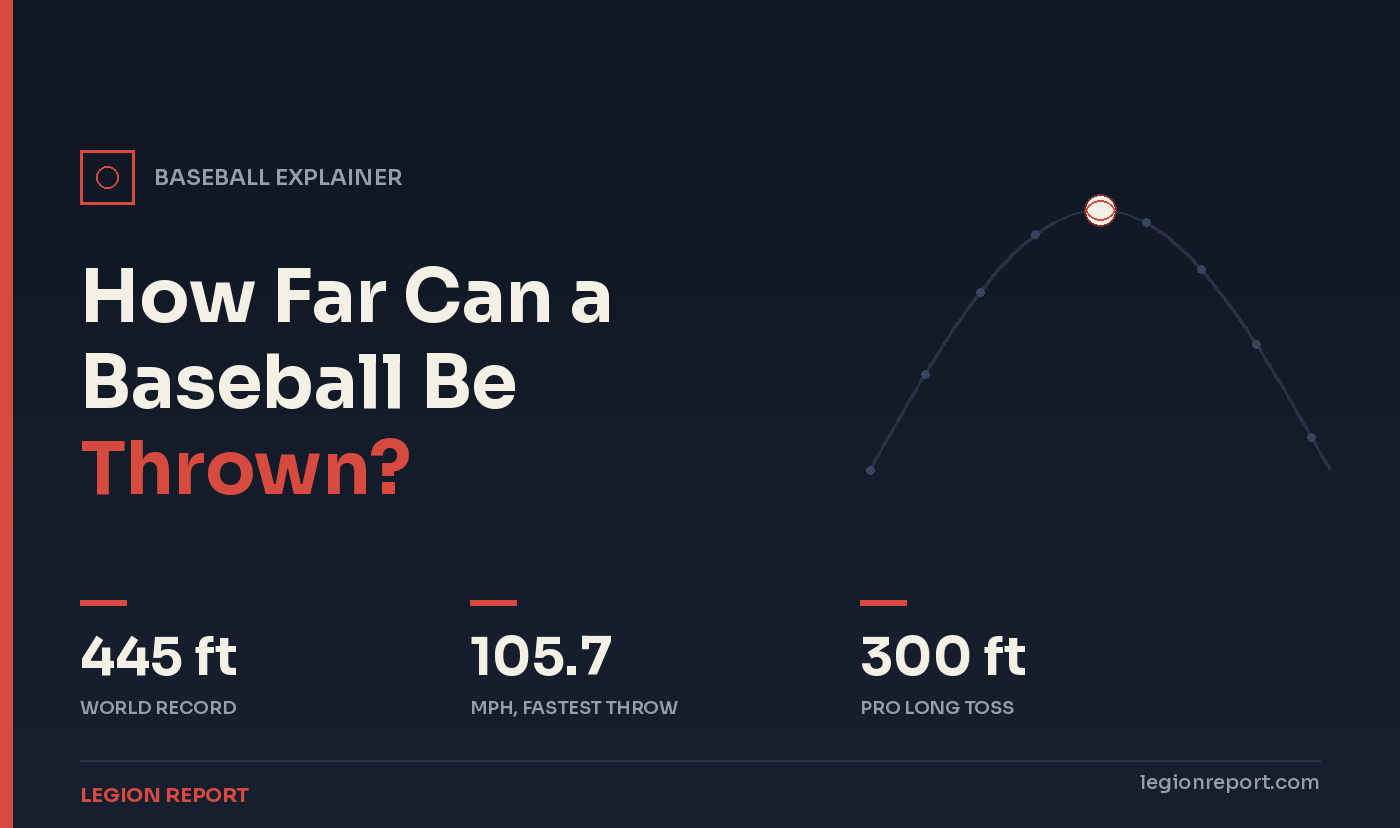

Get to a ballpark early and you will see the warmup ritual every team runs through: position players stretching their arms out to 90 feet and back, pitchers airing it out in long toss until the ball is carrying 300 feet across the grass. It is one of the few moments when you see just how hard these athletes can actually throw, and it raises a natural question. If a player truly let one go, with a running start and no cutoff man to hit, how far would the ball travel?
The honest answer is that nobody really knows the modern ceiling, because teams stopped letting players test it decades ago. The risk to a valuable arm is simply too high. What we do have is a remarkable historical record, a set of verified distances, and a body of modern velocity data that hints at what today’s strongest arms might be capable of.
The chart below is a full reference: the all-time distance record and the men who held it before, the fastest throws of the Statcast era, what players throw at every level, and the physics behind a record toss. Take a look, then we’ll get into the stories behind the numbers.
The record that has stood for almost 70 years
The longest verified baseball throw in history belongs to Glen Gorbous, a Canadian outfielder who, on August 1, 1957, threw a ball 445 feet and 10 inches during a pregame exhibition in Omaha. He was given a short running start and launched it from the right field corner toward the left field corner. Guinness World Records recognized the mark, and almost seventy years later it still stands, in large part because no one has formally tried to break it since.
What makes the record fascinating is how close the competition was. Gorbous beat the previous holder, Don Grate, by just nine inches. Grate, a former Phillies pitcher and Ohio State two-sport star, had set the mark at 445 feet 1 inch in 1956, breaking his own earlier records. He went to his grave insisting the two throws were not measured under equal conditions, arguing that his ball hit a backstop and was measured short while Gorbous threw with a helpful wind in thinner Omaha air. The two men talked about a head-to-head “grudge match” to settle it, but neither was enthusiastic and it never happened.
Before Grate, the record traces back to Sheldon Lejeune, who threw 426 feet 9.5 inches in 1910, a mark that stood for more than four decades. The whole lineage of the record reads like a lost corner of baseball history, a feat that used to be a celebrated pregame attraction and has since quietly disappeared from the game.
Why nobody breaks it anymore
The reason the record has gone untouched is simple: arms are too valuable to risk. A max-effort throw with a running start puts enormous stress on the shoulder and elbow, and modern organizations have millions of dollars tied up in their players’ health. As Grate himself recalled, managers in his own era already frowned on the stunt, and he heard of at least one player who was threatened with a fine if he attempted it. Today, with Tommy John surgery a constant worry, no club would let a prospect air out a ball for a novelty distance record.
That leaves a strange gap in our knowledge. We genuinely do not know how far a modern, strength-trained, biomechanically optimized arm could throw a baseball, because the test is never run. There is a real argument that today’s best arms could pass 445 feet if they ever tried, but the incentive structure of the sport guarantees we will probably never find out.
What the velocity data hints at
Since 2015, Statcast has measured how hard players throw, and those numbers give us the best modern proxy for raw arm strength. The hardest tracked throw belongs to Rockies outfielder Brenton Doyle at 105.7 mph in 2023, edging out the 105.5 mph rocket Aaron Hicks fired in 2016. For context, the average MLB outfield throw sits around 85 mph, and a throw in the high 90s or low 100s is considered elite.
Here is where the record gets its proper context. In his classic book The Physics of Baseball, physicist Robert K. Adair estimated that Gorbous must have released his record throw at roughly 115 mph, faster than any throw Statcast has ever recorded. Whether a 1957 outfielder truly out-threw today’s hardest arms, or whether the running start and conditions inflated the figure, is exactly the kind of debate that keeps the record interesting. What is clear is that distance and velocity are related but not identical: a flat 105 mph laser and a high, arcing 115 mph heave behave very differently once gravity gets involved.
What that means for the rest of us
For ordinary humans, the numbers come back to earth quickly. A typical adult who does not play regularly can throw a baseball around 100 feet, because throwing far depends on rotator-cuff conditioning and full-body mechanics that only develop with repeated use. A high schooler with a real throwing program might reach 250 feet, college and pro players routinely clear 300, and the very best outfield arms get out past 350. Even a 10-year-old can sometimes throw 120 feet, though early arm strength is a poor predictor of how a kid will develop, since a stronger thrower at ten is often passed by a late bloomer at fourteen.
The throw is also only one half of an outfielder’s job, because accuracy matters as much as raw distance. A 105 mph throw that sails ten feet wide of the cutoff man is worthless, which is why coaches drill players to keep the ball on a line to a target. If you are curious how the other half of the equation works, how far a ball travels when it is struck rather than thrown, we break that down in our look at how far a baseball can be hit.
How to actually throw farther
If you want to add distance to your own arm, the formula is not complicated, but it does demand consistency. The foundation is overall strength and explosiveness, since throwing far is a whole-body movement that starts in the legs and core, not just the shoulder. A real strength program, paired with mobility work, builds the engine that a powerful throw runs on.
On top of that sits long toss, the practice of gradually backing up and throwing progressively longer distances to build arm strength and arm speed. Three sessions a week is a common rhythm for players building toward a season. The last ingredient is intent: there is no benefit to lazy throws, so the gains come from throwing on a line, with purpose, and trying to push your maximum distance a little further week over week. Plenty of players who started at 250 feet have crossed 300 with a few months of steady work, the same way weightlifting yields steady progress over time.
Final Word
So how far can a baseball be thrown? The verified answer is 445 feet 10 inches, set by Glen Gorbous in 1957 and untouched ever since, a throw longer than many players can hit a ball and roughly a football field and a half. Whether a modern arm could beat it is an open and genuinely interesting question, one the sport is unlikely to answer because no team will risk the injury to find out.
For everyone below that rarefied level, distance is a product of strength, mechanics, and patient practice rather than pure talent. Most people top out around 100 feet, dedicated players reach 300 and beyond, and the gap between the two is mostly training. Next time you watch outfielders loosening up before first pitch, you will know that the easy 300-foot tosses you are seeing are already further than almost anyone outside the game can manage, and still nowhere near what the human arm has proven it can do.