
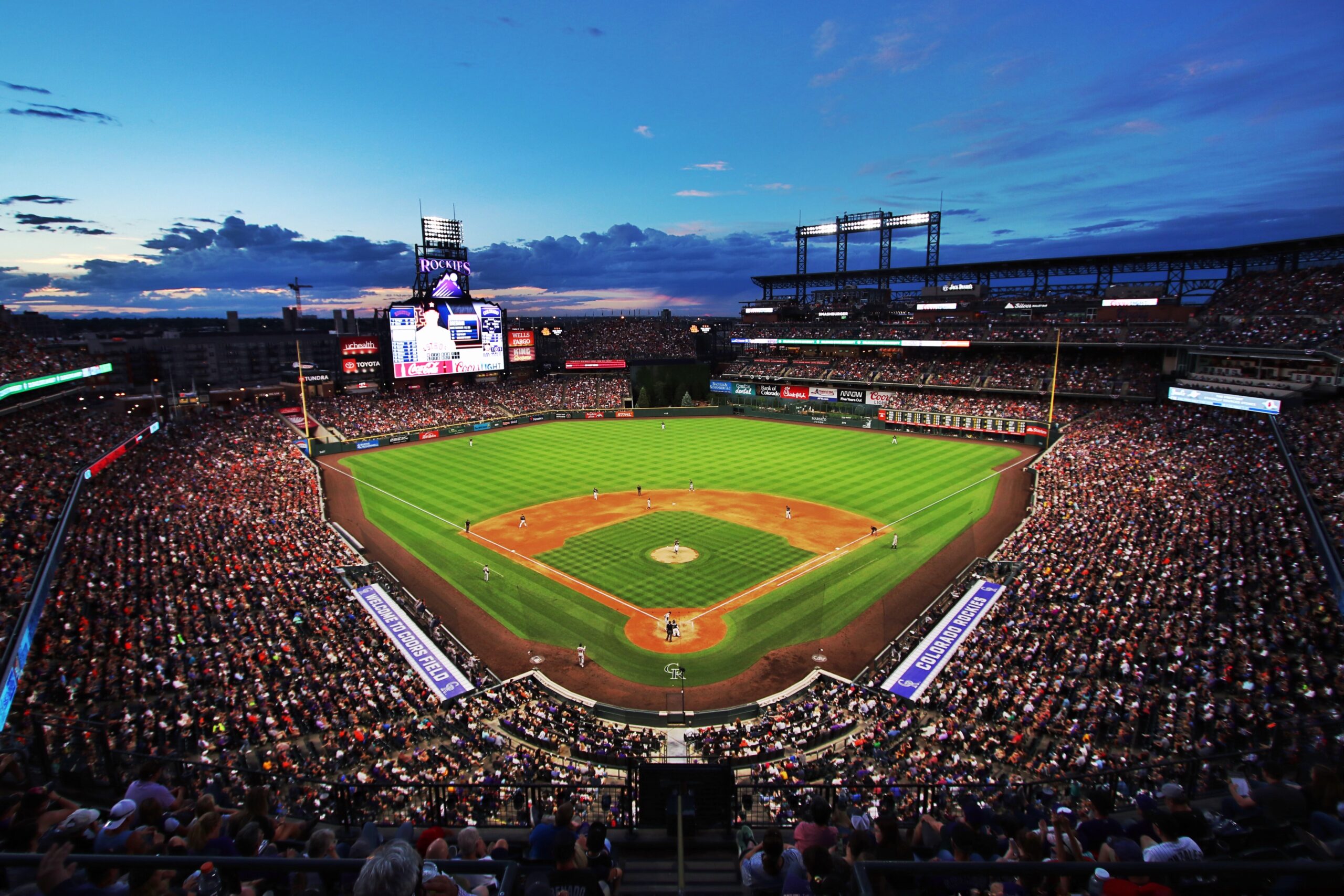

Here’s what’s wild about Major League Baseball that no other major sport does: every single stadium is different. The NFL doesn’t let you play on a 95-yard field. The NBA doesn’t let the Celtics use a shorter three-point line than the Lakers. But MLB? Fenway’s right field is 302 feet from home. Coors Field’s center is 415. That’s a 37-foot gap in what counts as a home run — in the same league, on the same night.
Every ballpark has its own personality, its own weather, its own carry, its own ways to help or hurt the home team. This page is the reference for all 30 of them — with the full sortable table below, plus the extreme cases, hidden quirks, and 2026 changes worth knowing about.
What the league actually requires (and doesn't)
Before we get into the weird stuff, the basic framework: the infield is identical at every MLB park. 90-foot baselines. Pitcher's mound 60 feet, 6 inches from home. That part's locked in. What MLB doesn't strictly enforce is outfield dimensions — there's a 1958 rule requiring 325+ feet down the lines and 400+ feet to center for any new stadium, but it's been ignored more than enforced. Camden Yards is 318 down the right line. Petco Park is officially 396 to center. Fenway's whole existence is a 60-year rule violation that nobody's going to touch.
The reason MLB doesn't care? The quirks are the product. A uniform 330-400-330 across all 30 parks would be boring. The Green Monster exists because the Red Sox needed to fit a baseball field into Lansdowne Street in 1912. A century later, it's one of the most recognizable features in American sports. That's the value of leaving the rules loose.
The parks that break the mold
Fenway Park is the one everyone talks about, and deservedly so. The Green Monster — a 37-foot wall standing 310 feet from home plate — is literally in play. Balls that would be home runs anywhere else in baseball are singles off the wall. Balls that would be catches at the warning track land on top of the Monster seats. And the right field? A 302-foot foul pole. That's a distance any Little Leaguer could theoretically hit, which is why "Pesky Pole" home runs sound more impressive than they sometimes are.
Minute Maid Park is the oddball on the other end. Center field is 409 feet deep with a slope called Tal's Hill — well, it was a hill until they removed it in 2016, but Houston's center is still one of the longest in the game. Combine that with the short left field porch (315 feet) and you get one of the most distinctive hit distributions in baseball. Opposite-field home runs to left feel like a gimmick; center field drives feel like moon shots.
Coors Field is the engineering experiment that never quite worked. When it opened in 1995, the Rockies' builders knew Denver's thin air (the stadium sits at 5,280 feet elevation) would turn routine fly balls into home runs. So they built the biggest outfield in baseball — 347 down the left line, 415 to center, 350 to right. It should've neutralized the altitude. It didn't. Coors is still the most hitter-friendly ballpark in the sport. Even with the humidor they introduced in 2002 to help the baseballs behave more normally, the place still produces ridiculous offensive numbers.
Oracle Park might have the most unique outfield shape in the league. Straight-away center is a reasonable 399 feet, but right field is complicated — a 24-foot brick wall, McCovey Cove behind it, and a distance that wraps out to 421 feet in the deepest part of right-center alley. It's called Triples Alley for a reason. Nobody hits a routine fly ball there; everything becomes an adventure.
The short porches
If you want home runs, you want the short outfield lines. Here's where they live:
Yankee Stadium is almost cartoonishly hitter-friendly. 318 down the left line, 314 down the right. The right field porch is famous — it turns routine fly balls into souvenirs, which conveniently suits left-handed Yankee hitters from Babe Ruth to Aaron Judge. There's a reason the Yankees have led baseball in home runs roughly forever.
Camden Yards is 318 down the right field line too, and its home run rate shows it. The warehouse beyond right field is far enough out of play that no ball has hit it on the fly in a game (Ken Griffey Jr. did it during the 1993 Home Run Derby), but balls clear the right field fence constantly.
Fenway Park's 302-foot right field is the shortest in baseball, but the curved wall and the way the stadium squeezes outfield space means it plays less homer-friendly than the raw number suggests. Still, if you're looking at pure distance-to-fence, Fenway wins.
Great American Ball Park, Cincinnati's home since 2003, is a home run factory that catches a lot of fans by surprise. Left field is only 328, right is 325, and summer air in the Ohio River valley does the rest.
The pitcher-friendly ones
On the other end:
Petco Park has the opposite reputation of Coors — it's been punishing to hitters since it opened in 2004. Marine air off San Diego Bay suppresses carry, and while the Padres brought the fences in a bit in 2013, it's still one of the three or four most pitcher-friendly parks in the game. Baseball Savant's park factor numbers consistently rank Petco near the bottom of home run rates.
Oakland Coliseum is now (as of 2025) home to zero teams — the Athletics moved to Sutter Health Park in Sacramento for the 2025–27 seasons before their eventual Las Vegas relocation. But the Coliseum was legendary for suppressing offense. Massive foul territory, cold night air, and general aesthetic depression combined to make it a pitcher's park to the end.
Dodger Stadium is technically perfectly symmetrical (330-395-330) but consistently plays as a pitcher's park because of LA's cool evening air and the way the ball doesn't carry at night. 13 no-hitters have been thrown there, including two perfect games. No other current MLB stadium has that many.
The 2026 changes
Two things worth knowing about this season:
The Royals brought Kauffman Stadium's fences in by 10 feet across the entire outfield for the 2026 season, and they lowered the outfield walls to 8.5 feet from 10. Kansas City had been one of the worst home run parks in baseball — only 151 home runs hit there in 2025, fifth-fewest in MLB — and management decided the park was forcing their hitters to change their swings. The stadium will play meaningfully different this year.
Sutter Health Park in Sacramento is the Athletics' home through 2027. It's a converted minor-league park (the Triple-A Sacramento River Cats' normal home), which means it's the smallest-capacity stadium in MLB at around 14,000 seats. Dimensions are modest — 325 to both corners, 403 to center — but the novelty of an MLB team playing in a minor league park makes it worth a note.
The oldest and newest
Only two parks predate World War I: Fenway Park (1912) and Wrigley Field (1914). Both are still charming, still functional, and still producing the kind of atmosphere you can't build into a modern stadium. Wrigley's ivy-covered brick outfield walls and Fenway's Green Monster are two of the most iconic features in American sports.
On the other end, Globe Life Field in Arlington opened in 2020 and is the Rangers' current home. It's a climate-controlled dome (because Texas in July) with a retractable roof, artificial turf, and a fairly pitcher-neutral 329-407-326 layout. A stark contrast to the 112-year-old Fenway situation.
So which is "best"?
Honestly depends what you want. For baseball atmosphere and history, Fenway and Wrigley are the easy choices. For views, PNC Park in Pittsburgh (the Allegheny River and downtown skyline beyond center field) gets the vote from just about everyone who's been there. For scale and weirdness, Coors Field is one-of-a-kind. For pure modern comfort, Globe Life Field and Truist Park are hard to beat.
If you're trying to visit all 30, a note from friends who've attempted it: Oakland Coliseum is gone, but the Athletics are temporarily at Sutter Health Park in Sacramento, which is a weird item to cross off your list. And Tropicana Field in Tampa is probably the most-criticized park in the league — concrete dome, artificial turf, catwalks that routinely get hit by fly balls. Go, but don't make it your first stop.
One last note about the data
The dimensions in the tool above are the official numbers as posted at each ballpark — distances along the foul lines and to straightaway center. A few parks have quirky walls, angles, or seating sections that make the "real" distance hard to pin down (Oracle Park's Triples Alley, Yankee Stadium's scoreboard corners, loanDepot Park's old home run sculpture). But for standard reference purposes, what's in the table is what the scoreboards say.
If you're a coach or parent trying to use these numbers to understand what your kid is hitting into when they watch a game — the takeaway is that no two outfields are the same, and even "330 feet" in one park plays completely differently than 330 feet in another based on wind, altitude, wall height, and a dozen other factors. That's baseball.