
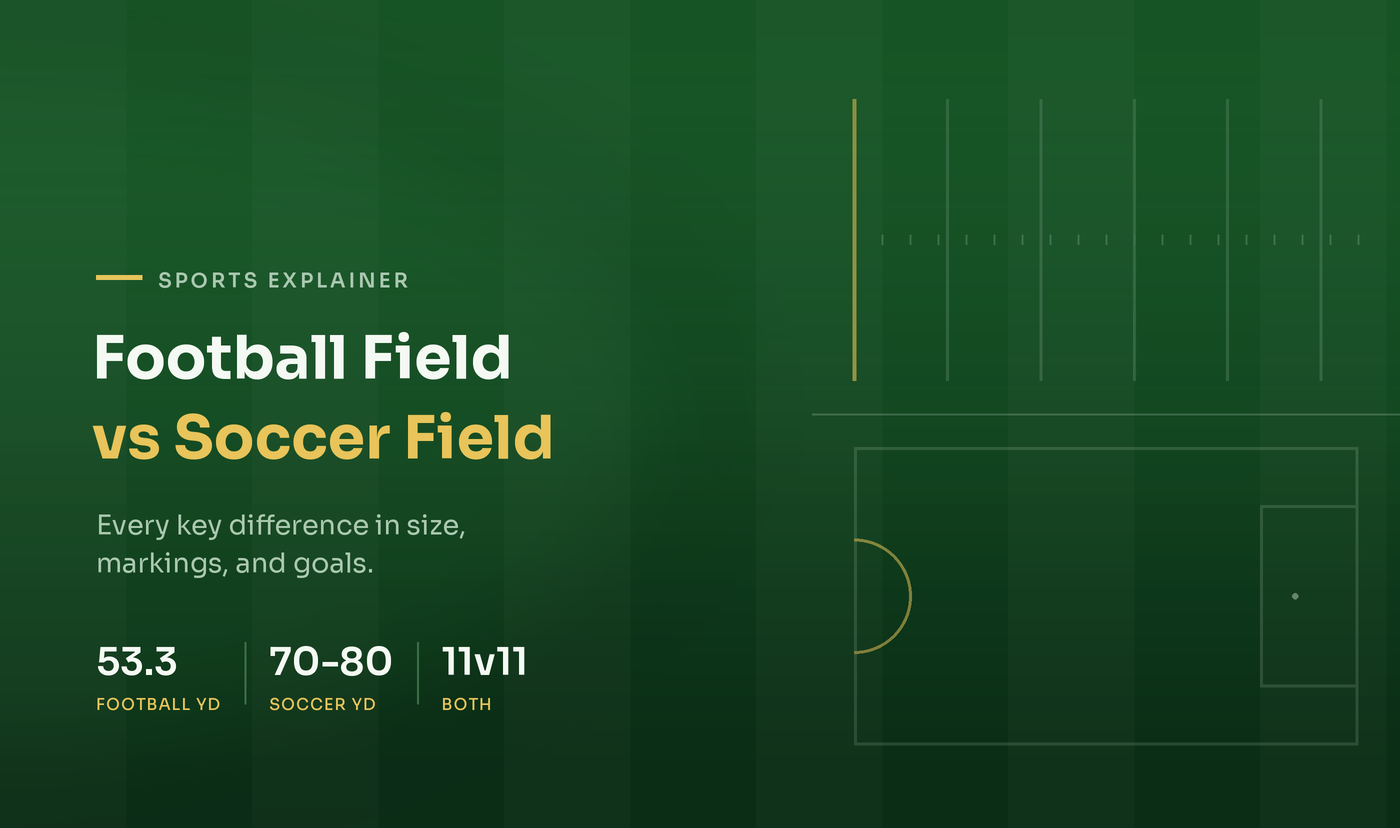

At first glance, a football field and a soccer field look like the same thing: a big green rectangle with goals at each end. But line them up side by side and they tell two completely different stories. One is a fixed, rigidly standardized grid built for stop-and-start, yard-by-yard combat. The other is a larger, flexible expanse designed for open, flowing play. So what are the real differences between a football field and a soccer field, and why does converting a stadium from one to the other cost millions?
The differences go far beyond the markings. Size, width, goal design, and even the rulebooks that govern them all set these two surfaces apart, and the contrast explains a lot about how each sport is actually played.
The big comparison chart below breaks down every key difference: dimensions, markings, and goals. Take a look, then we’ll walk through what makes each field unique.
The Core Difference: Dimensions
Both fields are rectangles, but their sizes diverge in important ways. An American football field is rigidly standardized: 120 yards long (including two 10-yard end zones) and 53.3 yards (160 feet) wide, and that exact size is used at every level from high school to the NFL. A soccer field, governed by FIFA and the IFAB Laws of the Game, is defined as a range instead. It can run from 100 to 130 yards long and 50 to 100 yards wide, with stricter international standards of 110 to 120 yards by 70 to 82 yards. Most professional soccer pitches land around 115 by 75 yards. The two are roughly comparable in length, but the soccer field is dramatically wider.
Why Width Is the Real Story
The single most important difference between the two fields is width, and it is the detail most comparisons gloss over. A football field is just 53.3 yards wide, while a regulation soccer pitch is typically 70 to 80 yards wide, often more than 20 yards wider. That gap gives a soccer pitch up to about 30 percent more total playing area, even though the lengths are similar. The extra width is not cosmetic. It is the canvas for soccer’s tactical game: stretching defenses sideways, switching play from one wing to the other, and building attacks through space. Football’s narrow field does the opposite, compressing the action and emphasizing direct, physical, yard-by-yard play.
Comparing the Field Markings
The markings on each field reflect how its sport is played. A football field is a dense instructional grid: yard lines every five yards, yardage numerals, hash marks down the middle, two end zones, and clearly defined goal lines. Every line exists to measure progress and officiate a stop-and-start game built around downs and yardage. A soccer field is far sparser by comparison, with only the lines the game truly needs: a halfway line, a center circle with a 10-yard radius, a penalty box extending 18 yards from goal, a smaller 6-yard goal area, a penalty spot 12 yards out, and quarter-circle corner arcs. These minimal markings keep the field uncluttered to support continuous, flowing play.
The Goals Are Built Differently
The goals at each end tell their own story. A soccer goal is a rectangular frame with a net, 8 yards (24 feet) wide and 8 feet high, and it sits directly on the goal line, the line the ball must fully cross to score. A football goalpost is a different beast entirely: two uprights 18 feet 6 inches apart, mounted on a single post with a crossbar 10 feet off the ground, and crucially, it stands at the back of the end zone. That placement means scoring in football is a two-part action: a team must first reach the end zone, then, for a field goal or extra point, kick the ball over the bar and between the uprights. In soccer, the goal is the target you shoot at directly.
Why You Cannot Simply Swap Them
Because of these differences, especially width, you cannot just repaint a football field and call it a soccer pitch at the professional level. A regulation soccer match needs more width than a 53.3-yard football field provides, and the goal structures sit in completely different places. This is why converting a stadium between the two sports is a serious engineering challenge. Some modern venues, like Tottenham Hotspur Stadium in London, were purpose-built with retractable systems that slide a grass soccer pitch away to reveal an artificial NFL field beneath, but that is a multimillion-dollar feat, not a paint job. At the high school and community level, fields often share both sets of markings in different colors, though the soccer dimensions usually end up compromised. If you enjoy these breakdowns, see our guide to soccer ball sizes by age.
The Bottom Line
A football field and a soccer field may share a green, rectangular shape, but they are designed for opposite philosophies of sport. The football field is fixed, narrow, and densely marked for stop-start, yard-by-yard play, measuring exactly 120 by 53.3 yards everywhere. The soccer field is larger, flexible, and minimally marked for open, flowing play, often around 115 by 75 yards. The defining difference is width, which is why a pro soccer pitch offers so much more space, and why turning one field into the other is anything but simple. Understanding the contrast makes it clear just how much the field itself shapes each game.