
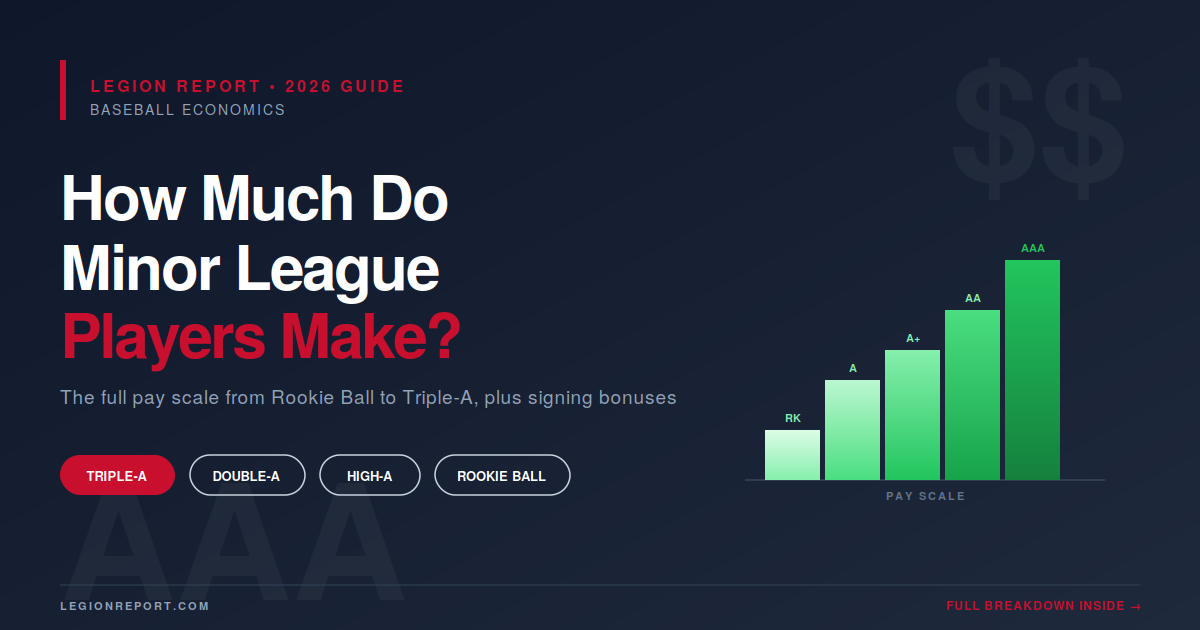

How Much Do Minor League Baseball Players Make? (2026 Salary Breakdown)

A Triple-A player in 2026 earns $1,225 per week — about $36,590 for the full season — under the standardized salary minimums. Five years ago, that same player would have made $502 per week, with no offseason pay and no guaranteed housing. The economics of minor league baseball have transformed faster in the past five seasons than at any point in the sport’s history.

The 2022 Collective Bargaining Agreement extended union representation to over 5,500 minor leaguers for the first time, and the 2023 ratification mandated minimum salaries, free housing, year-round pay, and expanded healthcare. Yet major league veterans on the same Triple-A roster can earn 5-7x what their teammates make. Here’s the full breakdown of minor league baseball salaries by level for 2026, the historical context that shows how far the system has come, and the gap between MiLB and MLB pay that’s still enormous.

Minor league baseball salaries complete breakdown
Current minimums by level, the historical transformation, 40-man roster pay, signing bonuses, and benefits.
By the numbers (2026)
$36,590
Triple-A min
$740,000
MLB min
$63,600
40-man min
5,500
Unionized
2026 minor league salaries by level
Standardized minimums for non-40-man players. Season runs ~22 weeks April through September.
Level
Weekly Pay
Season Total
Per Diem
Path to majors
Triple-A (AAA)
$1,225
$36,590
$32.50/day
One step away. Most call-ups come from here.
Double-A (AA)
$1,020
$30,905
$32.50/day
The real proving ground. Most prospects graduate from here.
High-A
$920
$27,940
$28/day
Skill refinement level. Players typically 21-23 years old.
Single-A (Low-A)
$870
$26,840
$28/day
First full-season level. Most drafted players start here.
Rookie Ball
$700
~$18,000*
N/A
Complex leagues. *Includes spring/offseason pay.
Historical transformation: 2019 vs 2026
How minor league pay changed after the 2022 CBA and the 2023 union ratification
Level
2019
2021
2023
2026
% Increase
Triple-A
$8,032
$14,000
$35,800
$36,590
+356%
Double-A
$5,600
$12,000
$30,250
$30,905
+452%
High-A
$4,640
$10,000
$27,300
$27,940
+502%
Single-A
$4,640
$10,000
$26,200
$26,840
+478%
Rookie Ball
$4,800
$6,400
$19,800
~$18,000
+275%
40-man roster vs non-40-man pay (Triple-A)
The biggest financial divide in modern minor league baseball isn’t between levels — it’s between contract types
Contract type
Min Annual
Max Annual
Notes
Non-40-man (standard)
$36,590
~$45,000
Most Triple-A players. Standardized minimums apply.
40-man (1st MLB contract)
$63,600
$130,500
Roughly double the standard rate.
40-man (2nd+ contract)
$130,500
$201,500
Veterans on 2nd MLB deal. Service time matters.
MiLB free agent
Negotiable
$201,500
Capped at $8,400/week. Limited to 1-2 year deals.
MLB minimum (called up)
$740,000
No cap
~$4,200/day prorated. The dream.
Additional compensation beyond base salary
Standard benefits and stipends that apply to every minor league player
Benefit
Details
Free housing
Furnished apartments within commuting distance of home ballpark. Implemented in 2022 after class-action lawsuit. Double-A and Triple-A players get their own bedrooms; Rookie/Single-A can be 2 per room.
Per diem (road trips)
$32.50/day at Triple-A. $28/day at Single-A and High-A. Total $2,340 for a typical Triple-A season. Rookie Ball doesn’t receive per diem (all home games).
Health insurance
Full medical, dental, vision. Covers mental wellness visits. Retained for months after release. Player contribution roughly $30/week.
Offseason pay
$4,160 for offseason off-site training. Plus $2,640 for spring training. Year-round pay was a major win in the 2023 CBA ratification.
Postseason bonuses
$2,500 for winning a Triple-A league championship. $5,000 for winning the Triple-A National Championship Game. $10,000 for the MVP award. Paid by MLB directly.
Meals during season
Two meals per day provided — one pre-game and one post-game. Spring training meals are also covered.
NIL rights
Players retain full rights to their name, image, and likeness for endorsements and personal branding deals.
Signing bonuses tell the real story
Recent #1 overall picks and what they earned before throwing a single pro pitch
Year
#1 Overall Pick
Bonus
Team
Status
2024
Travis Bazzana (2B)
$8.95M
Cleveland
Top Cleveland prospect
2023
Paul Skenes (RHP)
$9.20M
Pittsburgh
2024 NL Rookie of the Year
2022
Jackson Holliday (SS)
$8.19M
Baltimore
Now in Orioles MLB roster
2021
Henry Davis (C)
$6.50M
Pittsburgh
MLB debut 2023
2020
Spencer Torkelson (1B)
$8.42M
Detroit
Tigers regular
2019
Adley Rutschman (C)
$8.10M
Baltimore
2x All-Star
The takeaway
Minor league pay has been transformed in five years. A Triple-A player who earned $8,032 in 2019 now earns $36,590 — a 356% increase. The 2022 CBA forced housing reform, the 2023 union ratification mandated year-round pay, and the 2026 numbers reflect annual CPI adjustments. The biggest gap isn’t between levels but between standard contracts and 40-man roster spots, which roughly double pay. The MLB minimum at $740,000 is what every player is chasing — a single day in the majors pays more than a full Triple-A season under the standard contract.
Sources: Baseball America, MLB Players Association, MLB Trade Rumors, Spotrac. Salary data current through April 2026.

The honest summary of minor league pay in 2026

The biggest takeaway is that minor league baseball is no longer a sub-poverty profession the way it was in 2019. A Triple-A player on the standard contract now earns more than $36,000 in salary plus free housing, per diem of $32.50/day on the road, full health insurance, and offseason pay. Add in playoff bonuses and signing bonus money for drafted players, and a Triple-A player can realistically earn $40,000-50,000 in his first full year at the level — without ever reaching the majors. Compare that to 2019, when a Triple-A player earned $8,032 for the season with no offseason pay and frequently slept four-to-a-room in cheap apartments to make rent.

The biggest financial divide in modern minor league baseball isn’t between levels — it’s between players on the 40-man roster and players not. A 40-man player assigned to Triple-A earns a minimum of $63,600 in-season, which is essentially double what a non-40-man Triple-A player makes. A 40-man player who gets called up to the majors earns the MLB minimum of $740,000 prorated, meaning even a single day in the big leagues pays roughly $4,200. That gap between $1,225/week (Triple-A standard) and $740,000/year (MLB minimum) is what every minor leaguer is chasing.

Signing bonuses tell another story entirely. A first-round draft pick can earn a $5-9 million signing bonus while still being paid $26,840 as a Single-A player his first full year. Travis Bazzana, the 2024 #1 overall pick, signed for $8.95 million — money he keeps regardless of whether he ever reaches the majors. That bonus money is what makes the system financially livable for elite prospects. Undrafted free agents and lower-round picks who never reach the 40-man roster, on the other hand, often retire with career baseball earnings under $200,000 spread across 5-7 seasons.

What players actually earn varies more than the minimums suggest. Around 12% of minor leaguers have certified agent representation, which allows them to negotiate above-minimum weekly salaries, multi-year guarantees, and opt-out clauses. The Atlanta Braves reportedly paid top Double-A prospects an average of $1,250/week in 2025 (above the $1,020 minimum), and the San Diego Padres offered $1,400/week to select Triple-A pitchers with multiple years of service. Most non-prospects still earn the minimum plus the standardized stipends.

For continuously updated minor league salary data and contract analysis, Baseball America is the industry standard — they break down salary structures, prospect signing bonuses, and CBA changes more thoroughly than any other public source. For MLB salary data and how minor league pay compares to major league minimums by year, Spotrac’s MLB Minimum Salary tracker covers every annual minimum dating back decades, plus current 40-man roster pay rules.

The bottom line on minor league pay: it’s still not life-changing money, but it’s no longer poverty wages. The 2026 minimum at Triple-A ($36,590) is now roughly equivalent to a starting teacher’s salary in most US states. Add in housing, healthcare, and per diem, and a player can sustain themselves while chasing the majors. Whether that’s enough for the years of grind required to reach MLB depends on the player, the family situation, and how much signing bonus money is in the bank. For the 88% of minor leaguers without agents, the standard contract is what you get — and the standard contract has become meaningfully better than it used to be.