The World Cup has always been the biggest stage in football. What it pays, though, is a different story depending on when you showed up.
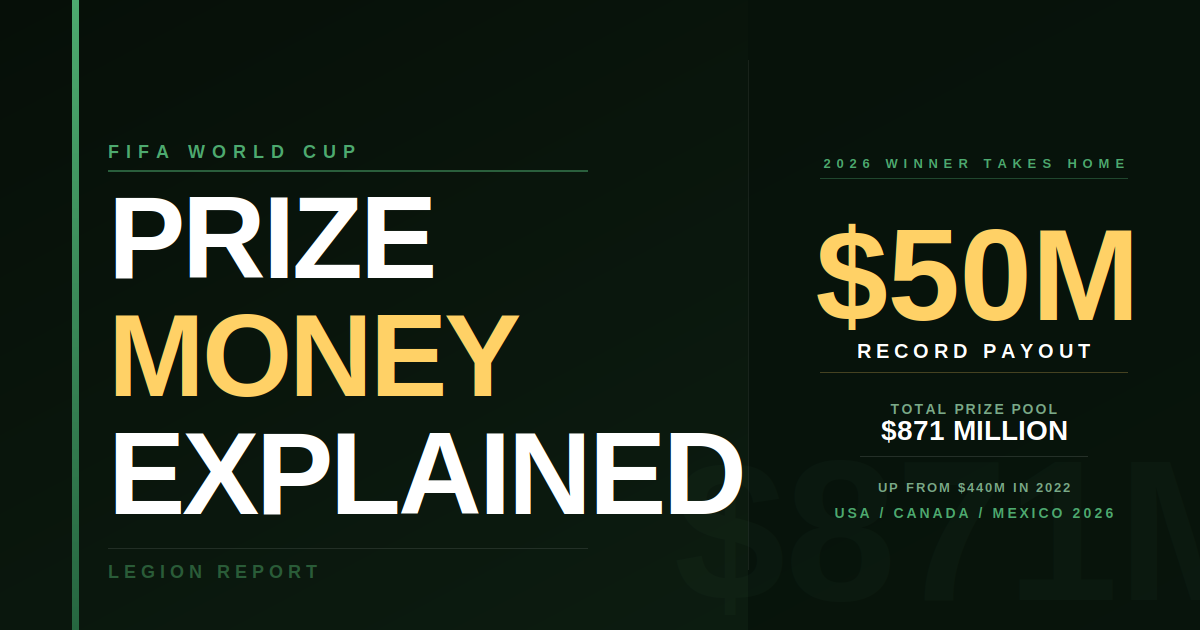
When Italy won in 1982, the prize for lifting the trophy was $2.2 million split among a squad of players and staff. Good money in 1982, but pocket change by today’s standards. Forty-four years later, the team that wins in New Jersey on July 19, 2026 takes home $50 million, with every single one of the 48 nations in the tournament guaranteed at least $12.5 million just for qualifying. The total prize pool this year sits at $871 million, making it the richest team sports event ever staged.
How did it get here? Who actually receives the money? And how does the breakdown work from the group stage all the way to the final? That’s what the chart below covers in full.
Updated June 2026
World Cup Prize Money: The Complete Reference
2026 round-by-round payouts, the full history since 1982, who gets the money and how it flows, records, and context.
2026 World Cup prize money by round
Performance prize + $2.5M preparation fee = total per team. Paid to national federations.
| Finish |
Performance Prize |
Prep Fee |
Total |
Notes |
| Group Stage exit |
$9M |
$2.5M |
$11.5M |
16 teams eliminated here |
| Round of 32 exit New in 2026 |
$11M |
$2.5M |
$13.5M |
New round in 2026 expanded format |
| Round of 16 exit |
$15M |
$2.5M |
$17.5M |
Last 16 teams |
| Quarterfinal exit |
$19M |
$2.5M |
$21.5M |
Last 8 teams |
| Fourth place |
$27M |
$2.5M |
$29.5M |
Third-place playoff loser |
| Third place |
$29M |
$2.5M |
$31.5M |
Third-place playoff winner |
| Runner-up |
$33M |
$2.5M |
$35.5M |
World Cup final loser |
| Winner Record |
$50M |
$2.5M |
$52.5M |
World Cup champion |
Total performance prize pool: $655M. Total distribution including prep fees and Club Benefits Programme: $871M. Source: FIFA official announcement.
The floor has never been higher. Every team eliminated in the group stage collects at least $11.5 million in 2026. That is more than the entire total prize pool winner received in 1982.
World Cup prize money history: 1982 to 2026
Total prize pool and winner’s share every tournament — the full picture
| Year |
Host |
Winner |
Total Pool |
Winner’s Share |
Teams |
Context |
| 1982 |
Spain |
Italy First |
$20M |
$2.2M |
24 teams |
First year FIFA formally disclosed prize money |
| 1986 |
Mexico |
Argentina |
$26M |
$2.8M |
24 teams |
Argentina’s Maradona era; 27% pool increase |
| 1990 |
Italy |
West Germany |
$54M |
$3.5M |
24 teams |
Pool more than doubled; 107% jump from 1986 |
| 1994 |
USA |
Brazil |
$71M |
$4.0M |
24 teams |
First US-hosted tournament; strong broadcast growth |
| 1998 |
France |
France |
$103M |
$6.0M |
32 teams |
Expanded to 32 teams; pool crossed $100M for first time |
| 2002 |
Japan/Korea |
Brazil |
$156M |
$9.0M |
32 teams |
First Asian tournament; joint-hosted |
| 2006 |
Germany |
Italy |
$266M |
$20.0M |
32 teams |
Biggest single-cycle jump; winner’s share more than doubled |
| 2010 |
South Africa |
Spain |
$420M |
$30.0M |
32 teams |
First African tournament; pool crossed $400M |
| 2014 |
Brazil |
Germany |
$576M |
$35.0M |
32 teams |
Germany’s dominant run to the title |
| 2018 |
Russia |
France |
$791M |
$38.0M |
32 teams |
Pool nearly hit $800M; France’s second title |
| 2022 |
Qatar |
Argentina |
$440M* |
$42.0M |
32 teams |
*Performance pool only; total including CBP was higher |
| 2026 |
USA/CAN/MEX |
TBD Current |
$871M |
$50.0M |
48 teams |
Record pool; 48-team format; largest prize in team sports history |
Who actually gets the money
The chain from FIFA to the players on the pitch
| Recipient |
Amount |
How it works |
| FIFA |
Keeps the rest |
Collects all commercial revenue from broadcast rights, sponsorship, and tickets, then distributes the prize pool |
| National Federations |
Full prize amount |
FIFA pays federations directly based on how far their team advances. No money goes to players from FIFA. |
| Clubs (CBP payments) |
$355M total (2026) |
Clubs receive compensation through the Club Benefits Programme for releasing players during the tournament |
| Players |
Varies by country |
Federations decide how much to share with players. Typical range is 20 to 30 percent of the prize money. |
| Coaching staff |
Varies by country |
Usually included in the federation’s internal bonus structure alongside players |
| Support staff |
Varies by country |
Medical, analytics, logistics staff may receive bonuses at the federation’s discretion |
Players never receive FIFA prize money directly. The check goes to the federation. What players actually take home depends entirely on each country’s internal agreement, which is negotiated separately before every tournament.
How selected nations split the prize money
Each federation decides independently. These are estimates and reported figures.
| Federation |
Reported Player Share |
Notes |
| France |
~25% to players |
Historically around €400,000 per player for winning; exact splits negotiated per tournament with the FFF |
| England |
Pre-agreed bonus pool |
FA agrees a sliding bonus scale with players before the tournament based on how far they advance |
| Brazil |
~20% to players |
CBF shares a portion with the squad; exact figure kept private but broadly in line with peers |
| USA |
Significant share |
US Soccer has pushed toward equal pay agreements; player shares have grown significantly post-2022 |
| Smaller nations |
Majority to development |
Federations from smaller countries often use prize money primarily for infrastructure and academies |
| Germany |
Per-player bonuses |
DFB typically offers per-round bonuses rather than a lump sum, incentivizing deeper runs |
Records and milestones
The numbers that define how far prize money has come
| Record |
Figure |
Context |
| Largest single prize pool ever |
2026 — $871M total |
Surpasses 2018 ($791M) and makes it the richest team sports event in history |
| Biggest jump in winner’s share |
1982 to 2026 — $2.2M to $50M |
Nearly 23x increase in winner’s payout over 44 years |
| Biggest single-cycle percentage jump |
2002 to 2006 — +122% |
Winner’s share went from $9M to $20M as broadcast revenues exploded |
| Biggest single-cycle dollar jump |
2022 to 2026 — +$8M |
Largest absolute dollar increase between any two tournaments |
| First $1B total distribution |
2026 |
$871M prize pool plus $355M Club Benefits Programme totals over $1.2B |
| First tournament with guaranteed pay |
1982 |
Before 1982, FIFA provided no formal prize money to participating nations |
| Most prize money ever won by one nation |
Multiple wins needed |
Nations that have won multiple times in high-paying eras earn the most cumulatively |
| Lowest winner’s share on record |
1982 — $2.2M (Italy) |
Italy’s 1982 prize would not cover a single week’s wages for a top modern player |
| Club Benefits Programme (2026) |
$355M |
Paid to clubs for releasing players; largest CBP fund in World Cup history |
| Preparation fee per team (2026) |
$2.5M each (48 teams) |
Up from $1.5M in 2022; guaranteed regardless of performance |
2022 vs 2026: side-by-side comparison
How this year’s tournament stacks up against Qatar
| Category |
Qatar 2022 |
2026 |
Change |
Note |
| Total prize pool |
$440M |
$871M |
+98% |
Nearly doubled |
| Winner’s share |
$42M |
$50M |
+19% |
|
| Runner-up |
$30M |
$33M |
+10% |
|
| Group stage exit |
$9M |
$9M |
= |
Performance payout unchanged |
| Guaranteed minimum |
$10.5M |
$12.5M |
+19% |
Incl. prep fee |
| Prep fee per team |
$1.5M |
$2.5M |
+67% |
|
| Participating teams |
32 |
48 |
+16 |
First 48-team WC |
| Club benefits fund |
$209M |
$355M |
+70% |
Paid to clubs, not federations |
Sources: FIFA official announcements, Sports Illustrated, NBC Sports, Sporting News. Prize money paid to national federations in USD. Updated June 2026 — Legion Report
Where the money actually goes
One thing most fans don’t realize: the prize money never goes directly to the players. FIFA pays national federations, full stop. What happens after that is entirely up to each country’s football association.
Some federations pass a percentage straight to the players. Others negotiate bonuses separately through player contracts and collective agreements before the tournament even starts. A few smaller nations historically kept the majority for federation operations and development programs, though that has become less common as player unions have grown stronger.
The general benchmark across most top nations is somewhere between 20 and 30 percent of the prize money flowing to the playing squad, though the actual split varies wildly. The England squad in 2022 had a pre-arranged bonus structure. France’s players have historically donated portions to charity. Some nations in their first World Cup appearances have used the money almost entirely for grassroots infrastructure.
On top of the prize money itself, FIFA runs a separate Club Benefits Programme, which pays clubs for releasing players during the tournament. In 2026 that fund is worth $355 million, paid directly to the clubs rather than the federations. So a club like Manchester City or Real Madrid, with ten or twelve players at the tournament, receives meaningful compensation for six weeks without its best players.
What the growth actually means
The jump from $20 million total in 1982 to $871 million in 2026 tracks almost exactly with the explosion in FIFA’s commercial revenues over the same period. Broadcast rights, sponsorship deals, and ticket revenue have grown at roughly the same pace as the prize pool. FIFA doesn’t give the money away out of generosity; the numbers move because the business grew.
The 2006 tournament in Germany was the real inflection point. The total pool jumped from $156 million in 2002 to $266 million in 2006, a 70 percent increase in one cycle, driven by a new generation of broadcast deals as the global appetite for the sport exploded in Asia and North America. The winner’s share nearly tripled from $9 million to $20 million in a single tournament. Every jump since has followed the same logic.
The 2026 expansion to 48 teams added fuel too. More teams means more guaranteed payouts, more matches, higher broadcast value, and a bigger pool to distribute. The team that goes home after the group stage this year still collects $10 million in performance money plus the $2.5 million preparation fee. That’s more than the entire prize pool winner took home in 1982.
The bottom line
World Cup prize money went from an afterthought to one of the largest single-event paydays in global sport in four decades. The federation that wins in July 2026 earns more in one month than most national football programs see in a generation. And the team that finishes last, eliminated without a win, still goes home with more money than the 1982 champions.
The numbers keep going up. They have every four years since 1982 without exception, and nothing about FIFA’s commercial trajectory suggests 2030 will be different.
— Legion Report