

Updated September 5, 2026 for the 2026 season. Capacities are the official listed football capacity for each stadium. Ties share a rank.
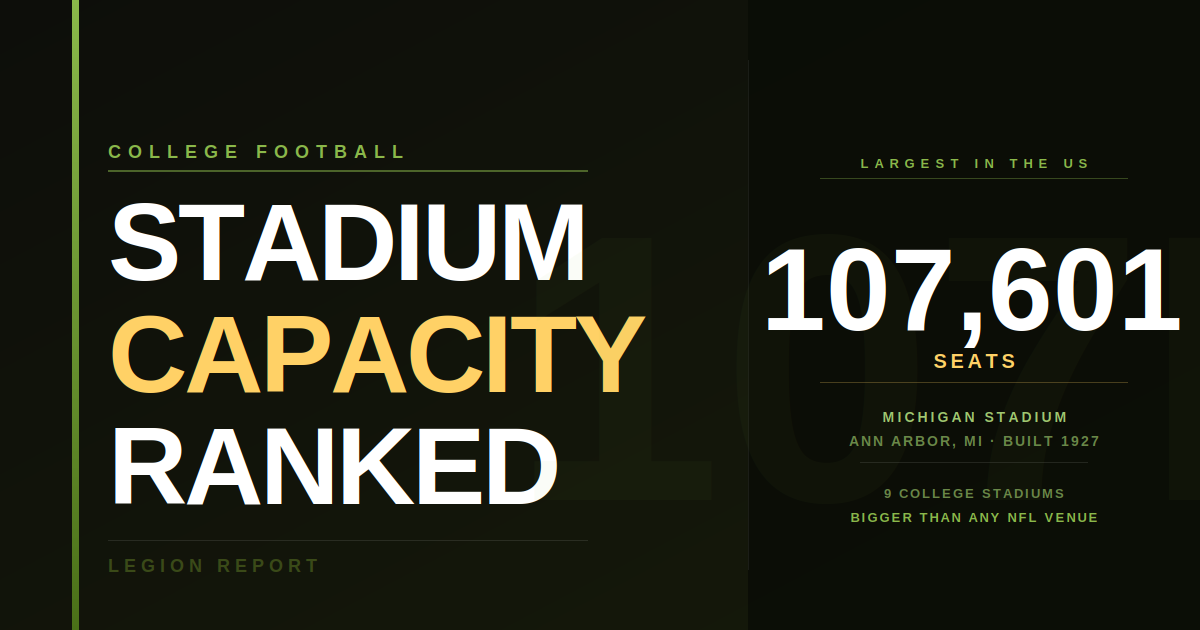
Eight college football stadiums hold 100,000 people or more. No NFL stadium does. The biggest of them, Michigan Stadium, seats 25,000 more than the largest pro venue in the country and has packed in 115,109 for a single game. Below are the 100 largest FBS stadiums, followed by the numbers that explain why college crowds dwarf everything else in American sports.
| Largest | Michigan Stadium, 107,601 (record 115,109 vs. Notre Dame, 2013) |
| Largest in the SEC | Kyle Field, Texas A&M, 102,733 (record 110,633) |
| Largest in the ACC | Memorial Stadium, Clemson, 81,500 |
| Largest in the Big 12 | LaVell Edwards Stadium, BYU, 62,073 |
| Largest Group of Five home | Lincoln Financial Field, Temple, 67,594 (shared with the Eagles) |
| Largest crowd ever | 156,990, Tennessee vs. Virginia Tech at Bristol Motor Speedway, 2016 |
The 100 Largest College Football Stadiums
| Rank | Stadium | School | Conference | Capacity | Opened |
|---|---|---|---|---|---|
| 1 | Michigan Stadium | Michigan | Big Ten | 107,601 | 1927 |
| 2 | Beaver Stadium | Penn State | Big Ten | 106,572 | 1959 |
| 3 | Ohio Stadium | Ohio State | Big Ten | 102,780 | 1922 |
| 4 | Kyle Field | Texas A&M | SEC | 102,733 | 1927 |
| 5 | Tiger Stadium | LSU | SEC | 102,321 | 1924 |
| 6 | Neyland Stadium | Tennessee | SEC | 101,915 | 1921 |
| 7 | Darrell K Royal Texas Memorial Stadium | Texas | SEC | 100,119 | 1924 |
| 8 | Bryant Denny Stadium | Alabama | SEC | 100,077 | 1929 |
| 9 | Sanford Stadium | Georgia | SEC | 93,033 | 1929 |
| 10 | Rose Bowl | UCLA | Big Ten | 89,702 | 1922 |
| 11 | Ben Hill Griffin Stadium | Florida | SEC | 88,548 | 1930 |
| 12 | Jordan Hare Stadium | Auburn | SEC | 88,043 | 1939 |
| 13 | Memorial Stadium | Nebraska | Big Ten | 85,458 | 1923 |
| 14 | Memorial Stadium | Clemson | ACC | 81,500 | 1942 |
| 15 | Gaylord Family Oklahoma Memorial Stadium | Oklahoma | SEC | 80,126 | 1923 |
| 16 | Notre Dame Stadium | Notre Dame | Independent | 77,622 | 1930 |
| 17 | Williams Brice Stadium | South Carolina | SEC | 77,559 | 1934 |
| 18 | Los Angeles Memorial Coliseum | USC | Big Ten | 77,500 | 1923 |
| 19 | Razorback Stadium | Arkansas | SEC | 76,212 | 1938 |
| 20 | Camp Randall Stadium | Wisconsin | Big Ten | 76,057 | 1917 |
| 21 | Spartan Stadium | Michigan State | Big Ten | 74,866 | 1923 |
| 22 | Husky Stadium | Washington | Big Ten | 70,083 | 1920 |
| 23 | Kinnick Stadium | Iowa | Big Ten | 69,250 | 1929 |
| 24 | Acrisure Stadium | Pitt | ACC | 68,400 | 2001 |
| 25 | Lincoln Financial Field | Temple | American | 67,594 | 2003 |
| 26 | Doak Campbell Stadium | Florida State | ACC | 67,277 | 1950 |
| 27 | Raymond James Stadium | South Florida | American | 65,857 | 1998 |
| 28 | Lane Stadium | Virginia Tech | ACC | 65,632 | 1965 |
| 29 | Allegiant Stadium | UNLV | Mountain West | 65,000 | 2020 |
| 29 | Faurot Field | Missouri | SEC | 65,000 | 1927 |
| 31 | Hard Rock Stadium | Miami | ACC | 64,767 | 1987 |
| 32 | Vaught Hemingway Stadium | Ole Miss | SEC | 64,038 | 1915 |
| 33 | Alamodome | UTSA | American | 64,000 | 1993 |
| 34 | California Memorial Stadium | Cal | ACC | 62,467 | 1923 |
| 35 | LaVell Edwards Stadium | BYU | Big 12 | 62,073 | 1964 |
| 36 | Jack Trice Stadium | Iowa State | Big 12 | 61,500 | 1975 |
| 36 | Scott Stadium | Virginia | ACC | 61,500 | 1931 |
| 38 | Ross Ade Stadium | Purdue | Big Ten | 61,441 | 1924 |
| 39 | Kroger Field | Kentucky | SEC | 61,000 | 1973 |
| 40 | L&N Federal Credit Union Stadium | Louisville | ACC | 60,800 | 1998 |
| 41 | Gies Memorial Stadium | Illinois | Big Ten | 60,670 | 1923 |
| 42 | Davis Wade Stadium | Mississippi State | SEC | 60,311 | 1914 |
| 43 | Galaxy Stadium | Texas Tech | Big 12 | 60,229 | 1947 |
| 44 | Milan Puskar Stadium | West Virginia | Big 12 | 60,000 | 1980 |
| 45 | Carter Finley Stadium | NC State | ACC | 56,919 | 1966 |
| 46 | Autzen Stadium | Oregon | Big Ten | 54,000 | 1967 |
| 47 | Mountain America Stadium | Arizona State | Big 12 | 53,599 | 1958 |
| 48 | Memorial Stadium | Indiana | Big Ten | 53,524 | 1960 |
| 49 | SHI Stadium | Rutgers | Big Ten | 52,454 | 1994 |
| 50 | Boone Pickens Stadium | Oklahoma State | Big 12 | 52,305 | 1919 |
| 51 | Bobby Dodd Stadium | Georgia Tech | ACC | 51,913 | 1913 |
| 52 | Sun Bowl | UTEP | Mountain West | 51,500 | 1963 |
| 53 | Rice Eccles Stadium | Utah | Big 12 | 51,444 | 1998 |
| 54 | Dowdy Ficklen Stadium | East Carolina | American | 51,000 | 1963 |
| 55 | Huntington Bank Stadium | Minnesota | Big Ten | 50,805 | 2009 |
| 56 | Casino Del Sol Stadium | Arizona | Big 12 | 50,782 | 1928 |
| 57 | Kenan Stadium | North Carolina | ACC | 50,500 | 1927 |
| 58 | Stanford Stadium | Stanford | ACC | 50,424 | 1921 |
| 59 | Folsom Field | Colorado | Big 12 | 50,183 | 1924 |
| 60 | Bill Snyder Family Stadium | Kansas State | Big 12 | 50,000 | 1968 |
| 60 | Simmons Bank Liberty Stadium | Memphis | American | 50,000 | 1965 |
| 62 | Protective Stadium | UAB | American | 47,100 | 2021 |
| 63 | Amon G. Carter Stadium | TCU | Big 12 | 47,000 | 1929 |
| 63 | Rice Stadium | Rice | American | 47,000 | 1950 |
| 65 | SECU Stadium | Maryland | Big Ten | 46,185 | 1950 |
| 66 | McLane Stadium | Baylor | Big 12 | 45,140 | 2014 |
| 67 | Alumni Stadium | Boston College | ACC | 44,500 | 1957 |
| 68 | Acrisure Bounce House | UCF | Big 12 | 44,206 | 2007 |
| 69 | JMA Wireless Dome | Syracuse | ACC | 42,784 | 1980 |
| 70 | David Booth Kansas Memorial Stadium | Kansas | Big 12 | 41,525 | 1921 |
| 71 | Canvas Stadium | Colorado State | Pac-12 | 41,000 | 2017 |
| 72 | Valley Children’s Stadium | Fresno State | Pac-12 | 40,727 | 1980 |
| 73 | FirstBank Stadium | Vanderbilt | SEC | 40,350 | 1922 |
| 74 | Space City Financial Stadium | Houston | Big 12 | 39,700 | 2014 |
| 75 | Falcon Stadium | Air Force | Mountain West | 39,441 | 1962 |
| 76 | University Stadium | New Mexico | Mountain West | 39,224 | 1960 |
| 77 | Nippert Stadium | Cincinnati | Big 12 | 38,088 | 1915 |
| 78 | Rentschler Field | UConn | Independent | 38,000 | 2003 |
| 79 | Albertsons Stadium | Boise State | Pac-12 | 36,387 | 1970 |
| 80 | Waldo Stadium | Western Michigan | MAC | 36,361 | 1939 |
| 81 | M.M. Roberts Stadium | Southern Miss | Sun Belt | 36,000 | 1932 |
| 82 | Reser Stadium | Oregon State | Pac-12 | 35,548 | 1953 |
| 83 | Kelly/Shorts Stadium | Central Michigan | MAC | 35,127 | 1972 |
| 84 | Wallace Wade Stadium | Duke | ACC | 35,018 | 1929 |
| 85 | Snapdragon Stadium | San Diego State | Pac-12 | 35,000 | 2022 |
| 85 | Ryan Field | Northwestern | Big Ten | 35,000 | 2026 |
| 87 | Navy Marine Corps Memorial Stadium | Navy | American | 34,000 | 1959 |
| 88 | Doyt Perry Stadium | Bowling Green | MAC | 33,572 | 1966 |
| 89 | Martin Stadium | Washington State | Pac-12 | 32,952 | 1972 |
| 90 | Gerald J. Ford Stadium | SMU | ACC | 32,000 | 2000 |
| 91 | Allegacy Stadium | Wake Forest | ACC | 31,500 | 1968 |
| 92 | Joan C. Edwards Stadium | Marshall | Sun Belt | 30,475 | 1991 |
| 93 | Veterans Memorial Stadium | Troy | Sun Belt | 30,470 | 1950 |
| 94 | Centennial Bank Stadium | Arkansas State | Sun Belt | 30,406 | 1974 |
| 95 | DATCU Stadium | North Texas | American | 30,100 | 2011 |
| 96 | Yager Stadium | Miami (OH) | MAC | 30,087 | 1983 |
| 97 | Yulman Stadium | Tulane | American | 30,000 | 2014 |
| 97 | Michie Stadium | Army | American | 30,000 | 1924 |
| 97 | Cajun Field | Louisiana | Sun Belt | 30,000 | 1971 |
| 97 | Kidd Brewer Stadium | Appalachian State | Sun Belt | 30,000 | 1962 |
| 97 | H.A. Chapman Stadium | Tulsa | American | 30,000 | 1930 |
| 97 | Flagler Credit Union Stadium | Florida Atlantic | American | 30,000 | 2011 |
| 97 | InfoCision Stadium | Akron | MAC | 30,000 | 2009 |
Seven stadiums are tied at 30,000, so the list runs to 103 entries. Highlighted rows are the eight stadiums at 100,000 or more.
What the Numbers Say
The SEC and Big Ten own the top of the list. Every one of the 13 stadiums above 85,000 belongs to one of the two leagues, and the SEC has seven of the eight six figure stadiums. The Big Ten’s three (Michigan, Penn State, Ohio State) are the three largest in the country.
Capacity has been shrinking at the top. Bryant Denny went from 101,821 to 100,077 in its 2020 renovation, the Rose Bowl from 91,136 to 89,702, Nebraska from 90,000 to 85,458 after widening seats, and Cal lost more than 9,000 seats in its rebuild. Schools are trading bleacher rows for club seats, wider seats and suites, which is why records set 10 or 15 years ago will mostly stand.
The biggest crowds are not always in the biggest stadiums. USC drew 104,953 to the Coliseum in 1947, Notre Dame’s stadium record is its capacity, and Nebraska sold out 85,000 plus for nearly 400 straight games. Meanwhile the Alamodome (64,000) and Allegiant Stadium (65,000) rank in the top 35 on paper and rarely come close to full for UTSA or UNLV.
New and coming. Northwestern’s rebuilt Ryan Field (35,000) opens October 2, 2026, the smallest stadium in the Big Ten by design. South Florida’s on campus stadium (35,000) is due in 2027 and will move the Bulls out of Raymond James. The new Aloha Stadium in Honolulu (about 31,000) is scheduled for 2029. Beaver Stadium is mid renovation through 2027 and Missouri’s Memorial Stadium reopened at 65,000 after its own rebuild.
Largest Stadium in Each Conference
| Conference | Stadium | Capacity |
|---|---|---|
| Big Ten | Michigan Stadium | 107,601 |
| SEC | Kyle Field, Texas A&M | 102,733 |
| ACC | Memorial Stadium, Clemson | 81,500 |
| Independent | Notre Dame Stadium | 77,622 |
| American | Lincoln Financial Field, Temple | 67,594 |
| Mountain West | Allegiant Stadium, UNLV | 65,000 |
| Big 12 | LaVell Edwards Stadium, BYU | 62,073 |
| Pac-12 | Canvas Stadium, Colorado State | 41,000 |
| MAC | Waldo Stadium, Western Michigan | 36,361 |
| Sun Belt | M.M. Roberts Stadium, Southern Miss | 36,000 |
| Conference USA | Aggie Memorial Stadium, New Mexico State | 28,853 |
The Bottom Line
Michigan Stadium is the largest college football stadium at 107,601, followed by Beaver Stadium, Ohio Stadium, Kyle Field and Tiger Stadium, and eight stadiums clear 100,000. The 100th largest still seats 30,000, more than most NBA and NHL arenas combined. For the biggest venues below the FBS line see our largest FCS stadiums, and for the atmospheres behind the numbers see our stadium guides for Tiger Stadium, Bryant Denny and Nebraska’s Memorial Stadium.