

If you’ve ever watched a big soccer match end level after 90 minutes, you’ve seen the game roll on into extra time. For new fans — especially in the U.S., where we tend to call it “overtime” — the rules can be genuinely confusing. Does the first goal win it? How long does it actually last? And what happens if the teams are still tied when it’s over?
It turns out extra time works differently than the sudden-death overtime most American sports use, and there’s a specific sequence of what happens after the 90th minute — including when a shootout comes into play and when it doesn’t.
The diagram below walks through it step by step, from the final whistle of regulation all the way to a decided winner. Take a look, then we’ll break down each piece.
When Does Extra Time Happen?
Extra time only applies to knockout matches — the win-or-go-home stage of a tournament where someone has to advance. At the 2026 World Cup, for example, group-stage games can end in a draw, but every match from the Round of 32 onward (through the Round of 16, quarterfinals, semifinals, third-place match, and final) goes to extra time if it’s tied after 90 minutes. Regular league matches like the Premier League or MLS never use it; a draw there just earns each team a point.
Is Extra Time the Same as Overtime?
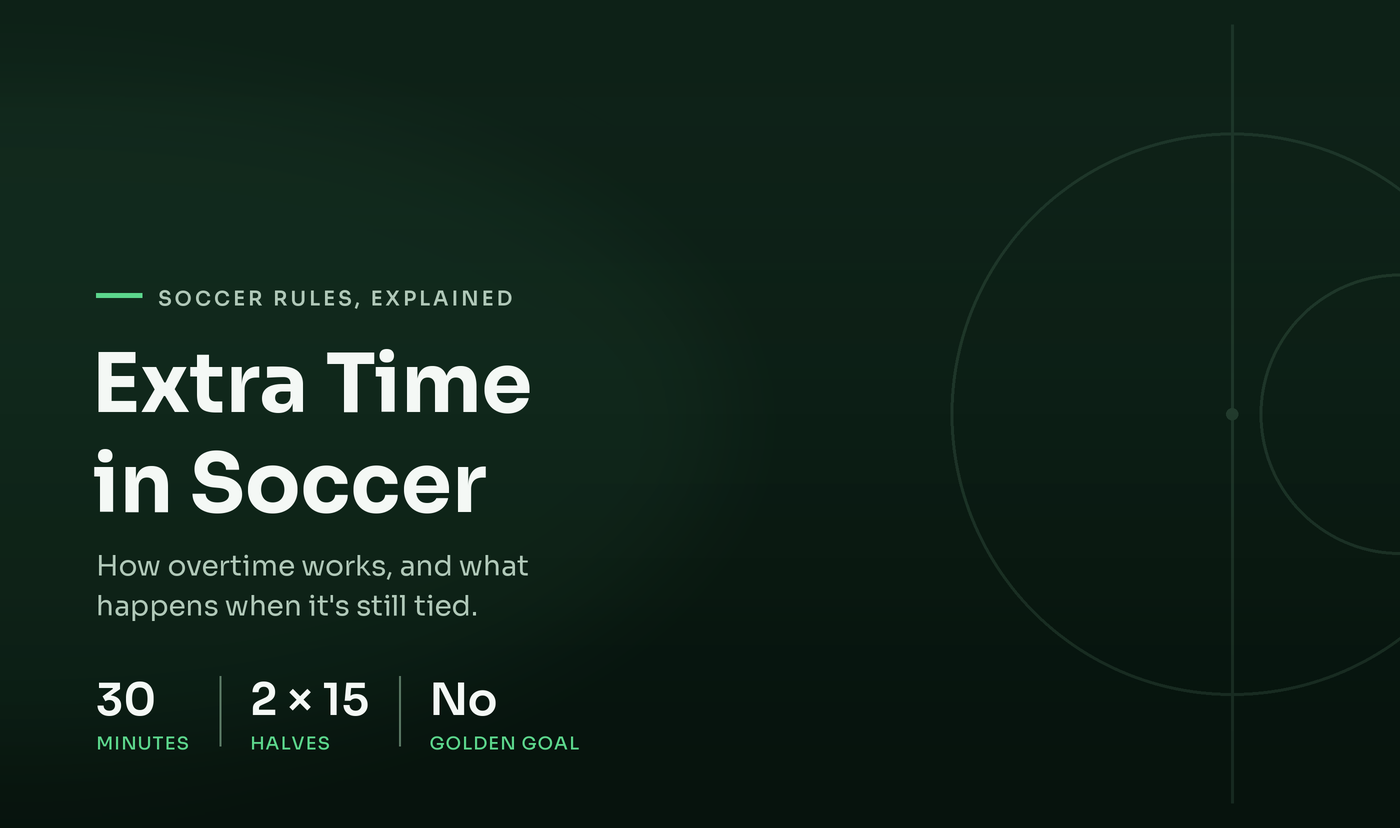
Yes. Soccer calls it “extra time,” while most American sports call the same concept “overtime.” They refer to the identical phase of a tied knockout match. The big difference from sudden-death overtime in the NFL or NHL is that soccer plays both 15-minute halves all the way through — a goal does not end it instantly.
What Happened to the Golden Goal?
You may have heard of the “golden goal,” a sudden-death rule where the first team to score in extra time won immediately. FIFA used it at the 1998 and 2002 World Cups, then phased it out after Euro 2004. Modern major competitions no longer use it — both extra-time halves are now always completed regardless of who scores.
Does Extra Time Have Stoppage Time?
It does. Just like the two regular halves, each 15-minute extra-time period can have added time tacked on for injuries, substitutions, and VAR reviews. There’s a short break before extra time begins and a quick switch of ends between the two periods, but no full halftime. Add it all up and a tied knockout match can run well past two hours before penalties even start.
The Bottom Line
Extra time is soccer’s answer to overtime: two 15-minute halves, 30 minutes total, played in full when a knockout match is tied after regulation. It’s not sudden death, there’s no golden goal anymore, and if the teams are still level at the end, a penalty shootout decides who advances. Once you know it only appears in knockout rounds — and that both halves always finish — the drama of a tied tournament match is a lot easier to follow.