

If you have ever watched a soccer match and seen the referee reach into a pocket and hold up a colored card, you have witnessed the sport’s main disciplinary system. Yellow and red cards are how referees keep games under control, punishing everything from a cynical foul to violent conduct. But what exactly earns each card, what happens after a player is shown one, and how do the suspension rules work? The system is simpler than it looks once you break it down.
With the 2026 World Cup bringing soccer to a huge new audience, plenty of fans are encountering these rules for the first time. Here is a complete guide to what yellow and red cards mean, the offenses behind them, and the consequences that follow.
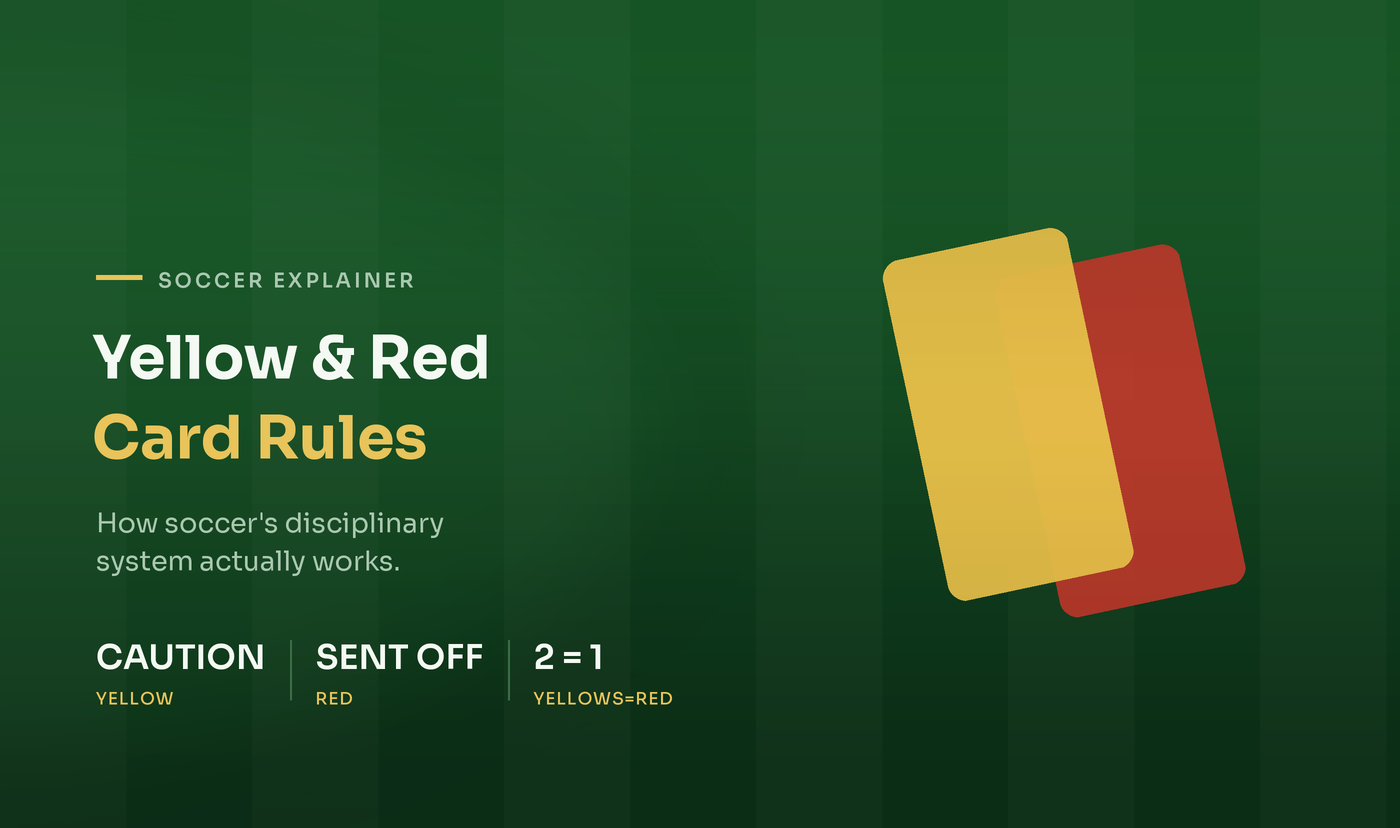
The chart below breaks down the card system: what each card means, the offenses that earn them, and how suspensions work. Take a look, then we’ll explain each piece.
What a Yellow Card Means
A yellow card is a caution, the referee’s official way of warning a player that their conduct has crossed a line. The player stays on the field and the game continues, but the card goes on the record. A yellow is shown for offenses that are reckless, cynical, or unsporting rather than violent: a hard foul to stop an attack, arguing with the referee, time-wasting, or diving to win a free kick. A single yellow does not remove a player from the match, but it puts them on notice, and a cautioned player often has to play more carefully for the rest of the game to avoid a second.
What a Red Card Means
A red card is the most serious punishment a referee can hand out: it means the player is sent off and must leave the field immediately. Crucially, the player cannot be replaced, so their team has to play the rest of the match a man short, a massive disadvantage. A red card can come in two ways. A direct red is shown for a single serious offense, such as violent conduct, a dangerous tackle, spitting, abusive language, or denying an obvious goal-scoring opportunity. The other way is by accumulation: if a player receives a second yellow card in the same match, the referee follows it with a red, and the player is sent off just the same.
Two Yellows Equal a Red
One of the most important things to understand is the relationship between the two cards. A player can receive one yellow card and keep playing, but a second yellow in the same match automatically becomes a red card. When this happens, the referee shows the second yellow and then immediately shows the red, and the player is sent off. This is why a cautioned player is in a delicate spot: managers will often substitute a player on a yellow card to avoid the risk of them earning a second and leaving the team short-handed. The result is the same as a direct red in that moment, the team plays on with ten players, though the suspension that follows is usually shorter.
The Offenses Behind Each Card
The laws of the game, maintained by the International Football Association Board, spell out which offenses earn which card. Cautionable (yellow) offenses include unsporting behavior, dissent, persistent fouling, delaying the restart of play, failing to respect the required distance on a free kick, and simulation. Sending-off (red) offenses are more severe: serious foul play, violent conduct, spitting or biting, denying a goal or an obvious goal-scoring opportunity through a foul or deliberate handball, and using offensive or abusive language. The referee uses judgment to decide whether an action is merely reckless, which is a yellow, or uses excessive force, which is a red.
How Suspensions and Accumulation Work
The consequences of cards extend beyond a single match, though the exact rules vary by competition. Yellow cards accumulate over a season: in the Premier League, for example, five yellows within the first 19 games earns a one-match ban, with higher thresholds later in the year, and the totals reset each season. Red cards always carry at least a one-match suspension, and serious offenses like violent conduct typically bring three games or more. In tournaments, the rules differ again: two yellow cards across separate matches usually trigger a one-game ban, and at the World Cup, single yellows are wiped clean after the quarterfinals so a player is not suspended from the final over minor cautions earlier in the event. It is also worth knowing that cards are not just for players on the field; referees can caution or send off substitutes and team officials, including head coaches. If you enjoy these rule breakdowns, see our explainer on the dropped third strike rule in baseball.
The Bottom Line
Yellow and red cards are the backbone of discipline in soccer. A yellow is a caution that keeps a player on the field but on notice, while a red is a sending off that forces their team to play a man down for the rest of the match. Two yellows in one game add up to a red, and the consequences can stretch into future matches through suspensions and accumulation rules that vary by league and tournament. Once you understand the system, those moments when the referee reaches for a pocket become some of the most dramatic and decisive in the entire sport.