
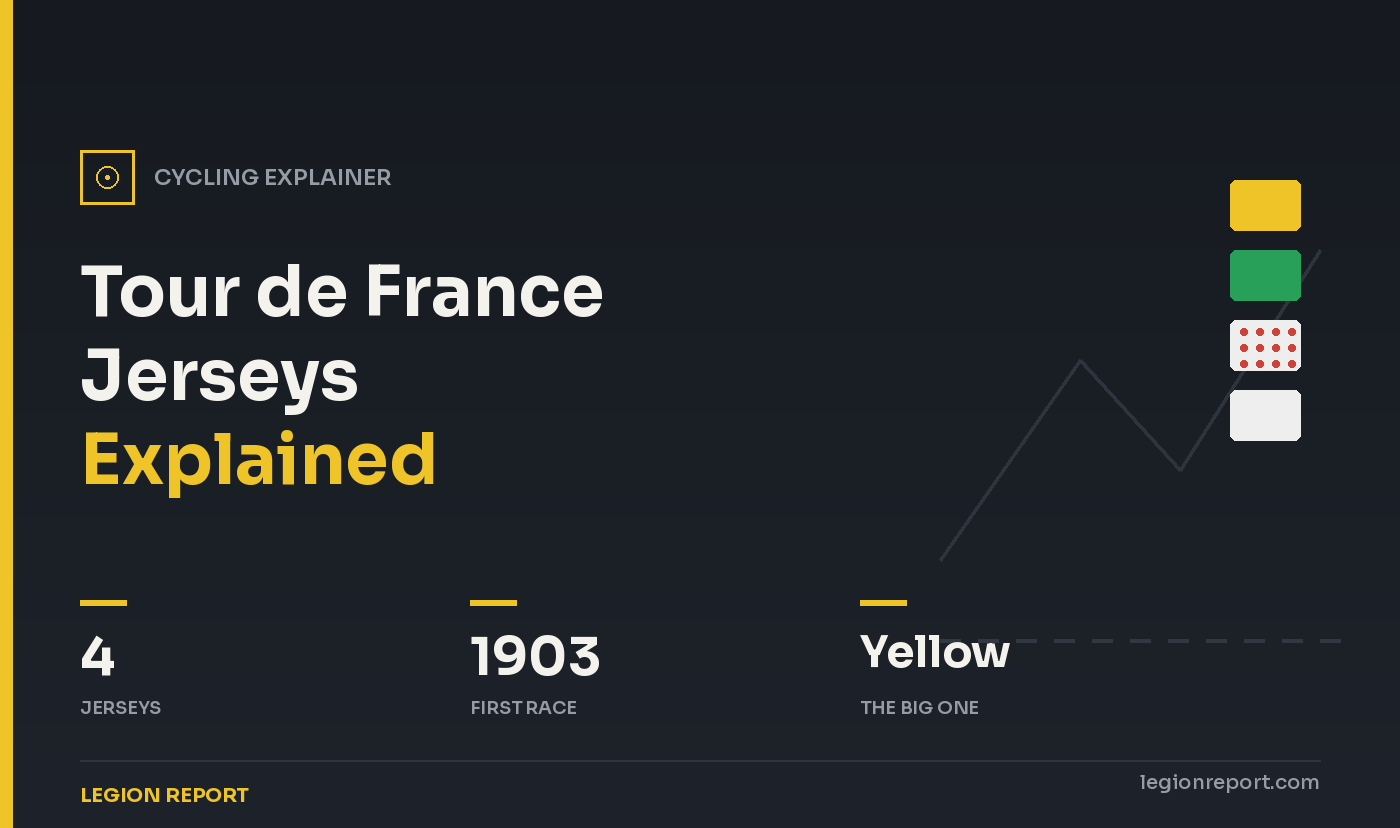

If you have ever flipped on the Tour de France in July and felt completely lost, the jerseys are the key to everything. Amid a blur of nearly 200 riders, four colored jerseys, yellow, green, polka dot, and white, tell you exactly who is winning what. Each one represents a completely different competition happening at the same time, rewarding a different kind of rider with a different skill set.
Understanding the four jerseys turns the Tour from a confusing three-week blur into four gripping races at once: the overall champion, the best sprinter, the best climber, and the best young rider. The most famous, the yellow jersey, is the one everyone chases, but each has its own history, its own legends, and its own dramatic story over the race’s 21 stages.
The chart below breaks down what each jersey means, how you win it, and who holds the records. Take a look, then we’ll get into the details.
The yellow jersey: the one that matters most
The yellow jersey, or maillot jaune, is the most famous piece of clothing in cycling and the prize every Tour is ultimately about. It goes to the leader of the general classification, which is simply the rider with the lowest cumulative time across all 21 stages. Crucially, it is decided by total time, not by winning individual stages, so a rider can win the Tour without ever winning a single stage, just by being consistently fast and never losing big chunks of time.
The color has a quirky origin: when the jersey debuted in 1919 to help spectators spot the race leader, organizers chose yellow because L’Auto, the newspaper that founded the Tour, was printed on distinctive yellow paper. Winning the overall title is the pinnacle of the sport, and only four riders, Eddy Merckx, Bernard Hinault, Miguel Indurain, and Jacques Anquetil, have done it a record five times each.
The green jersey: for the fastest sprinters
The green jersey, or maillot vert, rewards the points classification, which generally favors the sprinters. Riders earn points based on their finishing position on each stage and at intermediate sprint lines mid-stage, with far more points available on flat stages (50 for a stage win) than mountainous ones. This weighting means the green jersey is usually a battle among the pure speed merchants who can explode in a bunch finish at 45 miles per hour.
The undisputed king of the green jersey is Slovakia’s Peter Sagan, who won it a record seven times and spent 130 days in the maillot vert, far ahead of anyone else. The competition rewards a different kind of athlete than the yellow jersey: not an all-around stage racer, but a specialist with explosive power and the nerve to win chaotic, dangerous sprint finishes.
The polka dot jersey: King of the Mountains
The white jersey with red polka dots, the maillot a pois rouges, is the most distinctive in the race, and it goes to the best climber, known as the King of the Mountains. Points are awarded to the first riders over each categorized climb, and the climbs are graded by difficulty from Category 4 (easiest) up to the brutal hors categorie, or “beyond category,” peaks. The harder the climb, the more points are on offer, so the jersey rewards riders who attack the biggest mountains.
Frenchman Richard Virenque holds the record with seven polka dot titles and spent a record 96 days in the jersey. The distinctive design dates to 1975, when sponsor Chocolat Poulain reportedly chose the eye-catching dots to make the climbing leader stand out in the peloton. In recent years overall stars like Tadej Pogacar have won it alongside the yellow jersey, though it is often claimed by breakaway climbing specialists.
The white jersey: the next generation
The white jersey, or maillot blanc, works exactly like the yellow jersey, lowest cumulative time, but is restricted to young riders aged 25 or under. It exists to spotlight the future stars of the sport, and it has frequently served as a stepping stone to overall greatness. Tadej Pogacar won the white jersey a record four times early in his career, often while also wearing yellow, a sign of just how dominant he became at a young age.
Because the best young riders are often also the best riders overall, the white jersey winner sometimes also leads or wins the entire Tour. When that happens, the rider wears yellow (the higher priority) and the white jersey passes to the next-best young rider. It is a window into who might be dominating the race a few years down the line.
Final Word
The four jerseys of the Tour de France are the simplest way to follow the world’s biggest bike race. Yellow is the overall leader and the ultimate prize, green is the best sprinter, polka dot is the best climber, and white is the best young rider. Once you know what each color means, the three-week race snaps into focus as four distinct, simultaneous competitions, each with its own drama and its own legends.
So when you tune in this July and see a rider in polka dots attacking a mountain or a sprinter in green flying toward the line, you will know exactly what they are fighting for. The jerseys are the story of the Tour, told in color. For more on how the world’s biggest sporting events work, see our explainer on how World Cup standings and tiebreakers work.