
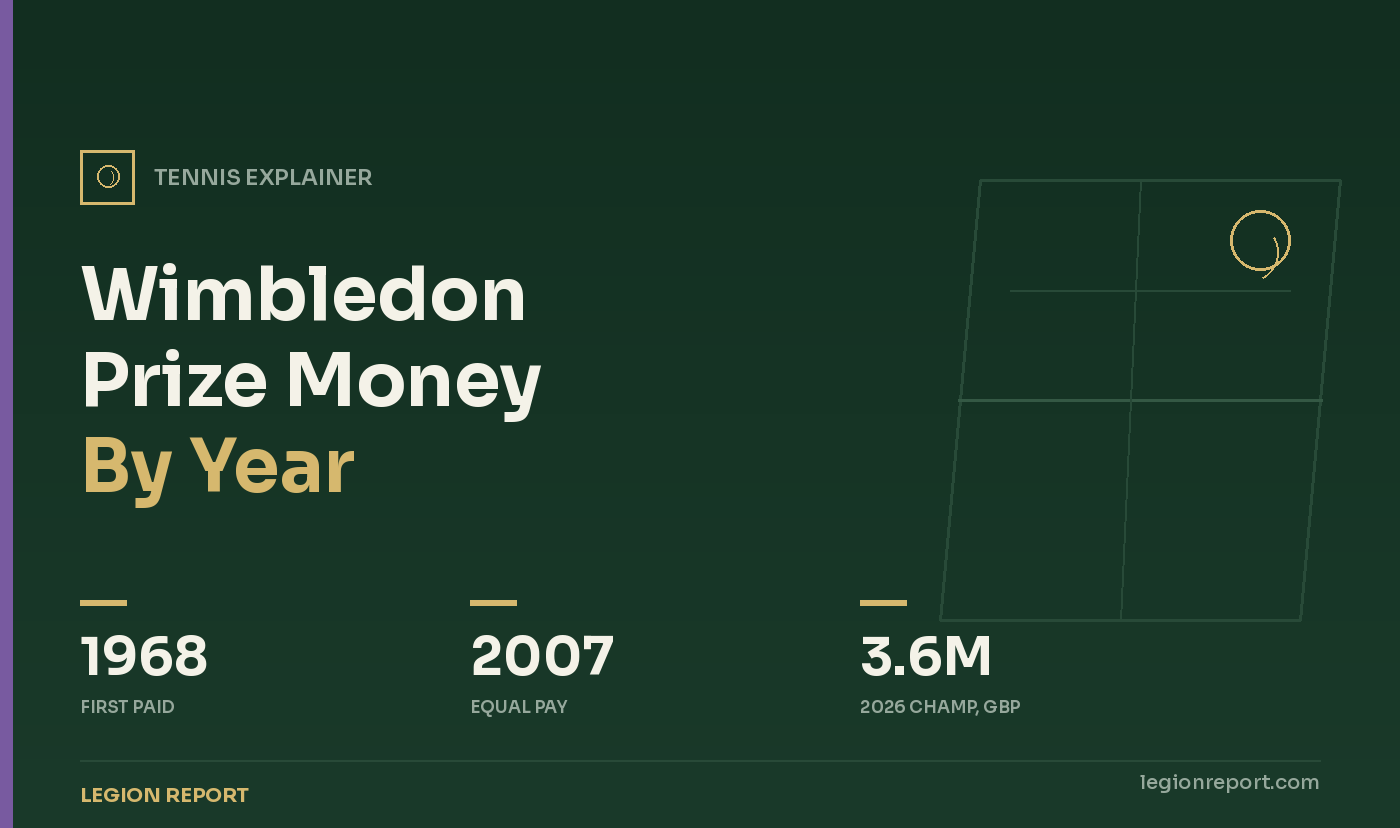

The story of Wimbledon prize money is really the story of professional tennis itself: its explosive commercial growth, the long fight for equal pay between men and women, and the All England Club’s modern push to reward players at every level. A champion’s cheque has risen from 2,000 pounds in 1968 to 3.6 million in 2026, a roughly 1,800-fold increase that tracks the sport’s transformation into a global business.
The chart below traces how the champion’s prize money has grown across the decades, the milestone moments, and the long road to equal pay. Take a look, then we’ll get into the history.
From prestige to prize money: the 1968 turning point
For the first 91 years of its existence, Wimbledon paid its champions nothing. From the inaugural tournament in 1877 through 1967, players competed as amateurs for a trophy and the prestige of winning the world’s most famous tennis title. That changed in 1968, the dawn of what is called the Open Era, when professional players were finally allowed to compete and Wimbledon paid prize money for the first time. The total purse that year was just 26,150 pounds, with the men’s champion earning 2,000 pounds and the women’s champion 750.
Those sums seem almost quaint now, but they represented a revolution. By opening the tournament to professionals and putting real money on the line, Wimbledon and the other majors transformed tennis from a gentleman’s pastime into a viable career. Nearly every year since, the prize fund has climbed, tracking the sport’s growing television audiences, sponsorships, and global popularity.
The explosive growth of the modern era
The numbers tell a story of relentless, accelerating growth. By 1975, the men’s champion’s cheque had reached 10,000 pounds; by 1984, it crossed 100,000 pounds for the first time. The climb continued through the Sampras and Graf years of the 1990s, when champions earned in the mid-hundreds of thousands, and then accelerated sharply in the 2010s. In 2010, a Wimbledon singles champion took home one million pounds for the first time. By 2022 that had doubled to two million, and the 2026 champions will each bank a record 3.6 million pounds.
This explosive growth at the top has been matched by a deliberate strategy to reward players further down the draw. In recent years, the All England Club has pushed larger percentage increases toward the early rounds and qualifying, so that even a first-round loser now earns 80,000 pounds in 2026. The logic is that lower-ranked players, who shoulder the heavy travel and coaching costs of life on tour, need that support to sustain a career, and the total purse has ballooned to a record 64.2 million pounds to fund it.
The long road to equal pay
The most significant storyline in Wimbledon’s prize money history is the fight for equal pay between men and women. For decades, the tournament paid its men’s champion more than its women’s champion, a gap visible right in the numbers: in 1968 it was 2,000 pounds to 750, and even as late as 2006 the men earned 655,000 pounds to the women’s 625,000. Wimbledon justified the gap by pointing to men playing best-of-five sets and drawing larger audiences, arguments that critics found increasingly unconvincing.
Tennis had actually led all of sport on this issue decades earlier, when the 1973 US Open became the first major sporting event to offer equal prize money, after Billie Jean King threatened a boycott. But Wimbledon, ever bound to tradition, was the last of the four Grand Slams to follow. It finally did so in 2007, when chairman Tim Phillips announced that both singles champions would receive 700,000 pounds. Equal pay has applied across every event ever since, and the issue is now a settled, structural part of the tournament rather than a debate.
What the numbers really mean
It is worth remembering that prize money is not cumulative at Wimbledon: players earn only the amount for the round in which they are eliminated, so the champion’s headline figure is the single largest cheque, not a running total. For the winner, 3.6 million pounds is genuinely transformational, even after the United Kingdom’s tax rate of 40 to 45 percent is applied. For a first-round loser, the 80,000-pound cheque, while substantial, can be largely eaten up by the costs of a season on tour.
That tension, enormous rewards at the top and a tougher financial reality lower down, is exactly what the All England Club’s recent strategy of boosting early-round pay is meant to address. Even so, top players have recently lobbied all four Grand Slams for a larger share of total revenue, arguing the current splits still fall short. The prize money story, in other words, is far from over.
Final Word
Wimbledon prize money has come an extraordinarily long way, from the first 2,000-pound champion’s cheque in 1968 to a record 3.6 million pounds in 2026, a roughly 1,800-fold increase that mirrors tennis’s rise into a global commercial powerhouse. Along the way, the tournament crossed major thresholds, the first six-figure champion in 1984, the first million-pound winner in 2010, and most importantly, the arrival of equal pay for men and women in 2007.
The champion’s cheque is the headline, but the real story is in the trend line: nearly six decades of almost unbroken growth, reflecting a sport that has never been more popular or more lucrative. As the 2026 Championships approach, the players competing on the grass of SW19 will be chasing not just the most prestigious title in tennis, but the richest payday in the tournament’s history. For the players who have won it most, see our list of Wimbledon champions by year.