
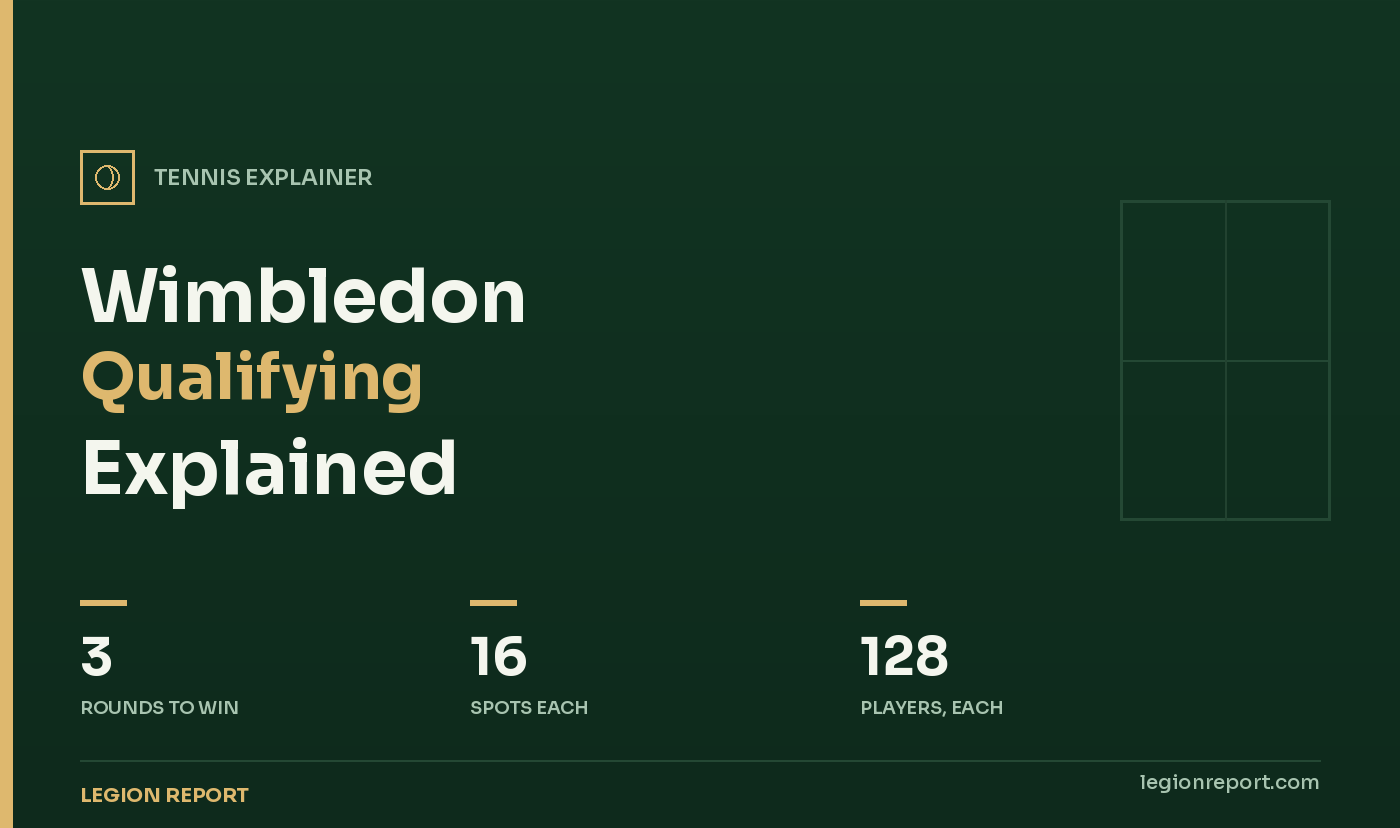

Every Wimbledon main draw has 128 players in each singles event, but not all of them got there the same way. Most earn direct entry through their world ranking, and a handful receive wildcards, but a select group has to fight its way in through one of tennis’s toughest tests: the Wimbledon Qualifying Competition. Held the week before the Championships at Roehampton, qualifying is where dreams are made and hearts are broken before the famous fortnight even begins.
For players ranked just outside the cut-off, qualifying is a brutal, high-pressure gauntlet: win three matches in a row and you earn a coveted main-draw spot at the All England Club, with all the prize money and prestige that comes with it. Lose, and you go home. It is one of the best-kept secrets in tennis, free to watch, packed with rising stars and comeback stories, and the launching pad for some of the sport’s most memorable Cinderella runs.
The chart below explains how Wimbledon qualifying works: the format, the rounds, where it is played, the prize money, and the path into the main draw. Take a look, then we’ll break it all down.
What Wimbledon qualifying is
The Wimbledon main draw consists of 128 players in both the men’s and women’s singles. The vast majority earn their place through their world ranking, with a small number receiving wildcards from the organizers. But the final 16 spots in each draw are reserved for players who come through the Qualifying Competition, a separate pre-tournament event for those who fall just outside the direct-entry cut-off. It is a chance for lower-ranked players to earn their way onto the sport’s grandest stage.
One unusual feature is where it takes place. Unlike most Grand Slams, which hold qualifying on their main grounds, Wimbledon stages its qualifying event off-site at the Community Sport Centre in Roehampton, about three miles from the All England Club. The reason is simple and very Wimbledon: it protects the pristine grass courts at SW19 from the extra wear of a week of additional matches. The All England Club has signaled it may eventually move qualifying on-site, but for now, Roehampton remains the proving ground.
How the format works
Qualifying is a single-elimination knockout, and the path is demanding: a player must win three matches in a row to claim a main-draw spot. With 128 players competing for 16 places in each singles draw, only one in eight survives. The format differs slightly by gender. Women play best-of-three sets in all three rounds, while men play best-of-three in the first two rounds and then step up to best-of-five sets in the decisive final round, mirroring the grueling format of the main draw.
In keeping with the modern Grand Slam standard, if the final set reaches 6-6, a 10-point tiebreak decides the match. The three-round structure packs enormous pressure into a few days: there are no second chances, and a player who has traveled across the world can see their Wimbledon hopes end in a single afternoon. That high-stakes, win-or-go-home intensity is exactly what makes qualifying such compelling viewing.
Who plays in qualifying
The qualifying field is typically made up of players ranked roughly between world number 100 and 250, those just below the direct-entry threshold for the main draw. But rankings can be deceptive at this level. The field is often packed with fascinating stories: rising teenage prospects chasing their first Grand Slam main draw, former top-50 players trying to rebuild their careers, and established names returning from injury or other absences whose rankings have temporarily dropped.
This last group can be especially dangerous. A player coming back from a long layoff might be ranked outside the top 100 but possess far more Grand Slam experience and raw ability than the number suggests. Because the depth of professional tennis is so great, genuinely strong players, sometimes former Grand Slam quarter-finalists, can find themselves grinding through Roehampton. The standard of play is remarkably high, which is part of why qualifying has become a favorite of dedicated fans.
The prize money and what is at stake
The financial stakes in qualifying are significant, especially for players at this level. In 2026, reaching the third and final round of qualifying paid £50,000, with smaller but still meaningful sums from around £20,000 for earlier-round exits, all drawn from a total qualifying purse of roughly £6.2 million. For a player ranked outside the top 100, who shoulders heavy travel and coaching costs, even an early qualifying exit provides valuable income.
The real prize, though, is reaching the main draw. A spot in the Championships guarantees a first-round cheque well into five figures, money that can fund a player’s team and travel for a large part of the season. That is why the final round of qualifying is so emotionally charged: it is not just about playing at Wimbledon, but about the financial security that comes with it. For many players outside the elite, qualifying week is the most important few days of their year.
Qualifiers, lucky losers, and Cinderella runs
Once players win their three matches, they become “qualifiers” and are placed into the main draw before the official draw ceremony, appearing as “Q” in the bracket until their names are confirmed. There is also a safety net for those who fall just short: the “lucky loser.” If a main-draw player withdraws after qualifying ends, their spot is filled by a player who lost in the final round of qualifying, chosen by a random draw among the highest-ranked of those final-round losers.
Qualifying has produced some of Wimbledon’s most magical stories. Players who battle through Roehampton arrive at the main draw with match sharpness on grass and nothing to lose, while their seeded opponents may be rusty. This combination has fueled famous Cinderella runs, with qualifiers occasionally reaching the second week and even the quarter-finals, stunning far higher-ranked opponents along the way. For fans seeking the sport’s next breakout star, qualifying week is often the best place to look.
Final Word
Wimbledon qualifying is the high-stakes competition that fills the final main-draw spots, staged at Roehampton the week before the Championships to protect the grass at SW19. With 128 players in each draw battling through three knockout rounds for just 16 places, it is one of the toughest and most dramatic tests in tennis, packed with rising stars, comeback stories, and genuine quality that rankings alone do not capture.
Free to watch and full of intensity, qualifying is one of tennis’s best-kept secrets and the starting point for some of Wimbledon’s most unforgettable underdog runs. For more on how the main tournament is structured, see our explainer on how Wimbledon seeding works.