
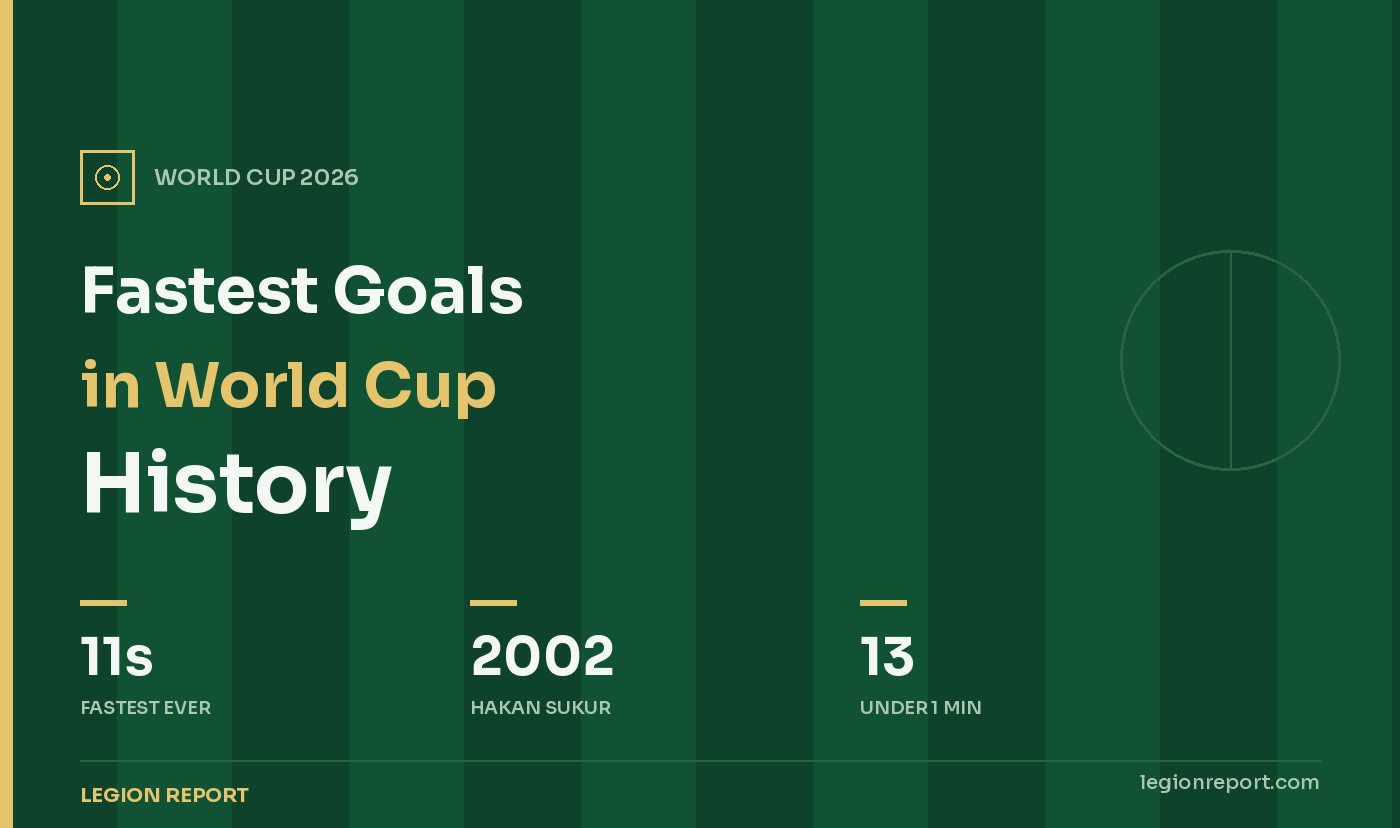

In football, a goal can change everything in an instant, and at the World Cup, a few players have struck before the crowd has even settled into their seats. Scoring in the opening seconds of a match on the sport’s biggest stage is one of the rarest feats in the game, a moment of pure opportunism that lives forever in the record books. In the entire history of the men’s World Cup, only 13 players have scored in the first minute of a match.
One stands far above the rest. On June 29, 2002, Turkey’s Hakan Şükür scored just 11 seconds into a match against South Korea, the fastest goal in World Cup history, a record that has now survived more than two decades and five completed tournaments. What makes it even more remarkable is the context: it came in a game where Şükür’s team did not even kick off, and it was the captain’s only goal of the entire tournament.
The chart below ranks the fastest goals in World Cup history, with the player, country, and match, plus the related speed records and the story behind the famous strike. Take a look, then we’ll break it all down.
The fastest goal ever: Şükür’s 11-second strike
The fastest goal in World Cup history was scored by Hakan Şükür, Turkey’s legendary captain, just 11 seconds into the third-place playoff against co-hosts South Korea at the 2002 World Cup. Often timed precisely at 10.8 seconds, it broke a record that had stood for 40 years. What makes it so astonishing is the sequence: South Korea, not Turkey, kicked off. The Koreans passed the ball back, but Ilhan Mansiz pounced, robbing defender Hong Myung-bo and slipping it to Şükür, who took a touch and finished past the goalkeeper before most fans had registered the match had begun.
The story carries an extra layer of drama. Şükür had gone the entire tournament without scoring, failing to find the net in his previous matches across more than eight hours of football, and there had even been talk of him being dropped for the playoff. Instead, he delivered the fastest goal in the competition’s history with his only strike of the tournament, then added two assists as Turkey won 3-2 to secure third place, their best-ever World Cup finish.
The chasing pack: the rest of the top of the list
Behind Şükür, the next-fastest goal belongs to Czechoslovakia’s Vaclav Masek, who scored 15 seconds into a 1962 match against Mexico, the very record Şükür would later break. Remarkably, it was the only World Cup goal of Masek’s career, scored on his tournament debut in a game his side went on to lose. Germany’s Ernest Lehner is third on the list, with a 25-second strike against Austria in the 1934 third-place playoff.
The rest of the top of the list spans nearly the entire history of the tournament, from the 1930s to the modern era. England’s Bryan Robson scored after 28 seconds against France in 1982, and the United States’ Clint Dempsey netted in 30 seconds against Ghana in 2014. France’s Bernard Lacombe (31 seconds, 1978) and a cluster of goals around the 35 to 50-second mark, including strikes from the 1938, 1962, and 1966 tournaments, round out the fastest goals ever recorded on the game’s biggest stage.
The other speed records
Beyond the fastest goals from kickoff, the World Cup holds a few other fascinating speed records. The fastest goal in a World Cup final came from the Netherlands’ Johan Neeskens, who converted a penalty after about 86 seconds in the 1974 final against West Germany, before the Germans had even touched the ball. It remains one of the most dramatic starts to a showpiece occasion in the sport’s history, though the Dutch ultimately lost the match.
There is also a record for the fastest goal by a substitute: Uruguay’s Richard Morales scored just 16 seconds after coming on at halftime against Senegal in 2002. And on the unfortunate side of the ledger, Bosnia and Herzegovina’s Sead Kolasinac holds the record for the fastest own goal in World Cup history, deflecting the ball past his own keeper after 2 minutes and 11 seconds against Argentina in 2014. Quick goals, it turns out, come in many forms.
Why these goals are so rare
Scoring in the opening seconds of a World Cup match is extraordinarily rare for good reason. Teams at this level are highly organized and typically begin matches cautiously, feeling each other out rather than committing players forward. Most early goals come not from elaborate buildup but from a mistake: a loose pass, a defensive lapse, or a misjudged kickoff, seized upon by an alert attacker. Şükür’s goal is the perfect example, born entirely from an opponent’s error in the very first touches of the game.
That is why only 13 players in the long history of the men’s World Cup have managed to score within the first minute of a match. It requires a rare combination of opportunism, sharp instincts, and a bit of luck, all on the most pressurized stage in the sport. These goals are not the product of tactics or planning; they are moments of chaos and alertness that etch a player’s name into history before the match has truly begun.
Could the record fall in 2026?
With the 2026 World Cup expanded to 48 teams and a record 104 matches, there are more games than ever, and therefore more chances for an early goal. So far, though, Şükür’s mark looks safe. The fastest goals of the 2026 tournament have come from Paraguay’s Matias Galarza, who scored after 65 seconds, and Morocco’s Ismael Saibari, who netted in 71 seconds, both quick, but well outside the all-time top 10 and nowhere near the 11-second record.
Şükür’s record has now survived five completed tournaments since 2002 and is holding through a sixth. As the modern game grows faster and more pressing-based, the theoretical possibility of a new record always exists, a single misplaced kickoff pass could do it. But for now, those 11 seconds in Daegu remain the definitive measure of speed on the World Cup stage, a record that has proven remarkably difficult to beat.
Final Word
The fastest goal in World Cup history belongs to Hakan Şükür, whose 11-second strike for Turkey against South Korea in 2002 came from an opponent’s kickoff mistake and remains untouched more than two decades later. Behind him sits a list of quickfire goals spanning the tournament’s entire history, from Vaclav Masek in 1962 to modern strikes by Clint Dempsey and others, with only 13 players ever scoring in the opening minute.
These blink-and-you-miss-it moments are among the rarest and most thrilling in football, proof that at the World Cup, history can be made in a matter of seconds. For more on the tournament’s scoring feats, see our guide to the Golden Boot winners by year.