

If you follow international soccer, you will constantly hear that a player has earned a certain number of “caps” for their country. A commentator might note that a veteran is “winning his 100th cap,” or that a youngster is “making her international debut, her first cap.” But what exactly is a cap, and why is it called that? The term is one of soccer’s oldest traditions, and its origin is surprisingly literal.
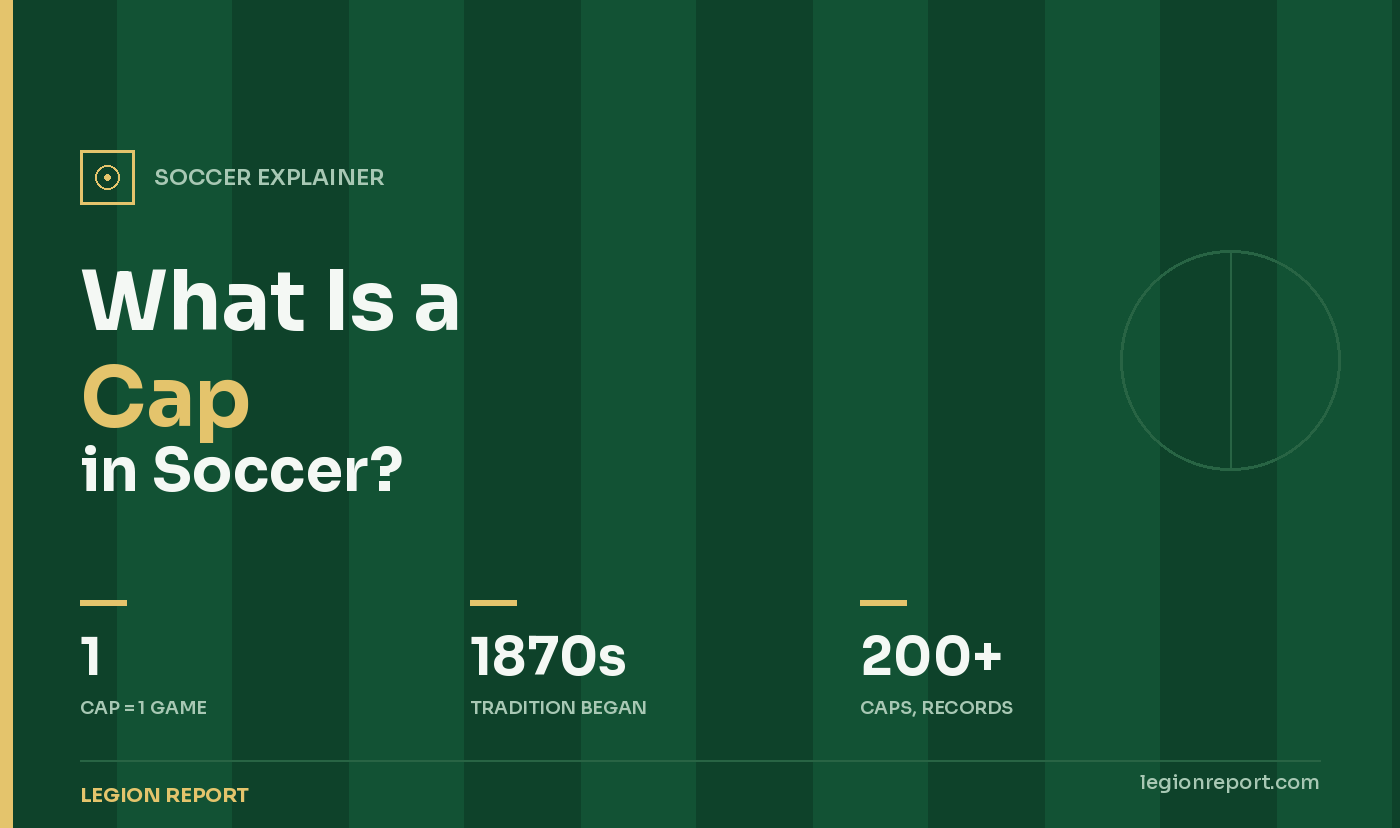
A cap simply means one appearance for a national team. Every time a player takes the field in an official international match, they earn one cap, and their career total is a running count of those appearances. The word comes from a real 19th-century tradition in England, where players were awarded an actual cap for each international they played. Today the caps are mostly symbolic, but the term has stuck worldwide.
The chart below breaks down what a cap is: the definition, where the tradition comes from, what counts, and the all-time records. Take a look, then we’ll go through the details.
What a cap actually is
A cap in soccer is one appearance for a national team in an official international match. Every time a player represents their country, they are credited with a cap, and the sum of those appearances is their “caps” total, a headline measure of international experience. So when you hear that a player “has 80 caps,” it simply means they have played 80 times for their national side.
Importantly, caps are earned whether a player starts the match or comes on as a substitute, as long as they actually take the field. A player who is named on the bench but does not get on does not earn a cap. Caps also only apply to national-team matches: appearances for clubs, no matter how many, do not count toward a player’s international cap total. The two are tracked entirely separately.
Where the word “cap” comes from
The origin of the term is wonderfully literal. In 19th-century England, players who represented their national team were awarded an actual, physical cap to commemorate each appearance, an ornate, often velvet cap that served as a badge of honor. The practice is generally traced to the 1880s, with the idea formally proposed around 1886, and it gave players a tangible keepsake for the prestige of playing for their country.
Over time, as players began accumulating dozens or even hundreds of appearances, handing out a separate physical cap for every single game became impractical, and the caps became largely symbolic. But the term endured and spread across the football world, so that today “caps” universally means international appearances, regardless of whether any physical cap is actually given. Some national federations do still present commemorative caps to mark milestones like a debut or a 100th appearance.
What counts as a cap
Not every match a national team plays results in official caps, and there can be some nuance. Caps are awarded for official international matches, which include World Cups, continental championships, qualifiers, and recognized friendlies (often called “A” internationals) between senior national teams. Appearances for youth teams (such as under-21s) or in certain unofficial or invitational matches are typically recorded separately and do not count toward a player’s senior cap total.
FIFA and national federations maintain the official records, and occasionally there are small discrepancies between sources about exactly which matches count, which is why cap totals for some historical players can vary slightly. But the core principle is consistent everywhere: a cap represents one official senior international appearance, earned by taking the field for your country.
Cap records and milestones
Reaching certain cap totals is a significant marker of a player’s career. Winning a first cap, the international debut, is a landmark moment, while reaching 100 caps earns entry into the celebrated “century club,” an honor achieved by only a select few players in each nation’s history. A handful of exceptional players have gone well beyond 200 caps, a testament to remarkable longevity and consistency at the top level.
In the men’s game, Portugal’s Cristiano Ronaldo holds the record with over 230 caps, ahead of players like Kuwait’s Bader Al-Mutawa (the first to reach 200) and Argentina’s Lionel Messi. The all-time record across all of football, however, belongs to the women’s game: former United States midfielder Kristine Lilly earned an astonishing 354 caps. These totals underline just how much international experience the game’s most durable stars accumulate over careers spanning two decades or more.
Final Word
A cap in soccer is one appearance for a national team, with a player’s total number of caps serving as the standard measure of their international experience. The term comes from a charming 19th-century English tradition of awarding players a physical cap for each international, and although the caps are now mostly symbolic, the word has become universal.
From a proud first cap to the rarefied 100-cap century club and beyond, caps chart a player’s international journey. For more on the players who have worn their country’s shirt most, see our guide to the best USA soccer players of all time.