

Look at any soccer league table or World Cup group standings and you will see a column, often labeled “GD,” that can decide a team’s entire season or tournament. That is goal difference, one of the most important tiebreakers in the sport. When two teams finish level on points, goal difference frequently determines who finishes higher, who wins the title, and who goes home. Understanding it is essential to reading any standings.
Goal difference is simple to calculate: it is the number of goals a team has scored minus the number it has conceded. A team that has scored 20 and conceded 12 has a goal difference of plus eight (+8); a team that scored 10 and conceded 15 has a goal difference of minus five (to be exact). It rewards teams for both scoring freely and defending well, and it is used across leagues and tournaments worldwide to separate teams on equal points.
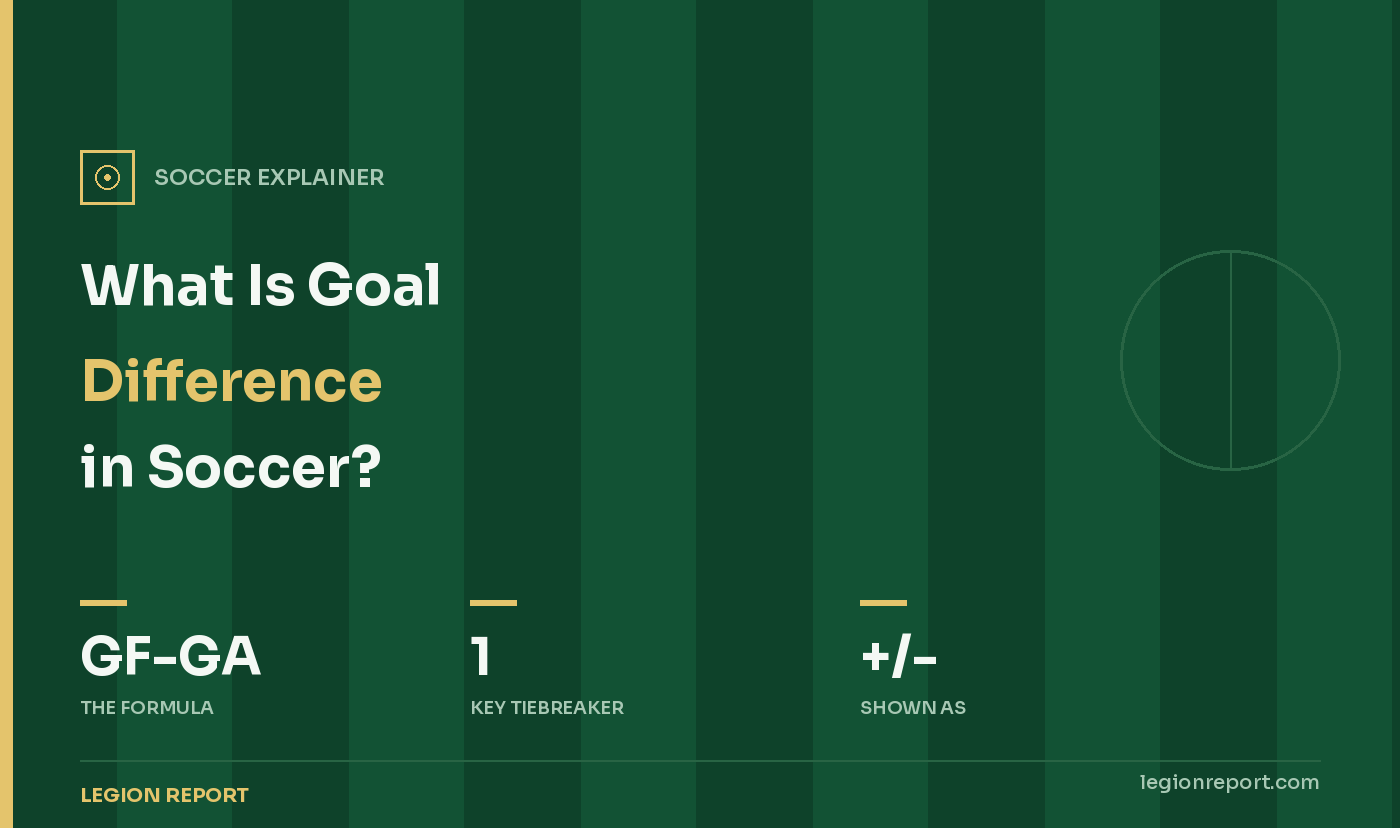
The chart below breaks down goal difference: the formula, how it is used, where it ranks among tiebreakers, and a worked example. Take a look, then we’ll go through the details.
What goal difference is
Goal difference is the number of goals a team has scored minus the number of goals it has conceded over a set of matches. It is one of the standard columns in any league table or group standings, usually abbreviated as “GD,” and it is displayed as a positive number (like +12) if a team has scored more than it has let in, or a negative number (like -8) if it has conceded more than it has scored. A team that has scored and conceded exactly the same number has a goal difference of zero.
The reason goal difference matters so much is that it is the most common way to separate teams that are level on points. In almost every league and tournament, points are the first thing that determines the standings (three for a win, one for a draw). But when two or more teams finish on the same number of points, a tiebreaker is needed, and goal difference is very often the first one applied.
How to calculate it
The calculation is straightforward: take a team’s total “goals for” (GF), the goals they have scored, and subtract their total “goals against” (GA), the goals they have conceded. The result is the goal difference. For example, a team that has scored 30 goals and conceded 18 across a season has a goal difference of +12. A team that has scored 22 and conceded 30 has a goal difference of minus eight.
Because it factors in both attack and defense, goal difference is a more complete measure than goals scored alone. A team can have a high-scoring attack but still end up with a modest goal difference if it also concedes a lot, while a well-organized team that scores moderately but defends superbly can post an excellent goal difference. It rewards teams that both find the net and keep it protected.
Why it decides titles and tournaments
Goal difference regularly has dramatic, season-defining consequences. In domestic leagues, championships have been won and lost on goal difference when the top teams finish level on points, most famously in tight title races where the smallest of margins separates first and second. It can also decide relegation at the bottom of the table, sending one team down and keeping another up despite identical points totals.
At the World Cup and other tournaments, goal difference is crucial in the group stage, where teams play a small number of matches and often finish level on points. A superior goal difference can be the thing that sends a team into the knockout rounds while an equal-on-points rival is eliminated. This is why you will sometimes see a team pushing hard for extra goals late in a group game that already looks won, those additional goals can prove decisive if the group comes down to goal difference.
Where it ranks among tiebreakers
Goal difference is usually applied after points but before other tiebreakers, though the exact order varies by competition. In many leagues, including the Premier League, and in FIFA World Cup groups, the typical order is: points first, then goal difference, then total goals scored, and then further criteria such as head-to-head results if teams are still level. Under this system, goal difference is effectively the primary tiebreaker.
However, not every competition uses the same rules. Some leagues and tournaments prioritize head-to-head records (the results between the tied teams) ahead of goal difference. It is always worth checking a specific competition’s regulations, but as a general rule, goal difference is one of the very first things used to break a tie, which is exactly why it carries so much weight in the standings.
Goal difference versus goal average
Goal difference has not always been the standard. For much of football’s early history, many competitions used “goal average” instead, a ratio calculated by dividing goals scored by goals conceded, rather than subtracting one from the other. Goal average was more complicated to calculate and could produce some counterintuitive outcomes, and over time it was largely replaced by the simpler, fairer goal difference.
Goal difference became widely adopted from the 1970s onward and is now the near-universal standard across world football. Its simplicity, just goals scored minus goals conceded, and the fact that it rewards attacking and defensive strength equally, are big reasons it has endured as the go-to tiebreaker for leagues and tournaments alike.
Final Word
Goal difference in soccer is simply a team’s goals scored minus goals conceded, shown as a positive or negative number in the standings. It is the most common tiebreaker used when teams are level on points, and it can decide league titles, relegation, and World Cup group qualification, rewarding teams that both score freely and defend well.
Once you know to read the “GD” column, following any league table or group becomes much clearer, especially in tight races where every goal counts. For more on how standings are settled, see our guide to World Cup standings tiebreakers.