

Scoring in a single World Cup match is a career highlight for most players. Scoring in several consecutive World Cup matches is a different category of achievement entirely, a streak that must survive elite defenses, knockout pressure, and often the four-year gaps between tournaments. For more than half a century, the record for the longest World Cup goal streak stood untouched, shared by two legends of the 1950s and 60s. Then Lionel Messi came for it.
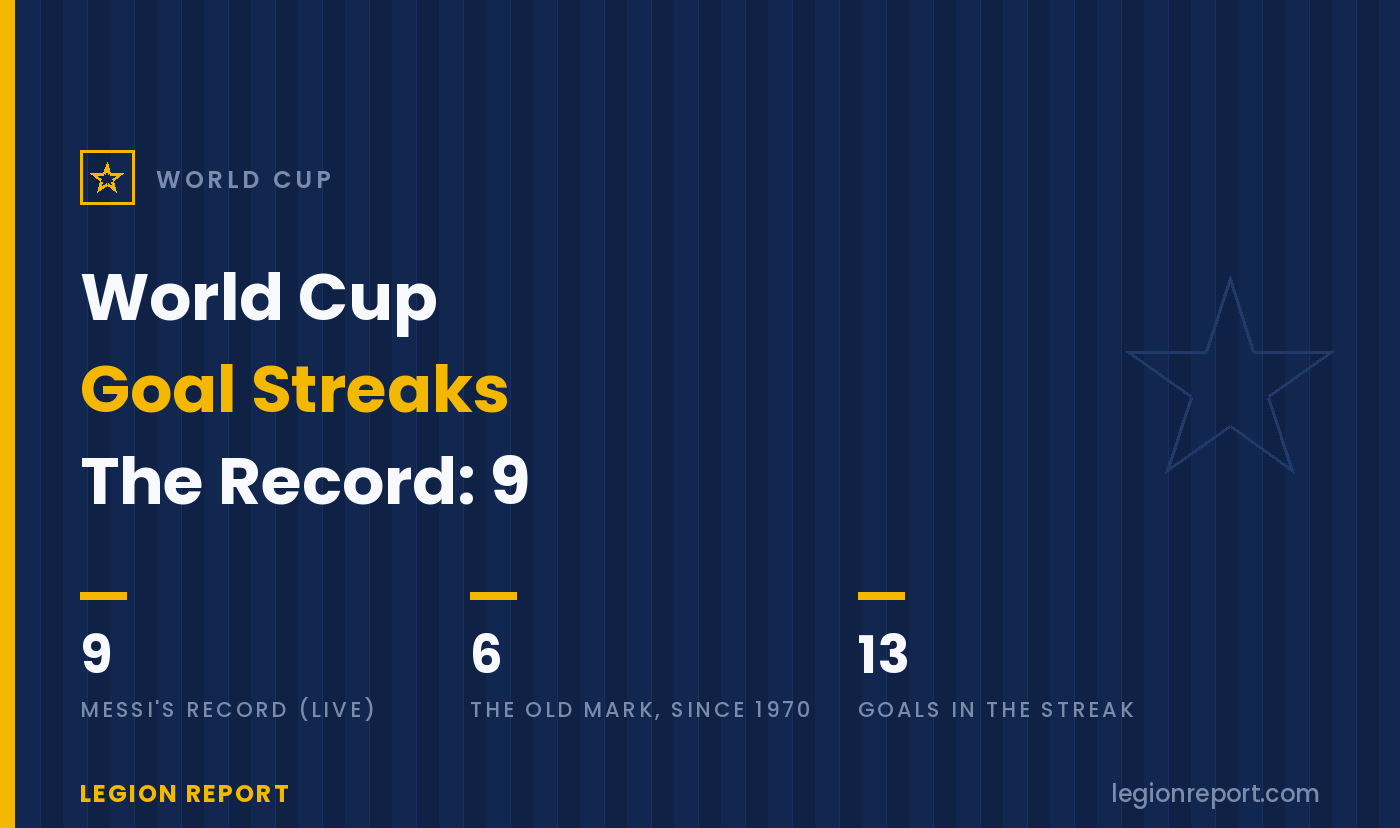
At the 2026 World Cup, Messi broke one of the sport’s oldest records by scoring in his seventh consecutive World Cup match, then kept going: his 83rd-minute equalizer in Argentina’s 3-2 comeback win over Egypt on July 7 stretched the new mark to NINE straight matches, a streak running from the 2022 knockout rounds in Qatar deep into the 2026 tournament on home-continent soil. The previous mark of six had been shared by France’s Just Fontaine, who scored in every match of his legendary 1958 campaign, and Brazil’s Jairzinho, who famously found the net in every game of Brazil’s perfect 1970 title run. And with Argentina into the quarterfinals, Messi’s streak is still active.
The chart below breaks down the longest World Cup goal streaks: the all-time list, a game-by-game look inside Messi’s record run, the legendary sixes, and the other great streaks in tournament history. Take a look, then we’ll get into the stories.
Messi breaks a 56-year-old record, and keeps stretching it
The record for the longest goal streak in World Cup history now belongs to Lionel Messi: nine consecutive matches with a goal, a run that began in the knockout rounds of the 2022 World Cup and has carried unbroken into the 2026 quarterfinals. The previous record of six straight had stood since 1970, shared by Just Fontaine and Jairzinho, and for decades it looked like one of those marks frozen in a different era of the game, until Messi, at 38 turning 39, chased it down across two tournaments.
The math of the streak is remarkable in itself: thirteen goals in those nine matches. Messi equaled Fontaine and Jairzinho’s six with his brace against Austria, broke the record in Argentina’s final group game against Jordan with a spectacular free kick off the bench, extended it against Cape Verde in the Round of 32, and then produced the streak’s most dramatic chapter yet on July 7 against Egypt: with Argentina trailing 2-0 and their title defense collapsing, and having already missed a first-half penalty, Messi buried the 83rd-minute equalizer, his ninth straight match with a goal, before Enzo Fernandez’s header completed the 3-2 comeback. Along the way he has also become the World Cup’s all-time leading scorer, now at 21 career goals, and the outright 2026 Golden Boot leader with eight. The streak remains alive as the defending champions head to Saturday’s quarterfinal in Miami Gardens.
Inside the streak: from Qatar to North America
What separates Messi’s run from the historic sixes is where the goals came. Fontaine’s and Jairzinho’s streaks each lived within a single tournament; Messi’s spans two, with a four-year gap in the middle, meaning he resumed scoring at 38 years old exactly where he left off at 35. The streak began in the highest-pressure environment possible: the 2022 knockout rounds, with goals against Australia (Round of 16), the Netherlands (quarter-final), Croatia (semi-final), and two in the final against France, making him the first player ever to score in every knockout round plus the group stage of a single World Cup.
Four years later, he picked it up with a flourish: a hat-trick against Algeria in Argentina’s 2026 opener (his first-ever World Cup hat-trick), a brace against Austria, the record-breaker against Jordan, the extender against Cape Verde, and now the Egypt equalizer, scored from open play minutes after the tournament seemed to be slipping away. Nine straight matches, thirteen goals, spanning a title run and a title defense, with the tournament still going. Every match Argentina plays is now a chance to push the record further out of reach.
The legendary sixes: Fontaine and Jairzinho
The two men Messi displaced own two of the most celebrated campaigns in World Cup history. Just Fontaine’s 1958 tournament remains the greatest individual scoring performance the World Cup has ever seen: he scored in all six of France’s matches, 13 goals in total, including four against West Germany in the third-place match, a single-tournament record that has never been seriously threatened. Astonishingly, 1958 was Fontaine’s only World Cup; injury ended his career at just 28.
Jairzinho’s six came in the most storied team campaign of all: Brazil’s perfect 1970 title run in Mexico. The winger scored in every single game, both group-stage rounds, the quarter-final, semi-final, and the final itself against Italy, earning him the nickname “the Hurricane of the World Cup.” He remains the only player ever to score in every match of a World Cup-winning campaign including the final, a distinction even Messi’s record streak does not touch, though if the streak survives two more matches, Messi would arrive at the July 19 final with a chance to match it in spirit: a title-defense campaign scored in from start to finish.
The five-streak club
Behind the record-holders sits an exclusive group: fourteen players in history have scored in five or more consecutive World Cup matches. The most fearsome five belongs to Gerd Muller, who scored in his first five World Cup appearances in 1970, ten goals, including back-to-back hat-tricks against Bulgaria and Peru just three days apart, a consecutive-hat-tricks feat matched only by Hungary’s Sandor Kocsis in 1954. Eusebio’s five straight powered Portugal’s run to third place in 1966, including four goals in one game against North Korea.
The club spans every era: from Leonidas and Gyorgy Sarosi in the 1930s to Helmut Rahn and Lajos Tichy in the 1950s and 60s, Teofilo Cubillas across 1970 and 1978, Careca and Toto Schillaci (the surprise hero of Italia 90), Hristo Stoichkov and Rivaldo, and most recently James Rodriguez, whose five straight in 2014 won him the Golden Boot. That it took until 2026 for anyone to reach seven, and that the man who did it has now reached nine, shows just how hard sustained World Cup scoring is.
The other great World Cup streaks
Consecutive-match scoring is the headline streak, but the World Cup has others. Cristiano Ronaldo owns a longevity version: he has scored in six consecutive World Cup tournaments (2006 through 2026), a span of two decades that no other player has matched. On the team side, Brazil hold the record of 11 consecutive match wins across their 2002 title run and the 2006 tournament, while the Netherlands have gone 16 matches unbeaten across recent editions.
And streaks belong to goalkeepers too: Spain’s Unai Simon recently set the record for consecutive scoreless minutes at 519, spanning the 2022 and 2026 tournaments, finally edging past Italian keeper Walter Zenga’s famous 517-minute wall from 1990, a record that had stood even longer than the scoring mark Messi broke. It has been a tournament for toppling ancient records.
Final Word
The longest World Cup goal streak is now nine consecutive matches, set by Lionel Messi across the 2022 and 2026 tournaments with thirteen goals along the way, breaking the six-match record that Just Fontaine (1958) and Jairzinho (1970) had shared for over half a century, and most recently extended with the 83rd-minute equalizer that saved Argentina’s title defense against Egypt. Behind them sits the five-streak club of fourteen players, from Gerd Muller’s double-hat-trick rampage to James Rodriguez’s Golden Boot run in 2014.
With Argentina into the quarterfinals, the record may not be finished growing, every Messi appearance is now a chance at history. For the scorers who defined each tournament, see our list of World Cup Golden Boot winners by year.