

If you watched the 2026 World Cup and found yourself asking “wait, where is Cape Verde?”, you are far from alone. The tournament’s great Cinderella story has sent millions of viewers to the map after the tiny island nation held Spain scoreless, drew with Uruguay, and became the smallest country by population ever to reach the knockout stage of a men’s World Cup, earning a Round of 32 date with Lionel Messi’s Argentina in Miami.
Cape Verde (officially the Republic of Cabo Verde) is an archipelago of ten volcanic islands in the Atlantic Ocean, roughly 350 miles off the west coast of Africa, near Senegal. Home to about 525,000 people, fewer than every single US state, it is a former Portuguese colony that gained independence in 1975 and has since become one of Africa’s most stable democracies, famous for its music, its beaches, and a global diaspora larger than its home population. And now, for the Blue Sharks.
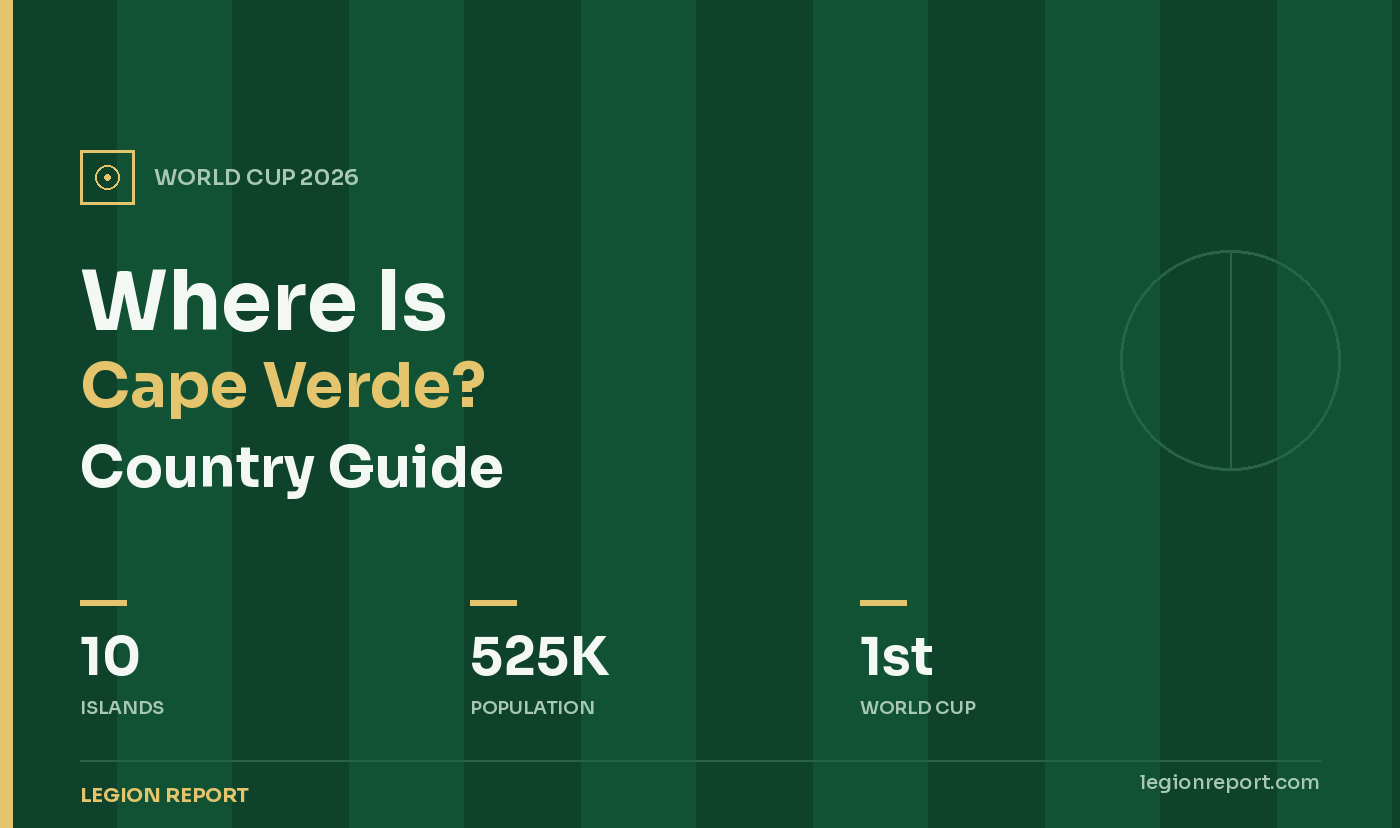
The chart below is the full country guide: where Cape Verde is, the islands, the essential facts, and the World Cup fairytale that put it on everyone’s screen. Take a look, then we’ll fill in the story.
So, where exactly is it?
Cape Verde sits in the middle of the Atlantic Ocean, roughly 350 miles (about 570 kilometers) off the westernmost tip of Africa, due west of Senegal and Mauritania. It is not attached to the continent at all: the country is an archipelago of ten volcanic islands and several islets, scattered across the ocean in two chains, the Barlavento (windward) islands to the north and the Sotavento (leeward) islands to the south. Politically and in football terms it is part of Africa, competing in CAF, the African confederation.
The name is a geography clue in itself: Portuguese sailors named the islands after Cap-Vert, the “green cape” that is the nearest point of mainland Africa (today home to Dakar, Senegal). Ironically, the islands themselves are largely dry and dramatic rather than green, sculpted volcanic terrain, salt flats, and dune beaches, with the still-active Pico do Fogo volcano as the country’s highest point.
A small nation with a global footprint
About 525,000 people live in Cape Verde, fewer than every single US state (Wyoming, the smallest, has around 576,000). The capital, Praia, sits on Santiago, the largest island, while Mindelo on Sao Vicente is the cultural heart. What the country lacks in size it makes up in reach: centuries of emigration mean the Cape Verdean diaspora abroad is larger than the population at home, with especially deep roots in New England, communities in Massachusetts and Rhode Island date back to the 19th-century whaling era, which made the team’s 2026 run in American stadiums feel like a series of home games.
The islands were uninhabited until Portuguese settlers arrived in the 1460s, and their location made them a major waypoint of the Atlantic slave trade, a history preserved at Cidade Velha, the country’s UNESCO World Heritage site. Cape Verde gained independence from Portugal on July 5, 1975, and has since built a reputation as one of Africa’s most stable democracies. Portuguese is the official language, Cape Verdean Creole the language of daily life, and morna, the aching, beautiful ballad style carried to the world by the great Cesaria Evora, is the national soundtrack. Tourism on the beach islands of Sal and Boa Vista drives much of the economy.
The World Cup fairytale
Cape Verde qualified for the 2026 World Cup, its first ever, by topping its African qualifying group, and arrived as one of four tournament debutants. What followed became the story of the tournament. In their opening match, the Blue Sharks held Spain, one of the pre-tournament favorites, to a 0-0 draw, with 40-year-old goalkeeper Vozinha, a journeyman who had played across six countries, producing the performance of his life. Against Uruguay, Kevin Pina and Helio Varela scored the nation’s first-ever World Cup goals in a 2-2 thriller, and a final 0-0 draw with Saudi Arabia sealed second place in Group H, unbeaten, a point clear of two-time champions Uruguay.
That made Cape Verde the smallest nation by population ever to reach the knockout stage of a men’s World Cup, going one better than the only smaller countries ever to qualify at all, Iceland (2018) and fellow 2026 debutants Curacao, both of whom exited in the group stage. The reward was the glamour tie of the Round of 32: defending champions Argentina and Lionel Messi at Hard Rock Stadium in Miami on July 3, David against the greatest Goliath the sport can offer, played in front of a huge Cape Verdean-American crowd. Fittingly, the country celebrates its independence day on July 5, the same week its footballers made history.
Why this run mattered
Underdog stories are a World Cup tradition, but Cape Verde’s is a different order of scale. This is a country whose entire population would not fill some metro areas’ suburbs, whose league produces few professionals, and whose squad was assembled largely from the diaspora, players born or raised in Portugal, the Netherlands, France, and beyond, choosing to represent the islands of their families. Vozinha, the keeper, went from second-division obscurity to more than 16 million Instagram followers in three weeks; fans in the stands carried signs reading “Small Islands, Big Dreams.”
Coach Bubista’s team also gave the expanded 48-team World Cup its proof of concept: the format’s critics argued it would dilute quality, but Cape Verde beat nobody’s expectations except everyone’s, defending with organization, striking on the counter, and going toe to toe with former world champions. Whatever happened against Argentina, the Blue Sharks left the 2026 tournament as its emotional center, and put their ten islands on millions of mental maps for good.
Final Word
Cape Verde is a ten-island volcanic archipelago in the Atlantic, about 350 miles off West Africa near Senegal, home to roughly 525,000 people, a former Portuguese colony independent since 1975, and now, thanks to an unbeaten group stage and a place in the knockouts at its first World Cup, the smallest nation ever to reach the last 32 of the men’s tournament. Praia is the capital, Creole is the heartbeat, morna is the sound, and the Blue Sharks are the pride.
Few World Cup stories have ever sent so many people to the atlas. For how the knockout stage they crashed actually works, see our guide to the World Cup Round of 32 explained.