

For distance runners, three letters carry more weight than almost any medal: BQ. A Boston Qualifier, a marathon time fast enough to apply for the Boston Marathon, is the sport’s great amateur ambition, the standard against which hundreds of thousands of runners measure their training. And the bar keeps moving: the Boston Athletic Association tightened the standards again for the 2026 race, the biggest single change in over three decades, and even hitting the time no longer guarantees a bib.
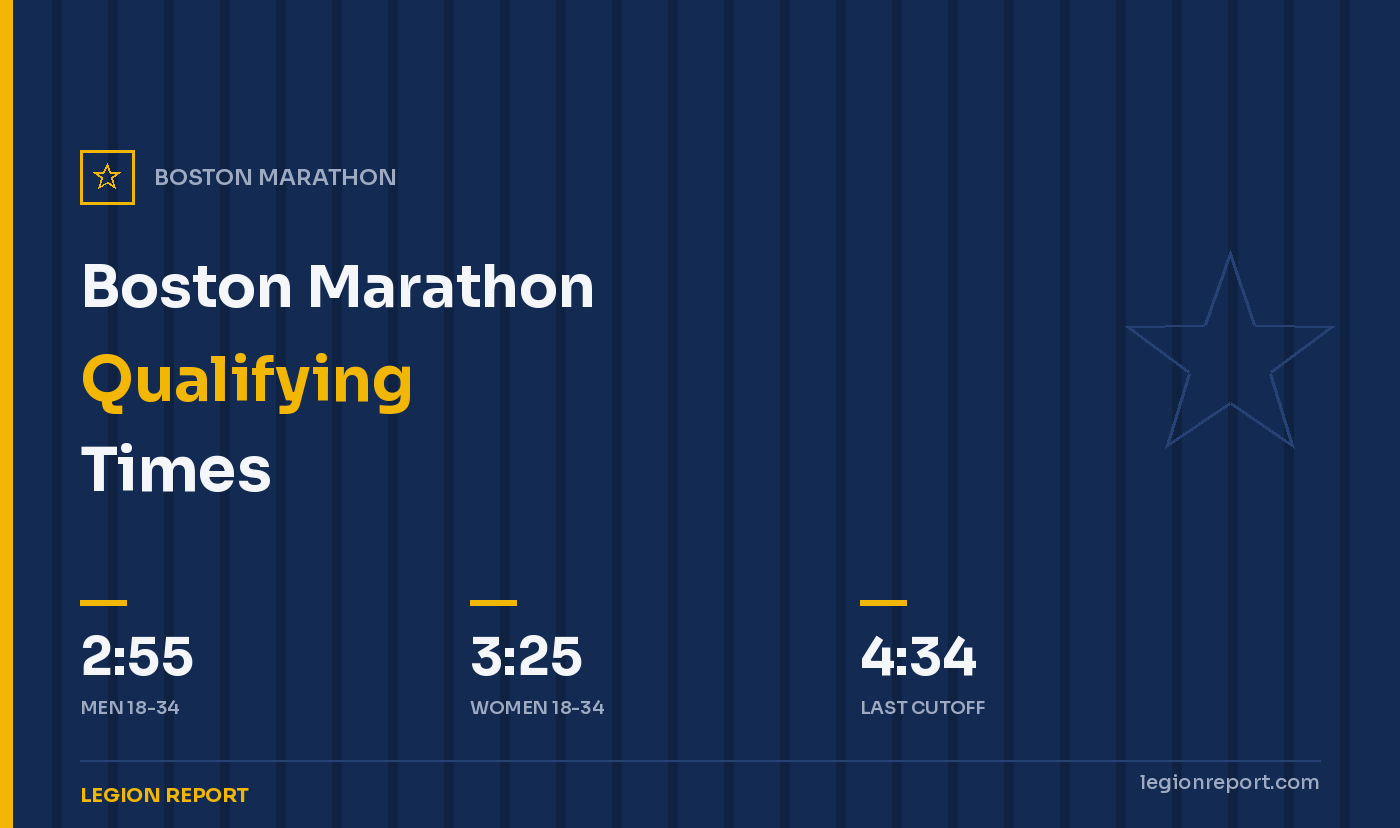
The current standards require men aged 18 to 34 to run 2:55:00 and women in the same group to run 3:25:00, with times graded upward through eleven age brackets to 80-plus. The same standards apply for the 2027 race. But the published time is only the door: because more qualifiers apply than the 30,000-runner field can hold, recent years have required beating your standard by an extra “cutoff” margin, 4:34 for the 2026 race. And those numbers are the latest chapter in a history that runs from a gentle sub-4:00 requirement in 1970 to a brutal 2:50 in 1980.
The chart below covers the Boston Marathon qualifying times: the full current standards by age group, how the standards have changed since 1970, the year-by-year cutoffs, and the key registration rules. Take a look, then we’ll break it all down.
The current standards
Boston Marathon qualifying times are set by the Boston Athletic Association across eleven age groups, with the standard based on your age on race day, not the day you qualify. The headline numbers: men 18 to 34 must run 2:55:00 or faster, women 18 to 34 must run 3:25:00, and the standards step upward from there in five-minute-style increments through the 80-plus bracket, with the women’s standard sitting 30 minutes above the men’s in every group. Non-binary athletes qualify using the women’s standards. The same times apply for both the 2026 and 2027 races.
These are the toughest standards in the race’s modern history. For the 2026 race, the BAA cut five full minutes from every age group under 60, the largest single tightening since 1990, after years in which even runners who hit the old standards were being turned away in the thousands. And the standards are now absolute: unlike earlier eras, when a 59-second grace applied, today not even one second over the time is accepted. A 2:55:01 for an open-division man is not a BQ.
The real bar: the cutoff
Here is the part that surprises newcomers: running your qualifying time does not get you into the Boston Marathon. It only earns you the right to apply. The field is capped at 30,000 runners, demand from qualifiers routinely exceeds that, and the BAA fills the race fastest-first: after the September registration window closes, applicants are sorted by how far under their standard they ran, and a “cutoff” emerges, the margin you needed to beat your own qualifying time by to actually get a bib.
That cutoff has become the true target. It was a modest 1:38 for the 2014 race, but demand pushed it steadily upward: 4:52 for 2019, a record 7:47 for the pandemic-shrunk 2021 field, 5:29 for 2024, and a brutal 6:51 for 2025, the number that finally prompted the BAA to toughen the standards themselves. Even under the harder 2026 standards, the cutoff was still 4:34. The practical advice in the running world has shifted accordingly: don’t train for the BQ, train for “BQ minus five” or better. The exceptions prove the pressure: only in 2022 and 2023, when post-COVID demand briefly dipped, was every qualifier accepted.
How the standards got here: 1970 to today
Qualifying times are almost as old as mass-participation running itself. Boston introduced the first standard in 1970, when growing fields forced organizers to cap entry: runners had to certify they could finish in under four hours. It lasted one year, demand exploded, and by 1971 the bar was 3:30. Women were officially admitted in 1972 (Nina Kuscsik winning the first sanctioned women’s race) under the same standard. Then came the running boom, and Boston responded with the most severe standards ever seen: by around 1980, an open-division man needed 2:50, and a woman 3:20, marks that would still be elite club-runner territory today.
The modern framework emerged as standards relaxed and age groups multiplied through the late 1980s, settling into the long, stable era of 3:10 for open men and 3:40 for open women that lasted from 1990 all the way to 2012. Then demand broke the system: the 2011 race famously sold out in eight hours, locking out thousands of qualifiers, and the BAA responded with the modern regime, five minutes off the standards and fastest-first rolling registration from 2013, another five-minute cut across all ages for 2020, and the latest tightening to 2:55/3:25 for 2026. Over 56 years, the open men’s bar has traveled from “under four hours” to nearly an hour faster.
The newest wrinkle: the downhill index
The BAA’s latest change targets not the times but the courses. Starting with registration for the 2027 race, qualifying times from heavily downhill marathons carry an automatic penalty, called an index: courses with a net elevation drop of 1,500 to 2,999 feet add 5:00 to your submitted time, courses dropping 3,000 to 5,999 feet add 10:00, and courses dropping 6,000 feet or more are ineligible entirely. The move closes a long-debated loophole in which gravity-aided “BQ factory” races offered a measurably easier path to the standard.
The ripple effects have been immediate: several famous downhill qualifiers have announced course changes to duck under the 1,500-foot threshold, and the standard advice for BQ hunters has shifted toward flat, certified, weather-reliable courses. The classic qualifying rules still apply alongside: your time must come from a certified marathon within the roughly year-long qualifying window (the 2027 window opened September 13, 2025), and it’s your official chip (net) time that counts.
What it all means for runners
Put together, the math of a modern BQ looks like this: find your age-group standard in the table above, then plan to beat it by five minutes or more, on a legitimate course, inside the window, and submit in September. For an open-division man, that means training for roughly 2:50, a 6:29-per-mile marathon; for an open-division woman, roughly 3:20, about 7:38 pace. It is intentionally hard: the qualifying system exists to keep the world’s oldest annual marathon, run every Patriots’ Day since 1897, both aspirational and achievable.
And that is exactly why the BQ retains its magic. Unlike the lottery-entry majors, Boston is earned on the clock, and the tightening standards have only raised the badge’s value. Roughly four out of five bibs still go to time qualifiers (the rest to charity and invitational entries), meaning nearly every runner streaming down Boylston Street in April ran their way there.
Final Word
Boston Marathon qualifying times currently range from 2:55:00 (men 18-34) and 3:25:00 (women 18-34) up the age brackets to 80-plus, the toughest standards of the modern era after the 2026 tightening, and history’s arc runs from the original sub-4:00 rule of 1970 through the savage 2:50 era of 1980 to today. Just remember the real rule of the modern BQ: the published time gets you an application; beating it by several minutes gets you to Hopkinton.