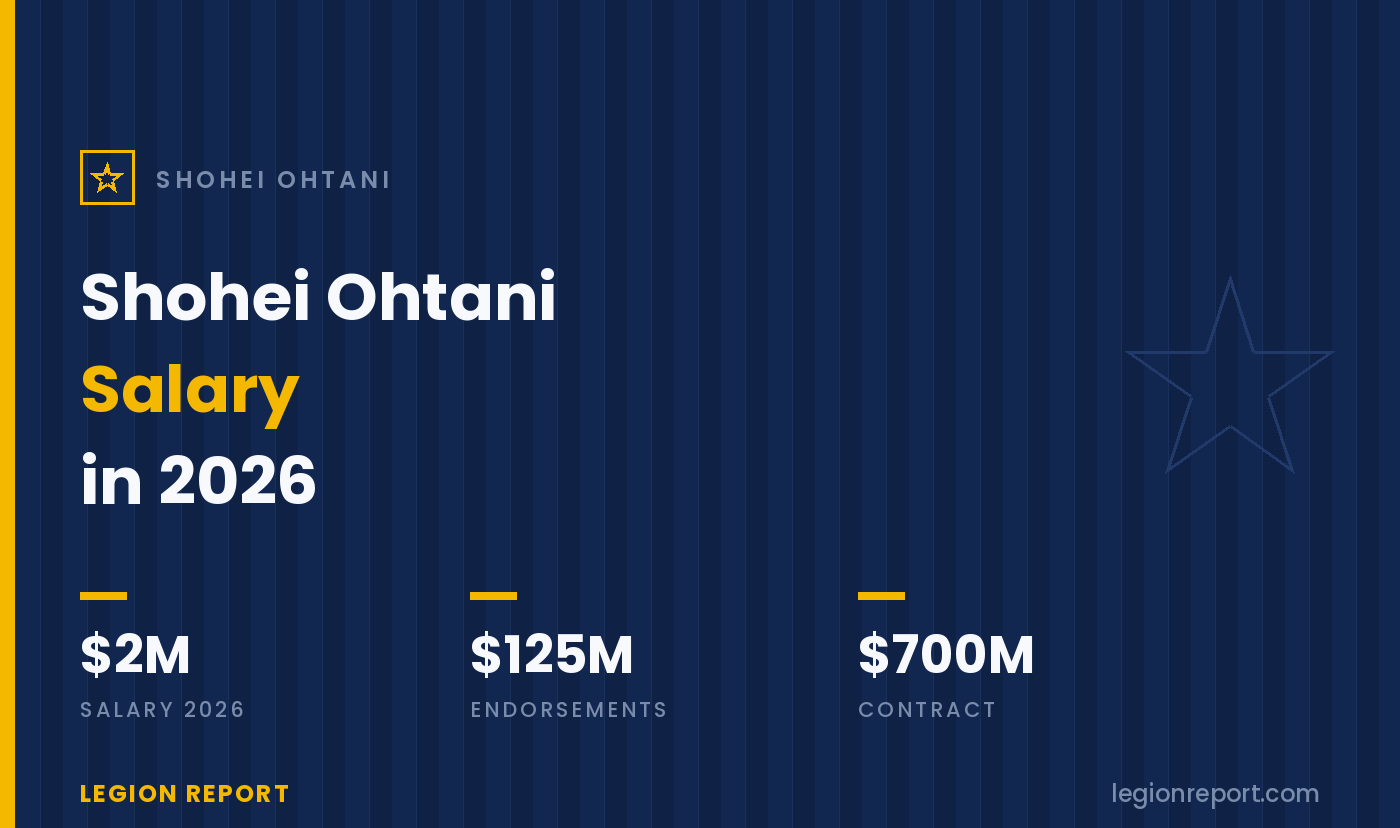

Shohei Ohtani holds the second-largest contract in the history of North American sports, a 10-year, $700 million deal with the Los Angeles Dodgers. And in 2026, his paycheck from that team is $2 million, less than 17 of his own teammates make. It’s the strangest arrangement in professional sports, and it’s entirely by design.
The trick is deferred money: Ohtani pushed $680 million of the deal, 97 percent of it, into the decade after the contract ends, so from 2034 through 2043 the Dodgers will pay him $68 million a year not to play. Meanwhile, his real 2026 income comes from everywhere else: roughly $125 million in endorsements, the largest off-field haul in baseball history and about ten times what any other MLB player earns off the diamond.
The chart below covers the full picture of Shohei Ohtani’s salary: his complete 2026 paycheck, the year-by-year contract structure, his career earnings all the way back to his Japan salaries with the Nippon-Ham Fighters, and how the deal stacks up against the rest of baseball. Take a look, then we’ll break it all down.
The $2 million paradox
Shohei Ohtani’s salary in 2026 is $2 million, the same figure it has been every season since he joined the Dodgers, and the same figure it will be through 2033. That ranks 17th on his own roster, behind teammates making a fraction of his headlines. Yet by any real measure he is the highest-paid player in baseball: adding his estimated $125 million in endorsement and off-field income, Ohtani will bank roughly $127 million in 2026, more than double the next player on the list and the largest single-year haul the sport has ever seen.
That inversion, tiny salary, enormous income, is the whole story of the Ohtani deal. When he signed his 10-year, $700 million contract in December 2023, he deferred $680 million of it, 97 percent, with no interest. During the playing years he collects $2 million annually; then, from 2034 through 2043, the Dodgers will cut him a $68 million check every year, most of it likely arriving after he has thrown his last pitch.
Inside the deferrals: $680 million on layaway
The deferral was reportedly Ohtani’s own idea, and the logic is straightforward: he doesn’t need the cash now. His endorsement income alone dwarfs any salary the Dodgers could pay him, so he converted his contract into two things: near-term payroll room for the front office to sign more stars, and a guaranteed $68 million-a-year retirement annuity. The plan worked almost immediately; the Dodgers used the flexibility to stack the roster that has since delivered back-to-back World Series titles.
The accounting is where it gets interesting. MLB’s luxury tax is charged on a contract’s average annual value, but heavily deferred dollars are discounted to present-day value. Ohtani’s $70 million-a-year deal therefore counts as only about $46 million against the Dodgers’ tax bill, and the true present value of the whole contract is roughly $460 million rather than $700 million. Nothing about the structure breaks the rules; the collective bargaining agreement places no limit on deferrals, and analysts note the same tools are available to all 30 teams. Ohtani may also benefit at tax time, since income deferred until after the contract ends could be received outside California, though tax experts have estimated the interest-free structure costs him tens of millions in present value.
Before the millions: the Japan years
Ohtani’s paychecks started small even by baseball standards. Taken first overall by the Hokkaido Nippon-Ham Fighters in the 2012 NPB draft, the team that famously sold him on the two-way experiment, he earned a reported 15 million yen as an 18-year-old rookie in 2013, roughly $150,000, while living in the team dormitory with his parents managing his finances. The raises came fast: he crossed the 100-million-yen mark in just his third season, one of the quickest climbs in Japanese baseball history, and after his 2016 Pacific League MVP and Japan Series title, his final 2017 salary reached a reported 270 million yen, about $2.4 million and among the very highest in NPB.
Then he took a massive pay cut to chase MLB. Because Ohtani left at 23, under baseball’s international rules for players younger than 25, he was treated like any amateur prospect: his bonus was capped, the Fighters collected a $20 million posting fee, and his first Angels salary of $545,000 was roughly a quarter of what Japan had been paying him. Five NPB seasons brought him around $5.5 million in total, more than his first five MLB seasons combined.
Career earnings: from $545,000 to the biggest AAV in baseball
The contract chart makes the deal look inevitable; the career chart shows how absurdly underpaid Ohtani was getting there. Because he came to MLB at 23, before international free agency rules would have let him command a market price, he signed with the Angels for a $2,315,000 bonus and a rookie-scale salary of $545,000 in 2018, a season in which he won Rookie of the Year. Through his first five seasons, including his unanimous 2021 MVP campaign at $3 million, he earned less than $10 million combined.
Arbitration finally caught up in 2023, when his record-setting $30 million salary became the largest ever for a third-year arbitration player. All told, Ohtani earned $42,269,259 across six seasons with the Angels, less than his current team pays him per year in deferrals, and his career MLB salary total through 2026 sits around $48 million. The other $680 million is coming; it just hasn’t been paid yet.
The endorsement empire
Off the field is where Ohtani has no peer. His roughly $125 million in 2026 endorsement, licensing, and memorabilia income is about ten times what the next-highest MLB player makes, a gap sports business analysts compare only to peak Usain Bolt’s dominance over track and field. He carries more than 20 brand partners split almost evenly between U.S. and Japanese companies, headlined by a New Balance deal structured more like an NBA superstar’s global shoe contract than anything traditional in baseball, alongside names like Fanatics, Seiko, Hugo Boss, Japan Airlines, and Kosé. Two straight World Series runs have only supercharged the machine, and he has sold more jerseys worldwide than any player since 2023.
Final Word
Shohei Ohtani’s salary in 2026 is $2 million from the Dodgers, roughly $127 million in total income, and a $68 million-a-year fortune quietly accruing for 2034 through 2043, all flowing from a $700 million contract that carries the highest average annual value in MLB history. He spent six years earning $42 million with the Angels, then structured the richest deal in baseball so that his team barely pays him at all, for now. The two-way player, it turns out, is also a two-era earner: modest checks while he plays, a second career’s worth of income after he stops.
The money story doesn’t stop at his paychecks, either — Ohtani’s earning power has spilled into the collectibles market, where his cards have surged right alongside his contracts. For that side of the empire, see our breakdown of Shohei Ohtani rookie card values.