
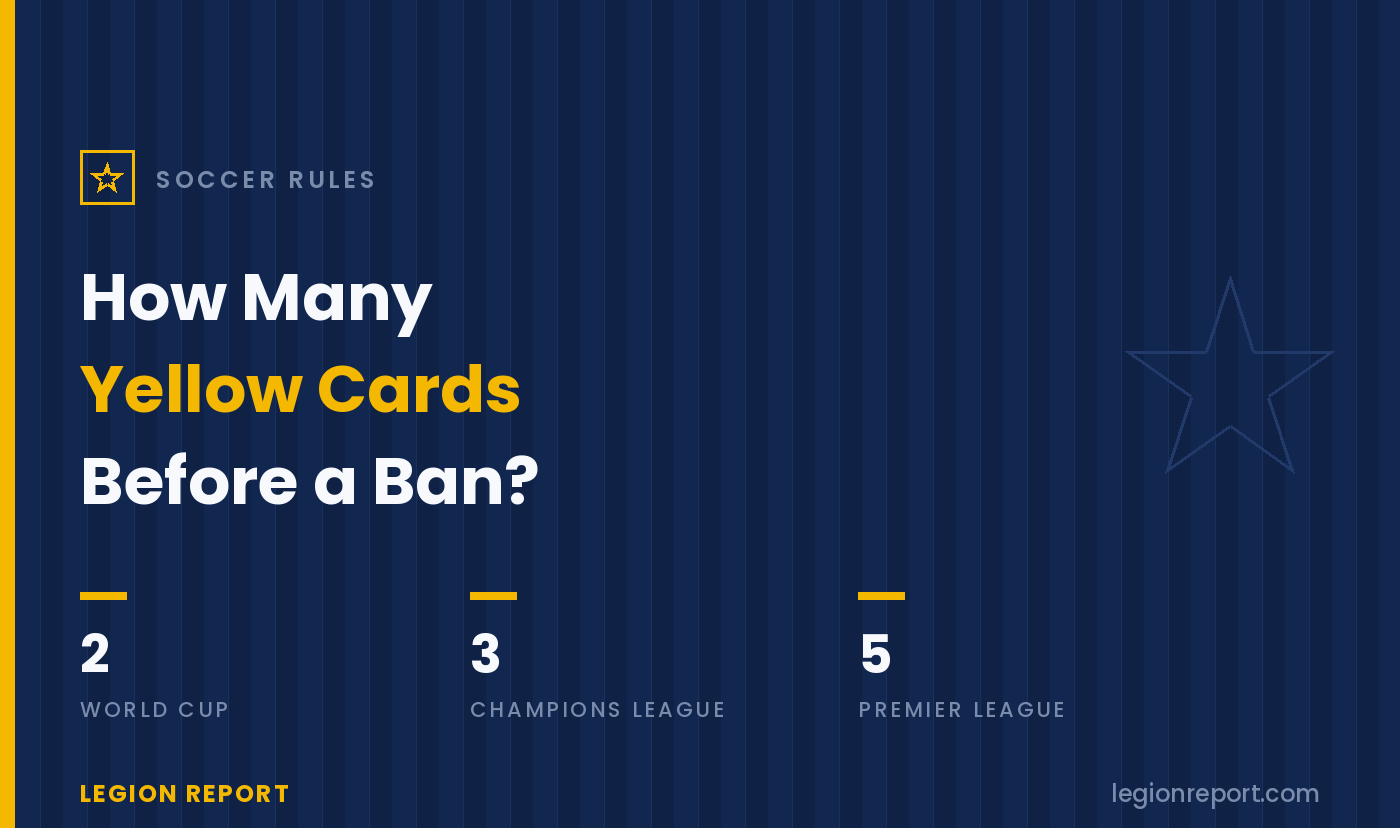

Every soccer fan knows two yellow cards in one match means a red. But the question that actually decides seasons, and World Cups, is the slower one: how many yellow cards across different matches before a player is suspended? The answer changes dramatically depending on where you’re watching. At the 2026 World Cup, playing out right now, just two bookings in separate games will cost a player a match. In the Champions League it’s three. In the Premier League and most domestic leagues, it’s five.
The details matter even more than the numbers: when the counts reset, which deadlines apply, whether cards carry between competitions, and what a red card costs on top. FIFA even rewrote its rules for this World Cup, wiping every player’s slate clean twice so that no one can miss the final through accumulated yellows.
The chart below covers the full picture: the suspension threshold in every major competition, the Premier League’s three-tier system, the World Cup 2026 rules, the Champions League math, MLS’s fine schedule, and what each type of red card costs. Take a look, then we’ll break it all down.
The universal rule: two in one game
Start with the piece that never changes. In every competition on Earth playing under the Laws of the Game, a player shown two yellow cards in the same match is sent off, and the resulting suspension is treated like a red card: an automatic one-match ban, usually with no right of appeal on the bookings themselves. Everything else about yellow cards, how many across separate matches trigger a ban, when the count resets, and what deadlines apply, is left to each league and tournament to decide. That’s why the honest answer to “how many yellow cards before suspension?” is: it depends on the badge on the ball.
The Premier League: five, ten, fifteen
England runs the most elaborate accumulation system in the sport, a three-tier structure with deadlines. Five yellow cards within your team’s first 19 league matches brings a one-match ban. Reach 10 by the club’s 32nd match and it’s a two-match ban. Hit 15 at any point in the season and it’s three matches, and a theoretical 20th booking would put the player in front of an FA regulatory commission, though nobody has ever come close: the single-season record is 14. The deadlines are the strategic wrinkle. A player sitting on four yellows can simply survive until his team’s 20th match, at which point the five-card threshold expires and those bookings can never trigger a ban.
Two more details trip up casual fans. Premier League yellow cards count only in the Premier League; bookings in the FA Cup or League Cup live on separate tallies, and accumulation bans can only be served in the competition where they were earned. Red cards are the opposite: those suspensions carry across all English domestic competitions. And a suspension doesn’t reset the count; a player banned at five yellows keeps climbing toward 10 the moment he returns.
The World Cup, right now: two cards and a double wipe
International tournaments are far stricter, and the 2026 World Cup’s rules are being stress-tested as you read this. Two yellow cards in separate matches means a one-match suspension, the trap that has cost stars semifinals for decades. What’s new this summer is the reset schedule: with the expanded 48-team field and its extra Round of 32, FIFA now wipes every player’s card count twice, once after the group stage and again after the quarterfinals. The design goal is simple: no player can ever miss a World Cup final because of accumulated bookings. The exposed stretch is the early knockouts; a booking in the Round of 32 followed by another in the Round of 16 rules a player out of the quarterfinal.
This tournament also added two brand-new red-card offenses, covering your mouth during a confrontation with officials and deliberately leaving the field to protest a call, and handed VAR the power to overturn mistaken second-yellow send-offs. Yellow cards from qualifying were forgiven at the tournament’s start; unserved red-card bans were not.
Europe’s midweek math: three, then every other
The Champions League (along with the Europa and Conference Leagues) uses the tightest club threshold: a one-match ban at three yellow cards, then another after every subsequent odd-numbered booking, the fifth, seventh, ninth and so on. Like FIFA, UEFA wipes all yellows after the quarterfinals so accumulation can never keep a player out of a final, and everything expires at season’s end. A red card in any UEFA club competition, meanwhile, carries at minimum a one-match ban that applies across all of them, and UEFA’s disciplinary bodies can extend it for serious offenses.
MLS: the only league that pays you back
Major League Soccer pairs its five-yellow threshold with two American twists. First, money: each accumulation ban comes with a fine that escalates from $250 at five cards to $1,000 by 13, doubling with each suspension after that. Second, forgiveness: MLS is the only major league with a good-behavior incentive, erasing one yellow card from a player’s total for every five consecutive matches played clean. Counts also reset ahead of the playoffs and again before MLS Cup, so no one enters the final carrying regular-season baggage.
Final Word
How many yellow cards before a suspension? Two at the World Cup, three in the Champions League, five in the Premier League, La Liga, Serie A, the Bundesliga, and MLS, and always two in a single match, anywhere. The fine print is where games are won: England’s expiring deadlines, FIFA and UEFA’s quarterfinal wipes, and MLS’s five-match forgiveness rule all exist to balance discipline against the sport’s horror of a star missing a final over an accumulation technicality.
Suspensions are only the end of the card story — the beginning is what earns a booking in the first place. For every offense that draws a caution or a sending-off, see our full guide to yellow and red cards in soccer.