

A red card is supposed to be final: off the pitch, banned for the next match, no arguments. Except sometimes the arguments win. Hours before the biggest American soccer match in a generation, FIFA freed USMNT striker Folarin Balogun from his red-card suspension, clearing him to face Belgium in Monday’s Round of 16 after one of the most disputed sending-offs in recent World Cup history. Fans had spent days chanting “Free Balo.” FIFA, using a little-known clause called Article 27, effectively did.
The Balogun reprieve is the newest entry in soccer’s strangest small genre: the overturned red card. It’s a genre with rules most fans have never heard, cards undone by mistaken identity, by appeal panels, by VAR mid-match, and now by a “suspended suspension”, and a genre the World Cup itself almost never participates in, which is exactly why today’s decision has Belgium’s federation publicly astonished.
The chart below covers the whole story: the Balogun timeline, every mechanism that can undo a red card, the famous rescinded reds, the infamous ones that stood, and what today means for a tournament already setting red-card records. Take a look, then we’ll break it all down.
What actually happened today
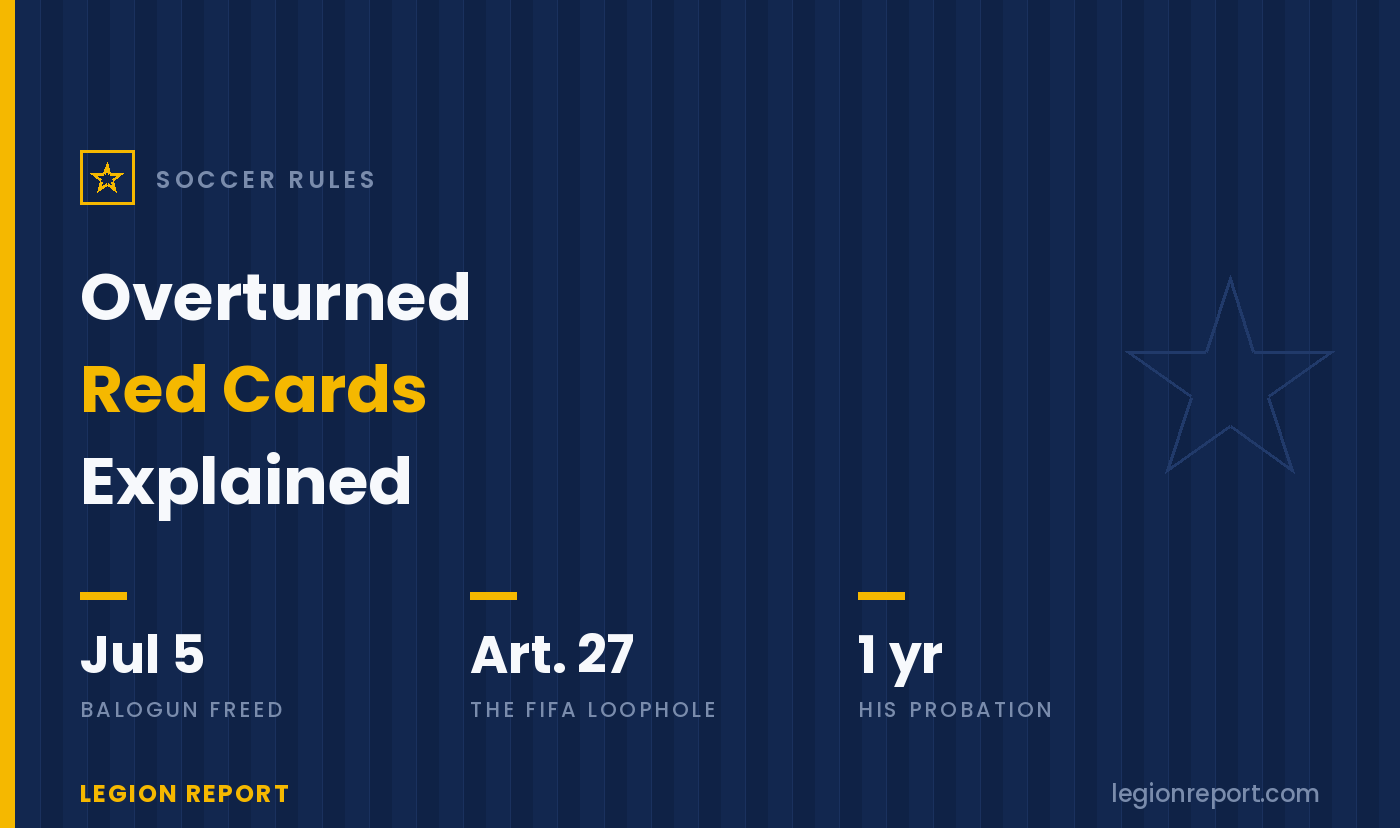
Start with the precise mechanics, because the headlines flatten them. Folarin Balogun was sent off in the USA’s 2-0 Round of 32 win over Bosnia and Herzegovina after a VAR-recommended review of what replays showed to be accidental contact with a defender’s ankle, a decision a former elite referee publicly called wrong, arguing VAR misused slow-motion replays that make any contact look violent. For three days there was no recourse: FIFA confirmed no appeal process exists for a referee’s judgment call at a World Cup. Then on Sunday, July 5, FIFA’s Disciplinary Committee reached for Article 27 of its Disciplinary Code, which allows the body to “fully or partially suspend the implementation of a disciplinary measure.” The red card still stands on the record; the one-match ban attached to it is paused under a one-year probation, if Balogun commits a similar offense in that window, the ban returns with interest. The practical effect: the USA’s three-goal leading scorer plays Belgium on Monday in Seattle. Belgium’s federation announced itself “astonished” and is contesting the decision’s logic publicly.
The ways out of a red card
Soccer has exactly four escape routes from a red card, and most fans only ever see the first. VAR can undo one in real time, the referee reviews the monitor and downgrades the card before play resumes. Club competitions offer the formal appeal: the Premier League’s “wrongful dismissal” claim has rescinded famous reds, including Son Heung-min’s 2019 sending-off after Andre Gomes’ gruesome injury, when the FA accepted that a tragic outcome didn’t make the tackle a crime. Mistaken identity provides the strangest route: in 2014, referee Andre Marriner sent off Arsenal’s Kieran Gibbs for a goal-line handball actually committed by Alex Oxlade-Chamberlain, and the FA simply transferred the ban to the correct player. And then there’s the fourth route, the one that mattered today: FIFA’s Article 27 suspended sanction, previously best known for freeing Cristiano Ronaldo, whose red card in a 2025 World Cup qualifier drew a multi-match ban that FIFA trimmed with the remainder suspended on probation, conveniently clearing him for Portugal’s World Cup opener. That Ronaldo precedent is precisely the mechanism, and the controversy, FIFA reached for with Balogun.
Why the World Cup almost never does this
The reason today feels historic is that World Cup discipline has traditionally been a one-way ratchet. Zidane’s 2006 final headbutt stood as the last act of his career. Beckham in 1998 and Rooney in 2006 served every minute of their bans while England went out. Luis Suarez’s 2014 bite went the other direction entirely, no card during the match, then a four-month retrospective ban. Even this tournament had set the expected tone: South Africa’s Themba Zwane saw his group-stage red card ban extended to three matches under the violent-conduct article. Harsher on review, never softer, that was the norm, and it’s why FIFA’s own initial answer to the Balogun outcry was that nothing could be done. The Article 27 reversal, arriving the day before the match, with the U.S. federation confirmed to have been “engaged in the process,” is the first time a World Cup knockout ban has been walked back this way mid-tournament. Belgium’s astonishment isn’t just gamesmanship; it’s a recognition that a precedent was set today, and nobody’s sure yet what it covers.
The context that made it combustible
None of this happens in a vacuum. The 2026 World Cup is the most card-happy in history, its first 27 matches produced more red cards than the entire 2018 or 2022 tournaments, putting the all-time record of 28 (set in 2006) in genuine danger, with players sent off for everything from last-man fouls to covering their mouths while talking to opponents. Balogun’s card became the movement’s face partly through sheer narrative excess: he was the first player to score and be sent off in a World Cup knockout match since Zidane in the 2006 final, an absurd statistical pairing for an accidental ankle clip. “Free Balo” went from meme to t-shirts to, apparently, FIFA’s docket. Monday’s match against Belgium now arrives with its own subplot pre-installed: the restored striker, the aggrieved opponent, and a disciplinary precedent that every federation in the tournament just added to its playbook.
Final Word
Overturned red cards, explained: they’re rare by design, rarer at the World Cup than anywhere, and they travel four routes, VAR in the moment, the club-level appeal, mistaken identity, and FIFA’s Article 27 suspended sanction, the once-obscure clause that freed Ronaldo before the tournament and freed Balogun today, on the eve of USA-Belgium. The card stays on the record; the punishment waits on probation; and a World Cup already breaking red-card records has now broken new disciplinary ground too. Whether today’s decision was justice for a wrongful red or a door FIFA will regret opening depends, as ever, on which federation you ask.
The machinery behind all of it lives in our rules library: what happens after a red card, the two-yellows version in the double yellow card explained, and the offense that produces the most debated reds of all in DOGSO explained.