

Until this weekend, Article 27 of the FIFA Disciplinary Code was a paragraph only lawyers had read. Then FIFA used it to free Folarin Balogun, the USMNT’s leading scorer, from a red-card suspension on the eve of the Round of 16, and four sentences of legal boilerplate became the most argued-about text at the World Cup. Belgium is astonished, American fans are ecstatic, and everyone else is asking the same question: what is this rule, and how does it let FIFA un-suspend a suspended player?
The short answer: Article 27 is FIFA’s “suspended sentence” power, borrowed straight from criminal law. It lets FIFA’s judicial bodies pause any punishment and replace it with probation, the sanction still exists, it just doesn’t get served unless the player reoffends. It comes with a one-to-four-year probation window, one absolute exception, and, controversially, no stated criteria at all for when FIFA may use it.
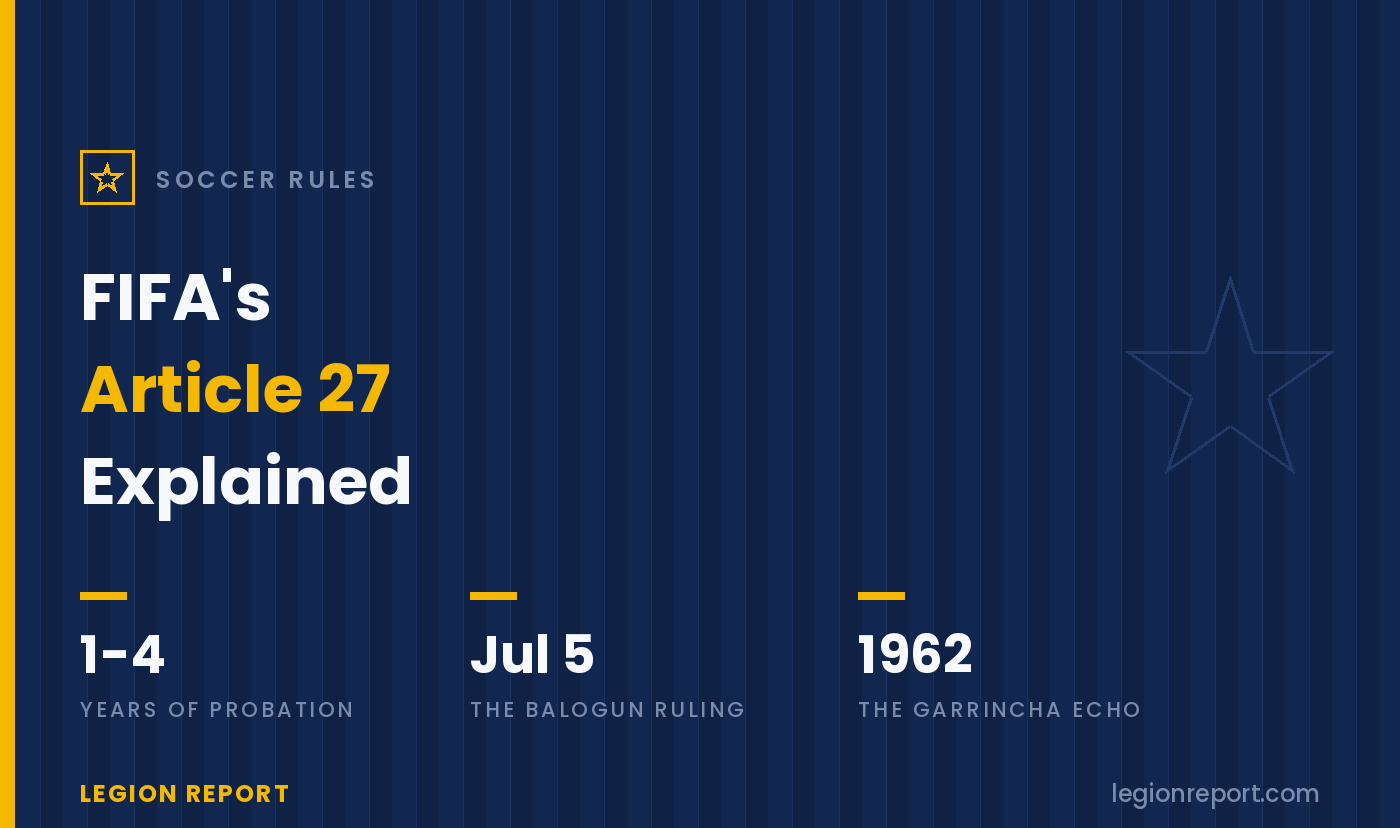
The chart below covers the whole rule: the four clauses in plain English, exactly how it was used for Balogun today, the legal fight Belgium is picking, the precedents from Garrincha to Ronaldo, and the fine print everyone’s now studying. Take a look, then we’ll break it all down.
What Article 27 actually says
Article 27, titled “Suspension of implementation of disciplinary measures,” runs four clauses. One: FIFA’s judicial bodies, the Disciplinary Committee and Appeal Committee, “may decide to fully or partially suspend the implementation of a disciplinary measure.” Two: doing so places the sanctioned person on probation of one to four years. Three: if the person “commits another infringement of a similar nature and gravity” during probation, the suspension is revoked and the original sanction enforced, on top of whatever new punishment the fresh offense earns. Four: sanctions for match manipulation can never be suspended, the code’s one untouchable category. The design is borrowed from criminal law’s suspended sentence: the conviction stands, the punishment hangs. What the article conspicuously does not contain is any test for when FIFA may use it. No criteria, no thresholds, no procedure for requesting it. The discretion is the entire rule, which is precisely what this weekend turned into a controversy.
How it freed Balogun today
Balogun’s situation was legally sealed until Sunday. His VAR-driven red card against Bosnia carried an automatic one-match ban under Article 66.4, “a sending-off automatically incurs suspension from the subsequent match”, and FIFA had confirmed no appeal exists against a referee’s judgment call at a World Cup. Article 27 was the door nobody was guarding. On July 5, the Disciplinary Committee invoked it: per FIFA’s statement, “the implementation of the match suspension is suspended for a probationary period of one year,” revocable if Balogun commits a similar offense in that window. Note the precision of what happened: the red card was not overturned, the tackle was not re-judged, and no one ruled the referee wrong. FIFA suspended the punishment, not the verdict. Balogun’s card stays on his record; his ban waits in escrow; and the USA’s three-goal leading scorer faces Belgium on Monday in Seattle with a quarterfinal, the Americans’ first since 2002, on the line.
Belgium’s objection, and the politics
The Royal Belgian FA’s “astonished” statement is really a legal brief. It cites Article 66.4’s automatic ban and Article 10.5 of the World Cup’s own Competition Regulations, which repeats it, arguing the ban wasn’t FIFA’s to waive. FIFA’s answer runs through Article 7.1 of those same regulations, which defers all disciplinary matters to the Disciplinary Code, where Article 27 lives, meaning the discretionary power sits above the automatic ban. Belgium’s sharper point is the one the code can’t answer: Article 27 names no circumstances for its use, so its invocation the day before a host nation’s biggest match in a generation looks, at minimum, unbounded. The political weather made everything louder: the U.S. President publicly thanked FIFA for “reversing a great injustice,” amid reporting that he had personally contacted FIFA’s president, while FIFA maintains the committee is independent and the decision rests entirely on Article 27’s established powers. Both things can be true; neither can be proven from outside. What’s certain is that every federation at this tournament just learned a new phone number to call.
Garrincha, Ronaldo, and the precedent question
FIFA’s defenders point out the tool has history. The closest ancestor is glorious: at the 1962 World Cup, Garrincha, carrying Brazil almost alone, was sent off in the semifinal, had his ban rescinded, and played and won the final, a 64-year-old rhyme with this weekend that Brazilian papers noticed immediately. The direct modern precedent is Cristiano Ronaldo in 2025: a red card in a World Cup qualifier drew a multi-match ban that FIFA trimmed with the remainder suspended on probation, conveniently clearing him for Portugal’s opening match of this very tournament, the exact Article 27 mechanics later applied to Balogun. But the counter-precedent came at this same World Cup: FIFA extended South Africa’s Themba Zwane’s red-card ban to three matches in the group stage. Harsher for one player, merciful for another, with no published criteria distinguishing them, that inconsistency, more than any single ruling, is what legal observers expect FIFA will eventually be forced to codify.
Final Word
Article 27, explained: FIFA’s suspended-sentence power, four clauses that let its judicial bodies pause any punishment (except match-fixing) in exchange for one to four years of probation, with the guilt intact and the sanction revivable on reoffense, and with no stated rules for when it applies. Today it freed Folarin Balogun for USA-Belgium, following the Ronaldo precedent and echoing Garrincha’s 1962 reprieve, over Belgium’s formal astonishment and beneath a swirl of presidential politics. The rule is old; its fame is one day old. However Monday’s match ends, Article 27 has entered soccer’s vocabulary, and probably, before long, its reform agenda.
This is the legal deep-dive behind our news piece on overturned red cards; the ordinary machinery it bypassed lives in what happens after a red card, and the accumulation system it doesn’t touch in how many yellow cards before a suspension.