
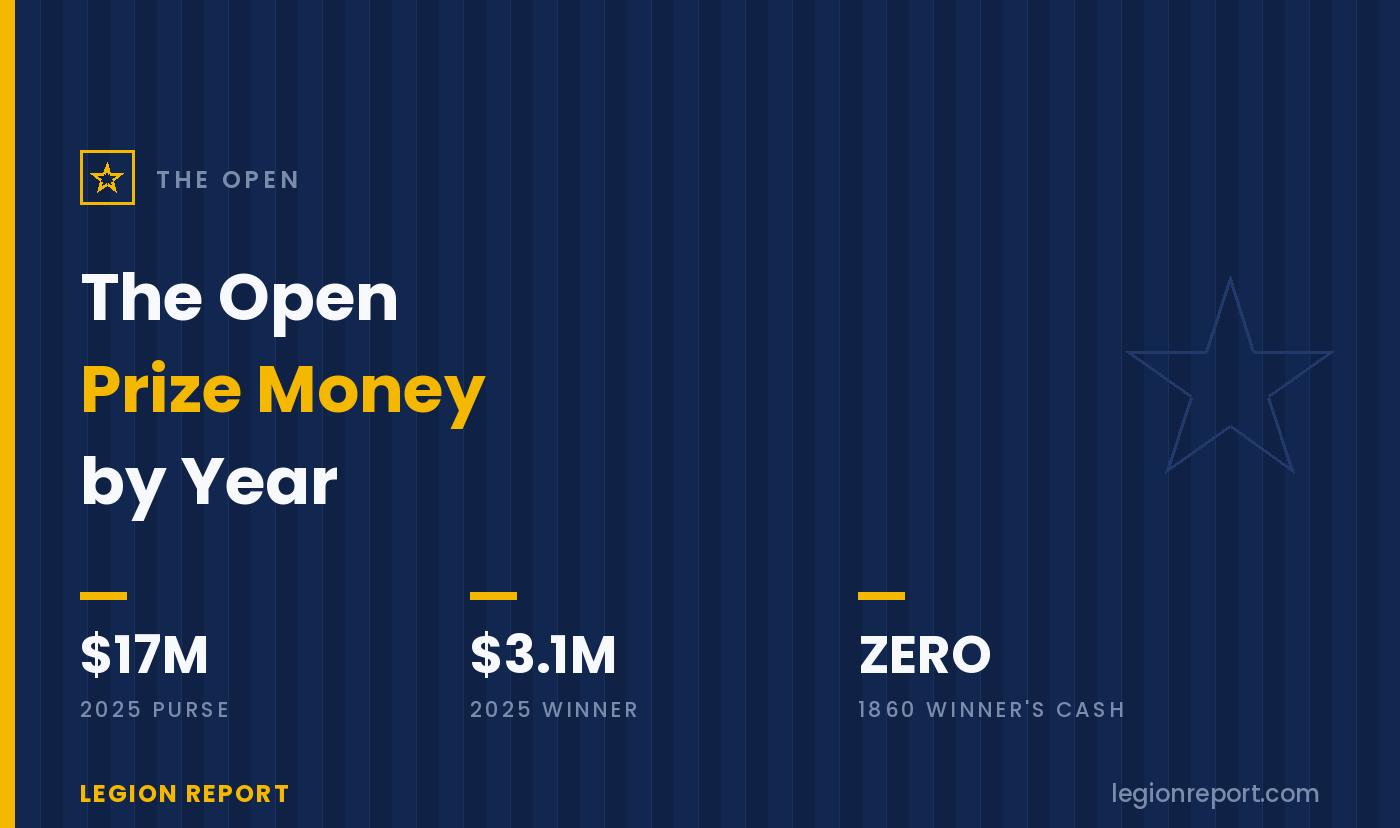

The winner of the 2025 Open Championship earned $3.1 million from a total purse of $17 million, numbers worth holding against the championship’s origin: the first Open, in 1860, paid its winner nothing at all. Not a reduced sum, nothing, the champion received a red leather belt to hold for a year, and when modest prize money arrived a few years later, the winner initially still got only the belt while the cash went to the runners-up.
The 166-year journey between those two figures tracks the entire economic history of professional golf: decades of pocket-change purses, the television inflection, the Tiger boom, and the modern majors arms race that pushed the jug’s payday past $3 million. The 2026 purse at Royal Birkdale will be announced championship week, and this page updates the moment it is.
The chart below covers the current numbers, the recent year-by-year purse growth, the historical milestones, how The Open pays against the other majors, and where the rest of the money goes. Take a look, then we’ll break it all down.
From a belt to $3.1 million
The Open’s prize history starts with a number that stuns modern readers: zero. The 1860 champion received the Challenge Belt, custody, not cash, and when a prize fund first appeared in 1863 (£10 total), it went to the runners-up while the winner still took only the belt; the champion’s first actual payment, £6, arrived a year later. That pricing of prestige above money set the tone for a century in which Open champions kept their day jobs as club professionals and greenkeepers, and the purse crawled upward at working-wage pace until television bent the curve in the 1960s and 70s. The modern ledger runs through the 2017 switch to US dollars, a quiet acknowledgment of where professional golf’s economy lives, and the 2022-25 arms-race years, when every major supersized in response to golf’s league wars, landing the purse at $17 million and the winner’s share at $3.1 million by 2025.
How the money is built, and the R&A’s restraint
The purse’s architecture reflects the championship’s open-door identity. Every player making the cut is paid down to last place; amateurs, by rule, take nothing (the low amateur receives the Silver Medal instead, one of golf’s most cherished non-payments); and, unusually among marquee events, The Open pays players who miss the cut a set amount, meaning the club pro who survives Final Qualifying leaves Birkdale with real money even after a Friday exit. Against the other majors, The Open has historically run the most conservative purse of the four, a philosophical choice as much as an economic one: the R&A publicly steers championship revenue into global golf development rather than winner’s-check maximalism, betting, correctly, that nobody has ever chosen a major by payday. All four majors now live in the same $17-21M neighborhood; parity, not hierarchy, is the modern story.
The 2026 number, and what to watch
The Royal Birkdale purse follows the R&A’s usual rhythm: announced during championship week, typically with a modest rise on the prior year, and this page’s top row updates the day it drops, with the winner’s share confirmed by Sunday night. The subtext worth watching in 2026 is the same as the last three years, whether the majors keep escalating in step or the purse race plateaus, and the eternal footnote holds regardless: the champion’s most valuable earning remains the year with the jug, the gold medal, and a title, Champion Golfer of the Year, that has never had a price. The belt-to-millions arc is complete; the annual increments are just interest.
Final Word
Open Championship prize money by year: from the cash-free Challenge Belt of 1860 and the £6 first winner’s payment, through a century of working-wage purses, the TV inflection, the 2017 dollar switch, and the majors arms race, to 2025’s $17 million purse and $3.1 million winner’s share, with missed-cut payments and an unpaid Silver Medalist preserving the championship’s open-door soul. The 2026 figure lands during Birkdale week, and the top row above updates the moment it does.
What the money can’t buy is explained in the Claret Jug explained, everyone who’s earned it is listed in Open winners by year, and tennis’ equivalent ledger is in Wimbledon prize money by year.