
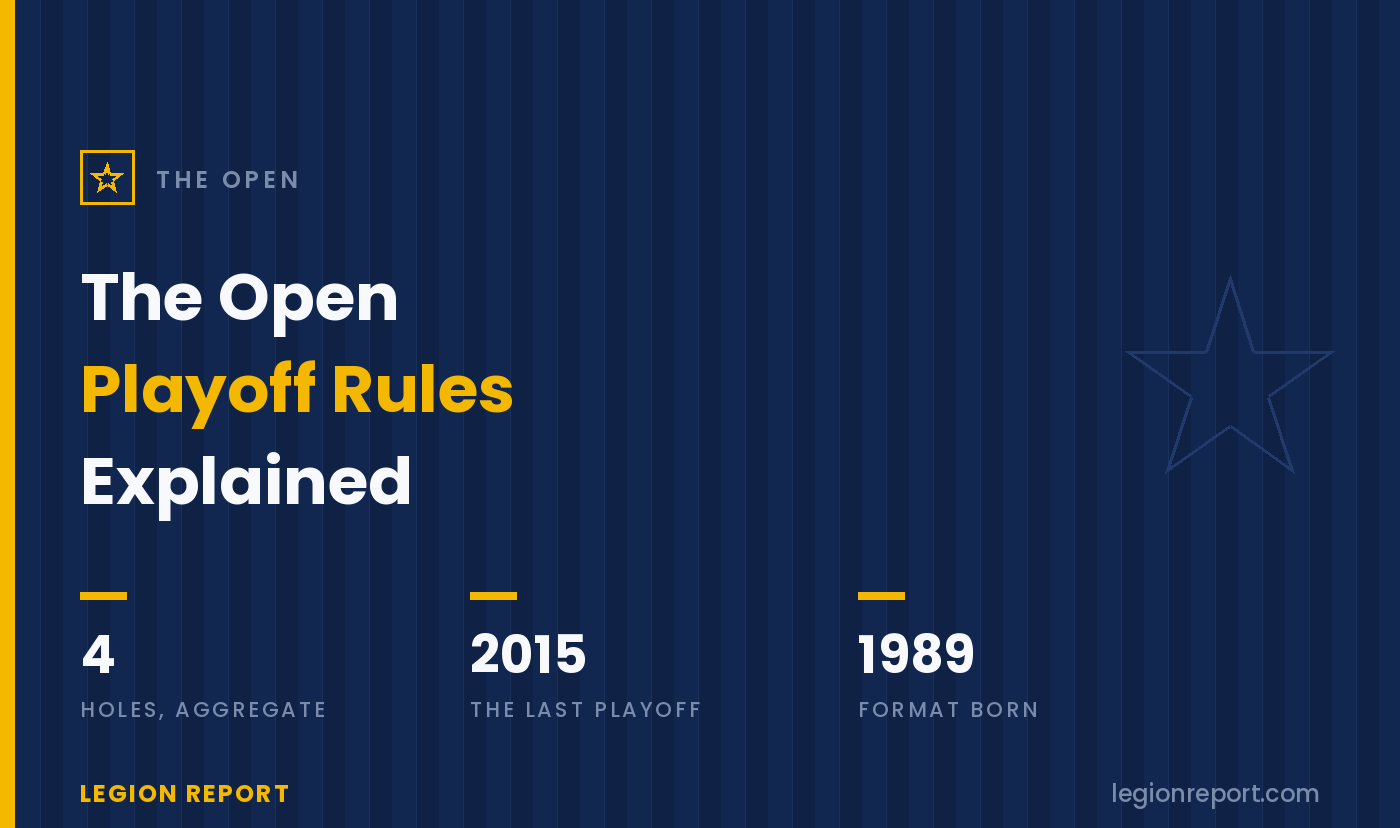

If the Open Championship ends in a tie on Sunday, there’s no Monday round, no sudden-death coin flip, and no shootout at a single hole. The Open settles its ties with a format unique among golf’s majors: a four-hole aggregate playoff, played immediately, over a set stretch of the host course, lowest total score over the four holes wins, with sudden death only if the deadlock somehow survives all four.
It’s golf’s best-calibrated tiebreaker, long enough to resist flukes, short enough for Sunday twilight, and it’s rarer than fans assume: The Open hasn’t needed a playoff since 2015, the longest such drought in the event’s modern history. Which means if Royal Birkdale produces one on July 19, an entire generation of viewers will be googling exactly how it works, mid-broadcast.
The chart below has it all ready: the format rules, how each major settles ties differently, every Open playoff of the modern era, and the format’s greatest hits. Take a look, then we’ll break it all down.
The four-hole logic
The Open’s playoff format is a deliberate middle path. Sudden death (the Masters’ method) is thrillingly fast but decides majors on single bounces; the old 18-hole next-day round was rigorous but crowned champions on Monday afternoons in front of emptying grandstands, a tradition The Open abandoned in 1989 and the US Open, the last holdout, finally dropped in 2018. Four holes, aggregate score, played immediately over an R&A-designated stretch of the host course, is the calibration between them: long enough that one bad swing isn’t fatal (a double bogey can be out-scored across the remaining holes), short enough to finish in Sunday light, and identical whether two players tie or five do. Only if the aggregate itself ends level does the championship go to sudden death, hole by hole, a fail-safe that has been needed just once, when Ernie Els finally shook Thomas Levet at Muirfield in 2002 after a four-man playoff.
Nine playoffs, and the ghosts inside them
Since Mark Calcavecchia christened the format at Troon in 1989 (over a Greg Norman who’d opened the playoff with birdies and lost anyway, the aggregate giveth and taketh), the four-holer has produced a disproportionate share of Open lore. John Daly’s 1995 win at St Andrews came only after Costantino Rocca’s miracle putt from the Valley of Sin forced it; Paul Lawrie’s 1999 title at Carnoustie exists because of Jean Van de Velde’s 72nd-hole collapse, the most famous unraveling in golf; Padraig Harrington outlasted Sergio Garcia at the same course in 2007; and Stewart Cink’s 2009 win at Turnberry, over a 59-year-old Tom Watson who had stood one par from the greatest story in sports history, remains the format’s cruelest afternoon. Royal Birkdale owns exactly one: Mark O’Meara over Brian Watts in 1998, worth knowing before the 19th.
The drought, and Sunday at Birkdale
Here’s the live angle: The Open hasn’t gone to a playoff since Zach Johnson beat Louis Oosthuizen and Marc Leishman at St Andrews in 2015, comfortably the longest gap of the four-hole era (nine playoffs in the format’s first 27 years, zero in the decade since). Every Open in between, Stenson’s 63, Spieth’s Birkdale escape act, Lowry’s Portrush coronation, through Scheffler last July, was settled in regulation. Statistically overdue is a superstition, not a forecast, but the practical takeaway isn’t: if the 154th Open reaches Sunday evening tied, the broadcast will pivot instantly to a format most casual fans have never actually seen used, four designated Birkdale holes, total score, winner takes the jug. Now you’re ahead of the commentary.
Final Word
The Open playoff format, explained: a four-hole aggregate playoff, played immediately after regulation over holes designated by the R&A for each venue, lowest total wins, sudden death only if still tied, golf’s longest aggregate tiebreaker and its best-calibrated one, introduced in 1989 to kill the Monday marathon. Nine playoffs since (Calcavecchia to Zach Johnson, via Van de Velde’s gift and Watson’s heartbreak), none in over a decade, and one prior at Birkdale itself. If Sunday, July 19 ends in a tie, this is exactly what happens next.
The champions these playoffs crowned are in Open winners by year, what the survivor lifts is in the Claret Jug explained, and what they bank is in Open prize money by year.