
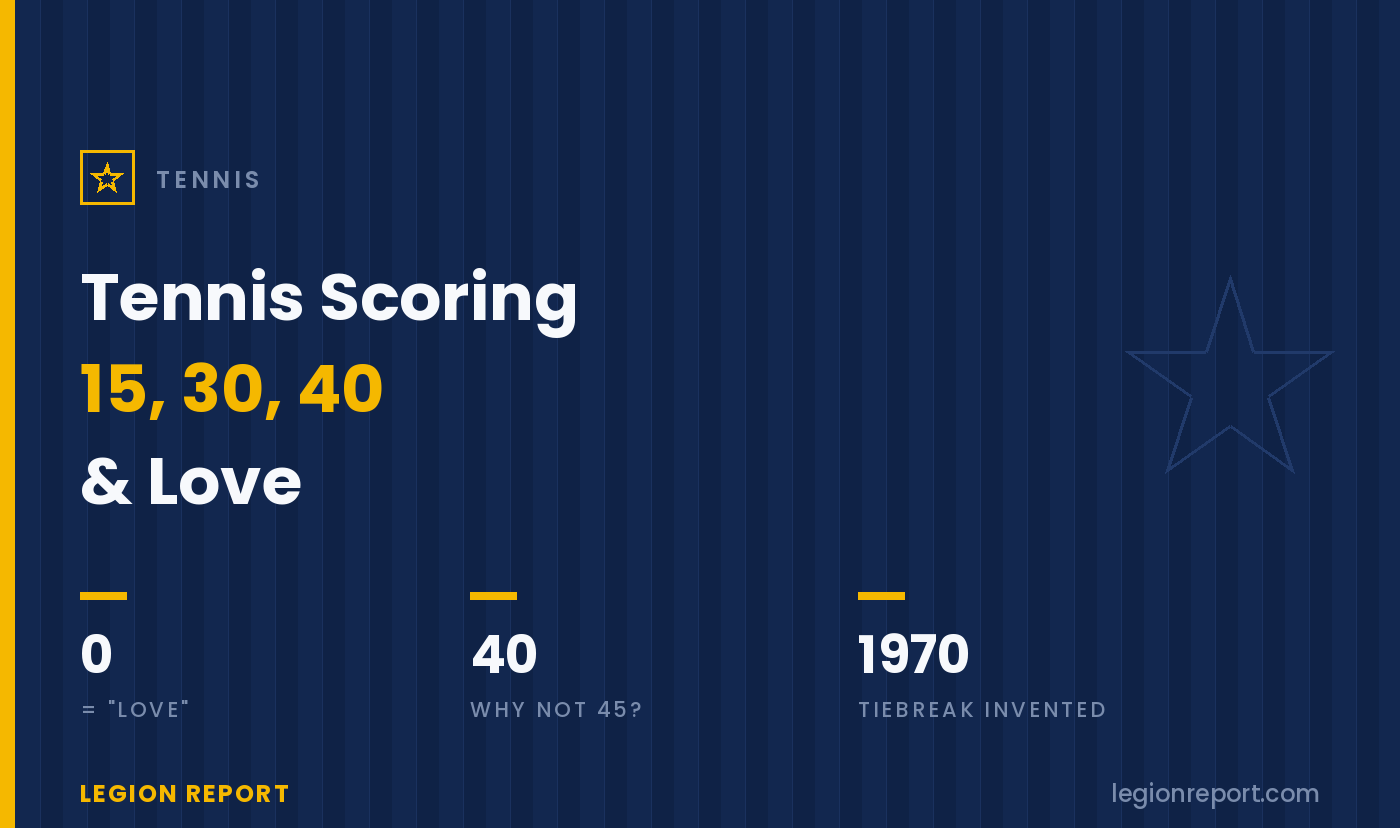

Tennis is the only major sport where the score goes 15, 30, 40, where zero is called “love,” where a tie at 40 is called “deuce,” and where nobody alive can tell you with certainty why. The scoring system is a 600-year-old inheritance from medieval France, so old that its original logic is genuinely lost, leaving historians with competing theories, a missing number (why 40 and not 45?), and a vocabulary that every new fan has to decode mid-match.
The system itself, once decoded, is elegant: points build games, games build sets, sets build the match, with a win-by-two demand at every level that guarantees no champion ever backs into anything. And its one modern addition, the tiebreak, was invented by a single impatient American in living memory.
The chart below decodes everything: how the scoring ladder works, the 15-30-40 origin theories, the “love” and “deuce” etymologies, the tiebreak’s story, and a cheat sheet for every term you’ll hear this weekend. Take a look, then we’ll break it all down.
The machine: points, games, sets, and the win-by-2 soul
Strip away the medieval vocabulary and tennis scoring is a clean three-story ladder. Points build a game (love, 15, 30, 40, game, with a tie at 40 called deuce, from which you must win two straight points: one for “advantage,” one for the game, slipping back to deuce endlessly until someone does). Games build a set: first to six, win by two, with a tiebreak at 6-6. Sets build the match: best of three, or best of five in men’s Grand Slams. The score is always called server-first (“30-15” means the server leads), and the win-by-two demand at every level is the system’s deepest feature: tennis has no clock, so no lead can be run out and no champion can back in, every match, set, and game must be won, on a final point, by the winner. It’s why the sport produces more genuine comebacks than any scoreboard game, and why “match point saved” is its signature drama.
The mystery: 15, 30, 40, love, and the lost logic
Why those numbers? The honest answer, rare for a sports explainer, is that nobody knows, because tennis inherited its scoring from jeu de paume, the palm-struck ancestor game of 15th-century France, and the original reasoning died unrecorded. The leading theory is the clock face: scores tracked at quarter-marks, 15, 30, 45, 60, with 45 later becoming 40, either as spoken shorthand (quarante beats quarante-cinq) or, more cleverly, to make room for advantage at 50 before game at 60. Rival theories involve medieval gambling stakes denominated in 15-denier units and early versions where players physically advanced 15 feet per point won. “Love” for zero splits historians between l’oeuf, the egg, zero-shaped, the same joke as cricket’s “duck”, and playing “for love” of the game when you’ve got nothing else. Only “deuce” is settled: from à deux, two points needed. Six centuries on, the mystery is load-bearing; the sport would be poorer with a footnoted answer.
The one modern patch: Van Alen’s tiebreak
For all its age, the system has accepted exactly one structural amendment: the tiebreak, invented by Jimmy Van Alen, a Newport, Rhode Island eccentric who spent decades crusading against endless deuce sets, and adopted by the US Open in 1970, the first change to tennis’ core scoring in centuries. The modern version at 6-6, first to 7 points, win by 2, is instantly recognizable as foreign tissue: it’s the only part of tennis scored in ordinary numbers, a visible 20th-century patch on 15th-century machinery. Its newest extension arrived in 2022, when all four Grand Slams unified on a 10-point breaker for deciding sets, and if you watch this weekend’s Wimbledon finals, you may see both eras in one afternoon: a game ground through deuce after deuce in medieval French, then settled by an American shot clock of a tiebreak. That collision, 600-year-old vocabulary, modern sudden death, is tennis scoring in full.
Final Word
Tennis scoring, explained: points climb love-15-30-40 through deuce and advantage, games build sets (six, win by two), sets build matches, with the server’s score called first and a win-by-two demand everywhere that makes every victory earned on a final point. The numbers descend from medieval France, clock faces, gambling stakes, or lost logic, take your pick; “love” is either an egg or devotion; “deuce” is à deux; and the tiebreak, one man’s 1970 invention, remains the only patch the old machine has ever accepted. Six hundred years old and still perfectly weird.
The rules governing this weekend’s deciding sets are in Wimbledon’s final-set tiebreak explained, the champions doing the scoring are in Wimbledon champions by year, and the all-time counts are in most Grand Slam titles ever.