
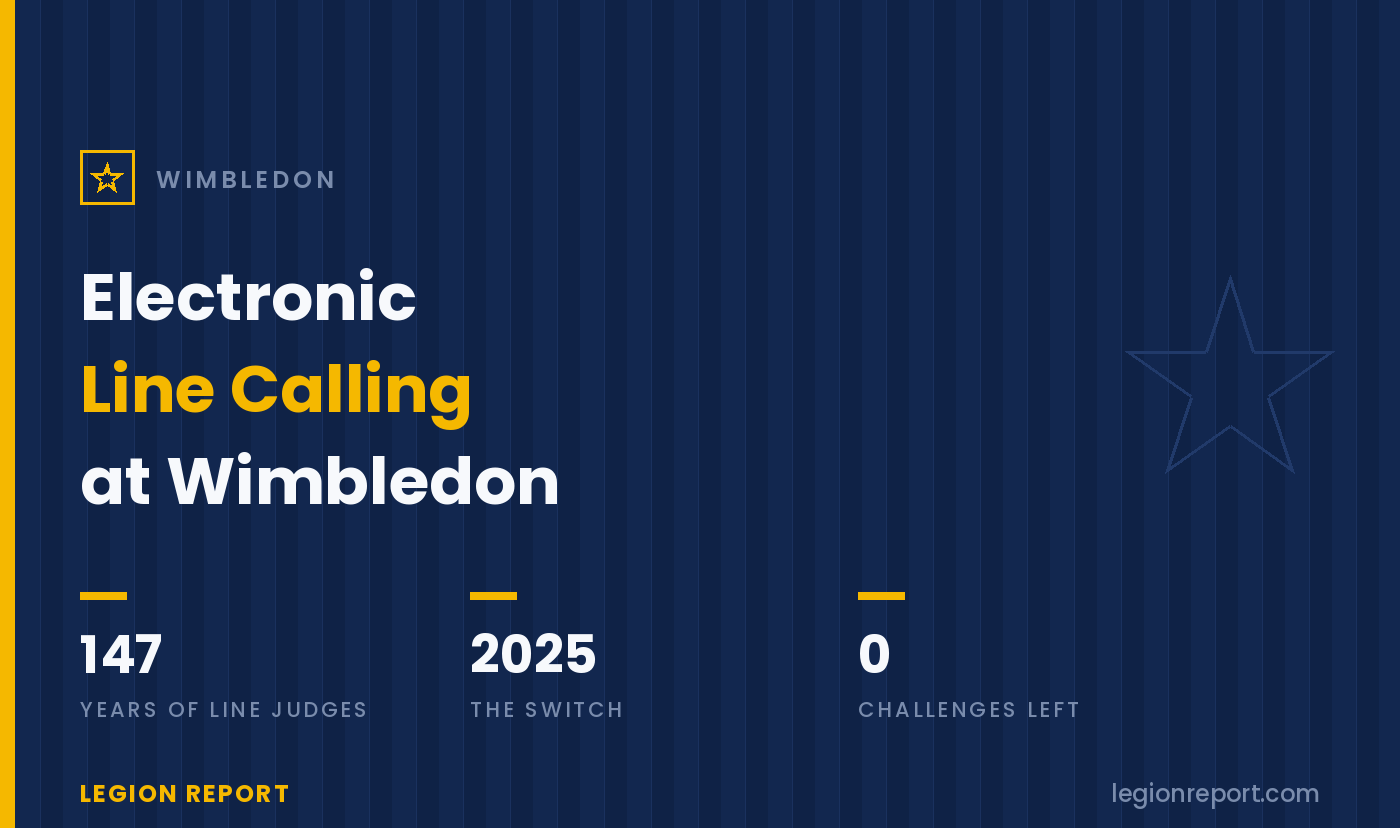

For 147 years, from the first championship in 1877 through 2024, every “out” at Wimbledon was called by a human being in a Ralph Lauren uniform. In 2025, that ended: the All England Club switched to full electronic line calling, retiring around 300 line judges in one stroke, abolishing the player challenge system entirely, and replacing the sport’s most famous shouts with recorded voices, and the first year included a malfunction so perfectly timed it made global headlines.
Now in its second year, the system is the invisible official of the 2026 Championships: every line on every court, called automatically, with no challenges because there’s nothing left to challenge. If you’re hearing disembodied “OUT!” calls this finals weekend and wondering who’s talking, whether players can argue, and why the French Open still uses humans, this is the full story.
The chart below covers how the system works, what disappeared in 2025, the famous failure, where each major stands, and what it all changed about watching tennis. Take a look, then we’ll break it all down.
What actually changed, and how the machine calls a line
The system Wimbledon adopted in 2025 is Hawk-Eye Live, the “live” distinguishing it from the review tool tennis used for two decades: banks of high-speed cameras track the ball against every line on every court and announce “out” or “fault” automatically, in real time, with no human confirmation step. The chair umpire remains, running the match, handling everything from code violations to rain, and match assistants (a role into which some former line judges moved) support on court, but the calls themselves are the machine’s alone, which is why the challenge system was abolished outright: challenges existed to let players appeal human eyes to the cameras, and once the cameras are the eyes, there is nothing left to appeal. Wimbledon’s signature touch is the voice: rather than a synthetic tone, the club recorded real AELTC behind-the-scenes staff, so every “OUT!” on Centre Court this weekend is a genuine employee, relocated from the baseline to a sound file.
147 years, 300 people, and one very human malfunction
The scale of what ended bears stating plainly: line judges had worked every Championships since the first in 1877, and the 2025 switch ended roughly 300 roles at a stroke, retiring one of sport’s iconic images, the Ralph Lauren-uniformed crews crouched at the baselines, along with the challenge ritual (the rhythmic clapping, the big-screen countdown, the roar at “IN”) that had become tennis’ best crowd theater. Year one then delivered an incident almost too perfect: mid-match on Centre Court, in Anastasia Pavlyuchenkova’s fourth-round match, the system was accidentally switched off, a clearly out ball went uncalled, and the point was replayed, forcing an apology from the club and a rule change removing the ability to deactivate the system mid-match. The irony wrote itself, the machine’s worst day was caused by a person turning it off, but the substantive lesson survived the jokes: when running, the system out-calls any human; the failure lived in the seam of the transition, not the technology.
Year two, the French holdout, and the quieter court
In 2026 the system is simply the water tennis swims in: the Australian and US Opens adopted electronic calling years earlier, the ATP went tour-wide in 2025, and Wimbledon’s second year has run without a Pavlyuchenkova moment, leaving the French Open as the lone Grand Slam still employing human line judges, a holdout with a genuinely clay-specific defense, since the ball’s physical mark on the surface is tennis’ original replay system and Roland Garros argues the cameras solve a problem clay never had. What remains contested is atmosphere, not accuracy. Players broadly accept the calls; what year one and two have surfaced instead is the strange new silence, no one to argue with, no challenge drama, fewer humans in the frame, and whether that’s a fair price for never again losing a championship point to a blown call is the question each viewer settles alone, probably this weekend, around the fifteenth disembodied “OUT!”
Final Word
Wimbledon’s electronic line calling, explained: full Hawk-Eye Live since 2025, ending 147 years of human line judges (~300 roles) and abolishing challenges entirely, calls announced instantly in the recorded voices of real club staff, with only the chair umpire remaining in charge; scarred once by the famous switched-off malfunction and Pavlyuchenkova’s replayed point, fixed since; now in its second, quieter year, while the French Open holds out alone with humans and clay marks. The calls are perfect. The arguments are extinct. Tennis is still deciding how it feels about both.
The rules the machine enforces at 6-6 are in Wimbledon’s final-set tiebreak explained, the traditions that did survive are in Wimbledon’s curfew and roof rules, and the champions the calls have crowned are in Wimbledon champions by year.