
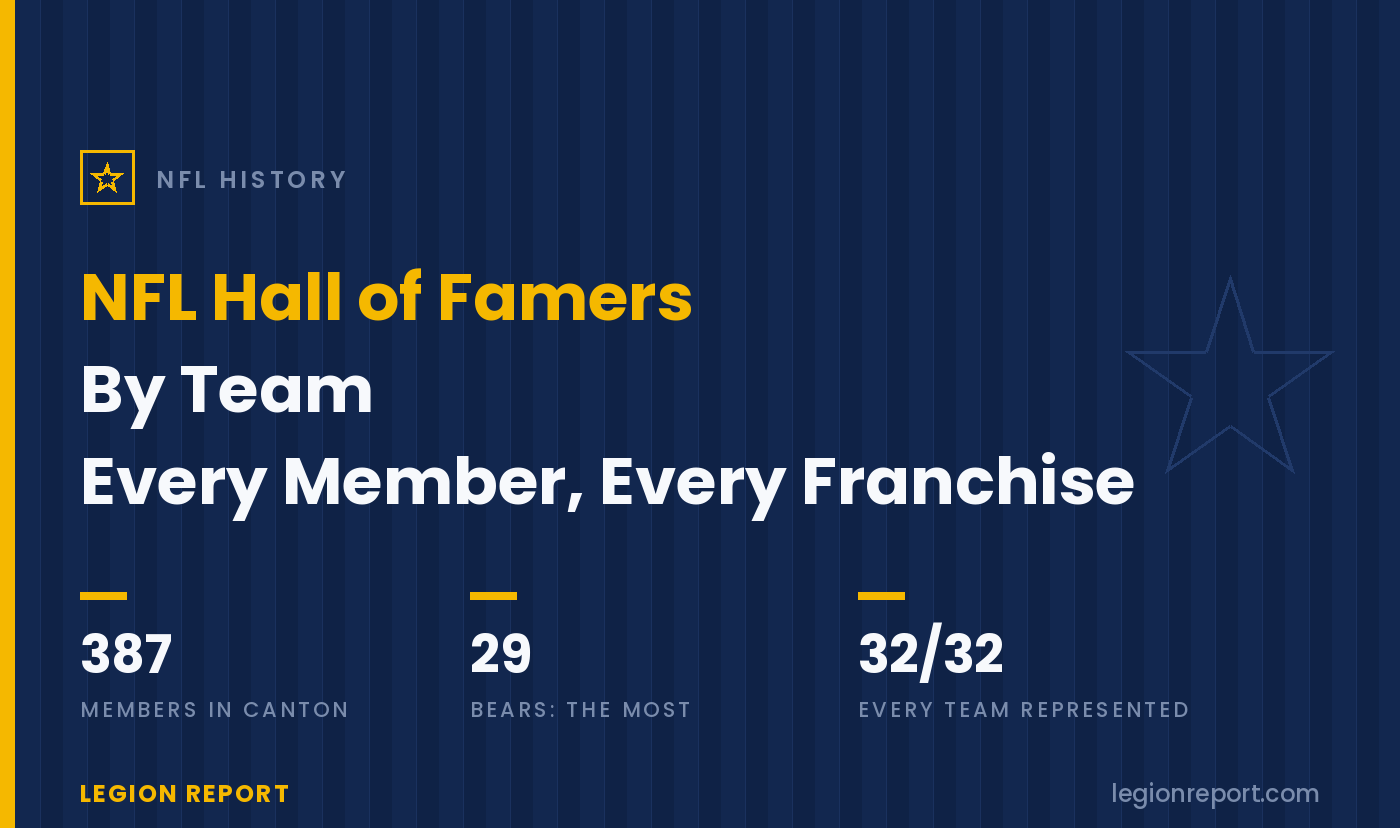

The Pro Football Hall of Fame has 387 members counting this year’s class — the 2026 group headlined by Drew Brees and Larry Fitzgerald that gets enshrined in Canton this August — and the way they distribute across the NFL’s 32 franchises is a map of the league’s entire power history: the Bears and Packers, the league’s 1920s founders, still sit atop the list a century later; the Steelers and Cowboys turned the 1970s into permanent bronze; and at the other end, the Texans and Jaguars each have exactly one bust, having gained their first representation only in the last few years.
One thing to know before reading: unlike Cooperstown, Canton doesn’t induct anyone “as” a member of a team — every affiliation is listed equally on a member’s bust. So any by-team count is an editorial convention. This chart uses primary-franchise attribution: each of the 387 members counted once, under the franchise most associated with their career, which is the same convention behind the famous “the Bears lead the Hall” claim.
The chart below has the ranked totals for all 32 franchises up top, and the complete name-by-name rosters below it. Take a look, then we’ll break it all down.
Why the 1920s Still Rule the Rankings
The top of the table is a century-old story that never changed. The Bears and Packers lead the Hall for the same reason they lead most all-time lists: they were there first, they were good immediately, and their founding decades came when rosters full of two-way legends could stack bronze busts fast — George Halas alone connects the 1920 founding meeting to the 1980s, and Green Bay’s 1960s Lombardi dynasty added an entire second wave (eleven members of those Packers teams, coach included, are in Canton).
The next tier is the dynasty math of the Super Bowl era: Pittsburgh’s 1970s teams put nine players plus the Rooneys, Noll, and scout Bill Nunn in the Hall, and the Cowboys’ twin dynasties (Landry’s and Jimmy Johnson’s) built a similar shelf, with the entire triplets era now enshrined. What the ranking punishes is youth and what it rewards is time: the bottom of the table isn’t a list of bad franchises, it’s a list of recent ones. The Texans (founded 2002) waited until 2024 for Andre Johnson to become their first bust; the Jaguars got Tony Boselli in 2022; the Ravens, despite two Super Bowls, have just three primary members because their history only starts in 1996 — and all three are inner-circle: Ogden, Reed, and Ray Lewis.
The Counting Problem Canton Built On Purpose
Any “Hall of Famers by team” list has to solve a problem Canton deliberately created: unlike baseball’s Hall, where plaques wear a single cap, the Pro Football Hall of Fame lists every affiliation equally, so a player like Deion Sanders is a Falcon, 49er, Cowboy, Redskin, and Raven all at once, and a literal count of affiliations gives the Bears forty-plus and produces more than 600 team-listings from 387 humans.
This chart uses the primary-franchise convention instead, one placement per member, which keeps the totals honest and the arguments interesting, because some primaries are genuine debates: Reggie White played more seasons in Philadelphia but won his ring in Green Bay (he’s an Eagle here); Charles Woodson split his career almost evenly between Oakland and Green Bay (a Raider here); Adam Vinatieri kicked longer in Indianapolis but made his legend in New England (a Patriot here). Those coin-flips move individual totals by one or two but never the shape of the list, and the shape is the point: a century of NFL history, sorted by which franchises manufactured the most immortality. The next names arrive with the Class of 2027, announced Super Bowl week, and the table updates the same day.
Final Word
NFL Hall of Famers by team: 387 members in Canton distributed across every one of the 32 franchises, led by the Bears (29) and Packers (27) on century-old head starts, the Steelers (26) and Cowboys (21) on dynasty math, with the Giants rounding out the top five, and the Texans and Jaguars holding one apiece at the other end as the league’s youngest franchises. Full name-by-name rosters for every team are in the chart above, one placement per member under their primary franchise, complete through the Class of 2026. Updated every February when the new class is announced.
For more from the sport’s history shelf, see what the Hall of Fame Game is, the NFL triplets, explained, and the greatest sports comebacks of all time.