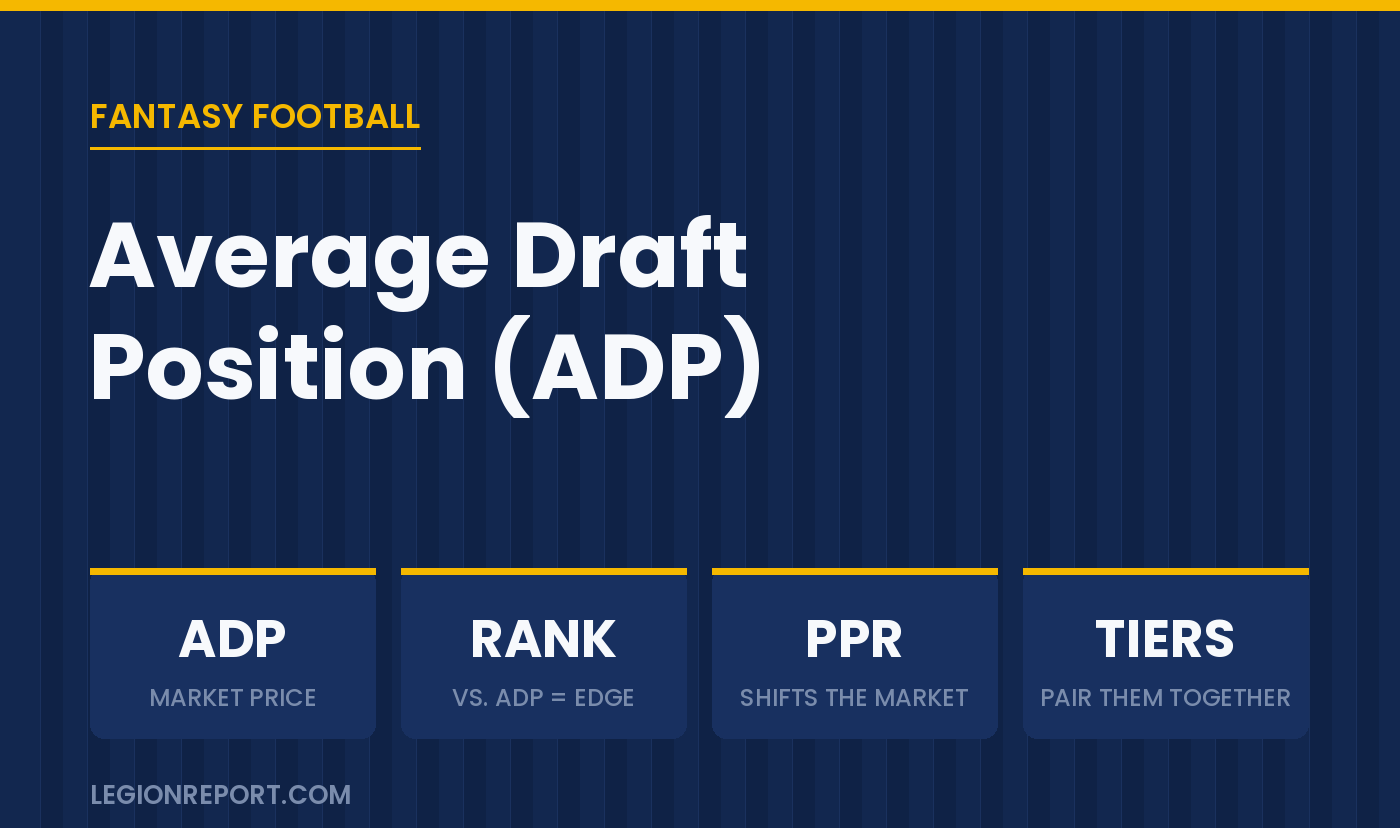
If you’ve opened a fantasy football draft room in the last decade, you’ve seen ADP — Average Draft Position — sitting next to every player’s name. It’s the single most-used number in fantasy drafting, and one of the most misunderstood. ADP is not a ranking and it’s not a projection. It’s a market price: the average pick number at which a player has been selected across thousands of real drafts on a given platform over a given window of time.
That distinction is the whole game. Rankings tell you how good a player is expected to be; ADP tells you how early other people are taking him. When those two numbers disagree, you have an edge — a player ranked 20th with an ADP of 35 is a value you can wait on, while a player ranked 40th with an ADP of 22 is one you’ll have to overpay for or let go. Every good draft strategy, from tiers to zero-RB to “best player available,” runs on reading that gap correctly.
The chart below covers how ADP is calculated, how it differs across platforms and formats, and a practical framework for using it on draft day. Take a look, then we’ll get into the traps.
FANTASY FOOTBALL
Average Draft Position (ADP), Explained
How the number is built, why it moves, and how to draft with it
WHAT IT IS
Market price
Not a ranking
SAMPLE
Recent drafts
Weeks, not months
KEY SKILL
Rank vs. ADP
The gap is the edge
BIGGEST SWING
Format
PPR, Superflex, best ball
How ADP works
The mechanics of the number
| Concept | What it means |
|---|
| Definition | The mean overall pick number at which a player was drafted, across a sample of real drafts on one platform over a recent window |
| Example | If a player went 8th, 12th, and 10th in three drafts, his ADP is 10.0 |
| Sample and recency | Most sites use the last 1-4 weeks of drafts; early-summer ADP is stale by late August as injuries and depth charts change |
| Round notation | Some sites show ADP as round.pick (e.g., 3.04 = 4th pick of Round 3 in a 12-team league) rather than an overall number |
| Positional ADP | Rank among players at one position (WR12, RB20) — useful for judging when position runs will start |
| Min / max pick | The earliest and latest a player was taken; a wide range signals disagreement in the market |
Why ADP differs by site and format
Same player, different price
| Platform / format | How ADP shifts |
|---|
| ESPN, Yahoo, Sleeper, NFL.com | Each site’s ADP reflects its own users’ drafts and default settings — the same player can differ by a full round between sites |
| PPR vs. standard | Pass-catching backs and high-target receivers rise in PPR; touchdown-dependent players fall |
| Superflex / 2QB | Quarterbacks jump multiple rounds; a QB with a 1QB ADP of 60 can go top-15 in Superflex |
| Best ball | Upside and late-round WRs climb; kickers and defenses are drafted, ceilings valued over floors |
| Dynasty | Age drives everything — young players rise, veterans over 28 fall regardless of last year’s production |
| High-stakes (NFFC, FFPC) | Sharper markets; ADP is usually a better proxy for true value than casual-site ADP |
Using ADP on draft day
A practical framework
| Situation | How to play it |
|---|
| Your rank is much higher than ADP | Wait — you can likely get him a round later. Set a target round, not a target pick |
| Your rank is much lower than ADP | Let him go. Someone else will pay the market price |
| A tier is about to empty | Take the last player in the tier now, even a few picks ‘early’ — ADP is a guide, not a rule |
| A position run has started | Check positional ADP: if the next 5 RBs go in the next 8 picks, grab yours or pivot to the WR pool |
| A player’s ADP is falling fast | Ask why: injury news is real; a bad preseason box score usually isn’t |
| Late rounds | Ignore ADP almost entirely — draft for upside and roster fit |
ADP TRAPS
ADP is a lagging indicator
It reflects drafts already completed. When a starter goes down in mid-August, his backup’s ADP takes days to catch up — that lag is where value hides.
Anchoring is real
Seeing ‘ADP 24’ next to a name makes pick 24 feel correct. It isn’t automatically; it’s just what the crowd did.
Reaches aren’t reaches if nobody else values him
Taking a player two rounds early only costs you if you could have gotten him later. Check the min pick — if he’s regularly gone by then, it’s not a reach.
Where ADP Fits in a Draft Strategy
The cleanest way to use ADP is alongside your own rankings and a tier sheet. Rankings tell you who you want; tiers tell you where the talent drops off; ADP tells you when the market will force your hand. Combine all three and drafting becomes a series of small decisions: is the best available player in a tier that’s about to empty, and will he still be there next round based on ADP? If yes to the first and no to the second, take him. If he’ll clearly last, take someone else and come back. That’s the whole method — ADP is the timing tool, not the value judgment.
The Bottom Line
Average Draft Position is the price the market has set for every player, drawn from real drafts on your platform in your format. Read it against your own rankings, respect it when tiers are thin, exploit it when the crowd is slow to react, and stop reading it altogether once the late rounds arrive. For the tools that pair with it, see our guides to fantasy football tiers and PPR scoring, and for the pro rules that shape a player’s real-life role, our breakdown of NFL bye weeks.