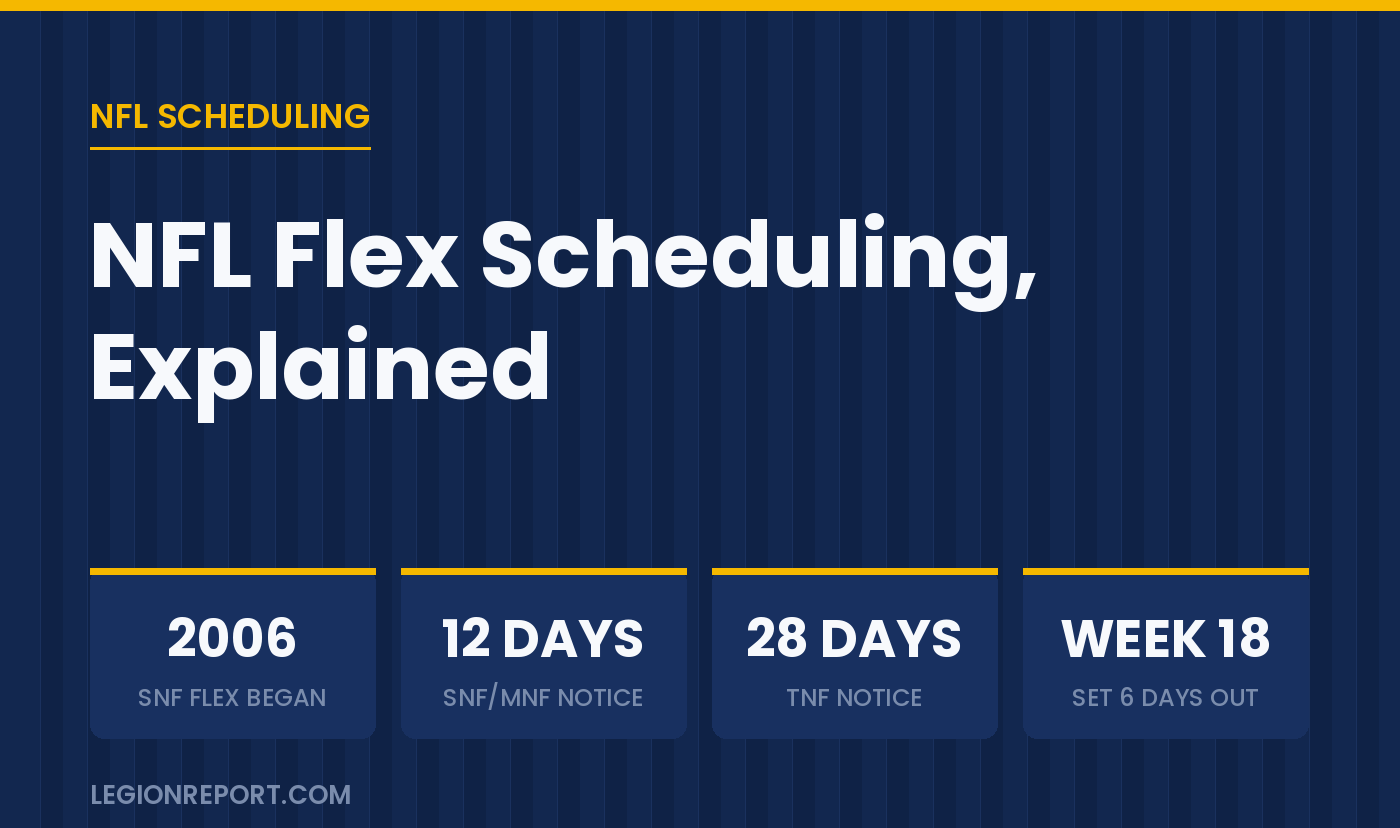
NFL flexible scheduling — “flexing” — is the league’s mechanism for rescuing its prime-time windows from bad games. When the schedule is built in May, the league is guessing which teams will matter in December; flex rules let it swap a scheduled prime-time dud for a better matchup once the season reveals itself, moving games between Sunday afternoon and Sunday, Monday, or even Thursday night slots with advance notice.
Flexing began in 2006 as a Sunday Night Football perk and has expanded steadily since: Monday night flexing arrived in 2023, Thursday night flexing in 2023-24 (over loud objections about short-week travel), and the league can now also move games between Sunday afternoon time slots in any week of the season. The result is that a December ticket or travel plan is never fully safe — and the best late-season games almost always end up in prime time.
The chart below covers the rules for each window, the notice requirements, and the limits. Take a look, then we’ll get into how the league decides.
NFL SCHEDULING
How NFL Flexible Scheduling Works
The rules for moving games into and out of prime time
SNF
Weeks 5-17
12-day notice
MNF
Weeks 12-17
12-day notice
TNF
Weeks 13-17
28 days, max 2/yr
WEEK 18
Fully open
Set 6 days out
The flex windows
Rules by broadcast package
| Window | Flex-eligible weeks | Notice required | Limits |
|---|
| Sunday Night Football (NBC) | Weeks 5-17 (Week 18 game picked that week) | 12 days (6 days in Week 14 onward… officially 12 days Weeks 5-13, 6 days Weeks 14-17) | No limit on number of SNF flexes |
| Monday Night Football (ESPN/ABC) | Weeks 12-17 | 12 days | No stated cap on MNF moves |
| Thursday Night Football (Prime Video) | Weeks 13-17 | 28 days | Maximum 2 Thursday flexes per season; teams can’t play more than 2 Thursday games |
| Sunday afternoon slots (CBS/FOX) | Any week | 12 days (typically announced earlier) | Games shift between 1:00 and 4:05/4:25 freely; cross-network moves limited by contract |
| Week 18 | All games scheduled that week | 6 days | The league sets the entire final-week slate — including Saturday games and the SNF finale — based on playoff stakes |
Notice periods per the league’s current broadcast agreements.
How a flex decision gets made
From monitoring to announcement
| Step | How a flex decision happens |
|---|
| 1. Monitoring | The league and broadcast partners track projected matchup quality weeks ahead — records, injuries, playoff implications, star availability |
| 2. Consultation | The NFL consults CBS and FOX, which can protect a limited number of games from being taken out of their Sunday packages |
| 3. The swap | The prime-time game moves to Sunday afternoon; the chosen afternoon game moves into the night window |
| 4. Notice | Teams, stadiums, and fans get the required notice (12 days SNF/MNF, 28 days TNF) |
| 5. Week 18 | Held completely open: the league schedules all matchups and windows six days out so the finale maximizes win-and-in games |
Flexing questions
The fine print
| Question | Answer |
|---|
| Why does Thursday need 28 days? | Short-week safety and travel — players’ loudest objection to TNF flexing; the long notice was the compromise |
| Can a team refuse a flex? | No. Clubs are notified, not consulted |
| How often does flexing happen? | A handful of times per year — SNF flexes most seasons; Thursday flexes remain rare |
| Does flexing change the opponent? | Never — only the date and time of an existing matchup |
| What about international and Saturday games? | International games can’t be flexed; late-season Saturday windows are set in-season like Week 18 |
FLEX FACTS
Born from a dead SNF slate
The 2006 rule exists because late-season prime-time games kept featuring eliminated teams; flexing guaranteed NBC a meaningful December.
CBS and FOX get protections
The Sunday networks can shield a set number of marquee games per season from being flexed away — the quiet tug-of-war behind every swap.
Week 18 is the ultimate flex
Nothing in the final week is scheduled until six days before: the league builds the whole slate around win-and-in scenarios, with division games guaranteed.
How and why the NFL moves games into prime time late in the season.
Why the League Flexes
Prime-time windows are the NFL’s most valuable inventory — SNF is routinely the No. 1 show on television — and a meaningless December game in that slot costs everyone: the network, the league’s ratings narrative, and the flexed-out teams’ exposure. The calculus is straightforward: maximize playoff stakes and star power in the standalone windows, protect the Sunday networks’ best doubleheader games, and respect the notice periods that keep fans and teams from being blindsided. The friction point is the traveling fan, whose December road trip can move from 1 PM Sunday to 8:15 Monday with 12 days’ warning — the cost the league accepts for never wasting a window.
The Bottom Line
Flex scheduling lets the NFL move games between Sunday afternoon and the SNF, MNF, and TNF windows late in the season — 12 days’ notice for Sunday and Monday nights, 28 for Thursdays, with Week 18 built entirely in-season around playoff stakes. The opponent never changes; only the stage does. For how the matchups themselves are set months earlier, see our guide to the NFL schedule formula, and for what the final-week chaos feeds into, NFL playoff seeding.