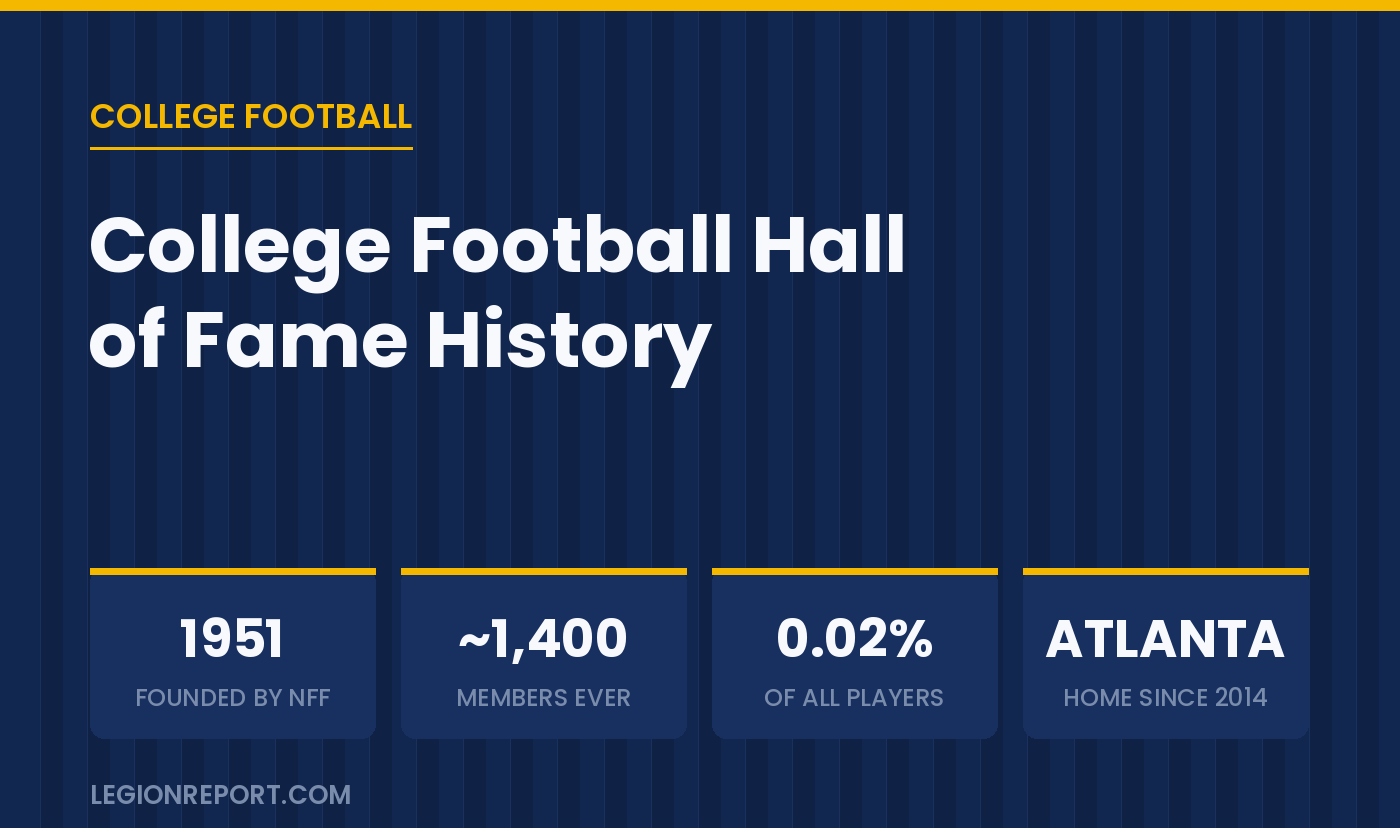
The College Football Hall of Fame is older than the Pro Football Hall of Fame, larger by enrollment, and far harder to enter by the numbers: more than 5.9 million people have played or coached college football, and fewer than 1,400 have been enshrined — roughly two-hundredths of one percent. Founded by the National Football Foundation in 1951, it has honored the sport’s legends for three-quarters of a century while leading a surprisingly nomadic life: New Brunswick, Kings Island, South Bend, and, since 2014, a 94,000-square-foot interactive museum in downtown Atlanta.
Induction runs through the National Football Foundation’s annual process: a ballot of eligible players and coaches goes to more than 12,000 NFF members and current Hall of Famers, an Honors Court weighs the votes, and each December’s class is enshrined at the NFF’s annual awards dinner. The playing criteria are strict — first-team All-America honors are a prerequisite, a player must be 10 full seasons past his final college game, and coaches generally need a .600 winning percentage across at least 10 years.
The chart below covers the Hall’s history, the induction rules, and the numbers behind its exclusivity. Take a look, then we’ll get into the debates the criteria create.
COLLEGE FOOTBALL
The Complete History of the College Football Hall of Fame
Seventy-five years, four homes, and the sport’s hardest door
MEMBERS
~1,400
From 5.9M+ participants
THE GATE
All-America
First-team required
The Hall’s history
From founding to Atlanta
| Year | Milestone |
|---|
| 1951 | National Football Foundation establishes the Hall; the first class of 54 includes Knute Rockne, Amos Alonzo Stagg, and Jim Thorpe |
| 1978 | First physical museum opens at Kings Island, near Cincinnati, after decades without a permanent home; closes within a few years |
| 1995 | Hall relocates to South Bend, Indiana, blocks from Notre Dame |
| 2012 | South Bend location closes as attendance lags |
| 2014 | Current Hall opens in Atlanta — 94,000 square feet adjacent to Centennial Olympic Park and the CFP’s frequent footprint |
| 2018 | Hosts College Football Playoff championship festivities for the first time in its own city |
| Today | About 1,400 members — roughly 1,100+ players and 230+ coaches — with new classes enshrined each December |
How induction works
The criteria and the vote
| Criterion | Requirement |
|---|
| Playing honors | Must have been a first-team All-American by a selector recognized by the NCAA — the gate that excludes most stars |
| Waiting period | 10 full seasons after the final year of college play; players remain eligible until age 75 (coaches: 3 years after retirement, or active at 70+) |
| Coaching record | Minimum 10 years and 100 games as head coach, with a .600 career winning percentage (relaxed case-by-case for special circumstances) |
| Character clause | Post-football citizenship and career are formally weighed — the Hall has delayed and declined candidates over it |
| Divisional inclusion | A separate ‘divisional’ ballot honors non-FBS greats — the Hall spans all levels of the college game |
| The vote | 12,000+ NFF members and living Hall of Famers vote; the NFF Honors Court finalizes each class |
Criteria per the National Football Foundation’s published standards.
The Hall by the numbers
The exclusivity math
| Number | Detail |
|---|
| ~0.02% | Share of everyone who has played college football that reaches the Hall |
| ~1,100 / ~230 | Players and coaches enshrined, approximately, through the mid-2020s |
| 54 | Members of the founding 1951 class |
| 10 years | The wait — why current NFL stars’ college cases sit on ice for a decade |
| 4 cities | New Brunswick era (offices), Kings Island, South Bend, Atlanta |
| December | Enshrinement month, at the NFF Annual Awards Dinner in Las Vegas (moved from its longtime New York home) |
HALL OF FAME FACTS
Older than Canton
The college Hall (1951) predates the Pro Football Hall of Fame (1963) — and its first class was voted before the NFL’s museum had a groundbreaking.
The All-America gate is the story
Four-year starters, record-setters, and champions are ineligible without a first-team All-America season — the single most-debated rule in the Hall’s history.
Atlanta saved it
Two museum failures preceded the current building; pairing the Hall with the CFP era’s southern footprint and a tourist district finally made it viable.
The history of the College Football Hall of Fame and how induction works.
The Debates the Criteria Create
The All-America prerequisite is the Hall’s defining choice: it keeps the standard objective and the door narrow, but it excludes legendary careers that never produced a first-team season — great players on great teams who split votes, or stars at positions selectors ignored. The .600 coaching threshold generates the same arguments in reverse, screening out program-builders who won at impossible jobs. And the 10-year wait means the Hall is perpetually a decade behind the sport’s memory. The NFF has softened edges case by case but held the framework, betting that a hard gate is what makes enshrinement mean something — at 0.02%, it’s difficult to argue the door isn’t hard enough.
The Bottom Line
The College Football Hall of Fame has honored the sport’s greatest players and coaches since 1951 — through four homes, a first-team All-America gate, a 10-year wait, and a voting process run by the National Football Foundation — landing in its Atlanta museum in 2014 with about 1,400 members from nearly six million participants. For the modern era those future classes are being built in, see our history of the College Football Playoff, and for the professional counterpart’s opening ritual, the NFL’s Hall of Fame Game.