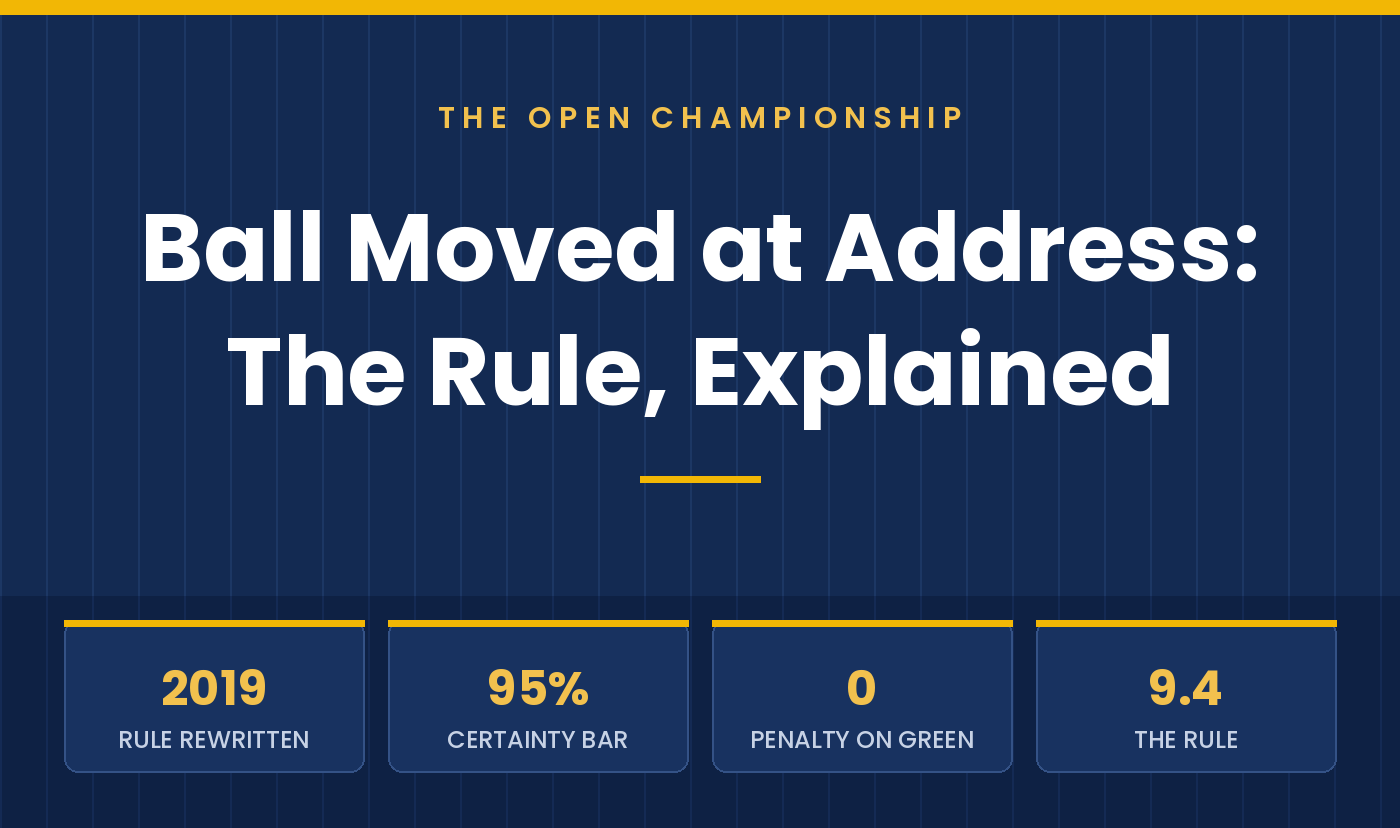
The “ball moved at address” penalty that generations of golfers feared no longer exists. Under the modern Rules of Golf, in force since 2019, there is no automatic penalty when a ball moves after you’ve taken your stance or grounded your club. A one-stroke penalty applies only when it’s “known or virtually certain” — a 95%-plus standard — that the player actually caused the movement, and even then there’s a sweeping exception: on the putting green, accidental movement carries no penalty at all. You simply replace the ball and play on.
The rule owes its existence to one famous mess: Dustin Johnson’s 2016 U.S. Open at Oakmont, where he was penalized a stroke mid-final-round for a ball that trembled on a glass-fast green — and played the closing holes not knowing his own score. The outcry produced a 2017 local rule and then the full 2019 rewrite (Rules 9.4 and 13.1d). The topic is back in the conversation this week because of the rules drama at Royal Birkdale — though note that Bryson DeChambeau’s two-shot penalty on Friday was a different rule entirely: Rule 8.1, for improving the area of his backswing in the rough, not for moving his ball.
The Open Championship
The Ball-Moved-at-Address Rule
What the modern Rules actually say — and the DJ disaster that rewrote them
2019Rule Rewritten
95%Certainty Standard
0Penalty on Green
9.4The Rule Today
Every Scenario, Ruled
Rules 9.4 and 13.1d of the Rules of Golf, as applied at the 2026 Open.
| Situation |
Ruling |
Detail |
| Ball moves after address, anywhere |
No automatic penalty |
The old rule presuming the player caused it was abolished in 2019 |
| You clearly caused it (not on the green) |
One stroke — replace the ball |
Applies only when it’s ‘known or virtually certain’ (at least 95%) you caused the movement |
| You accidentally move it on the putting green |
No penalty — replace it |
Rule 13.1d: practice-swing bumps, dropped clubs, addressing nudges all penalty-free on the green |
| Wind or gravity moves it |
No penalty — play it from the new spot |
Unless it had already been marked and replaced on the green, in which case put it back |
| You deliberately move it |
One stroke, always |
Intent removes every exception |
The Dustin Johnson Rule
DJ’s Oakmont penalty — assessed holes after the fact, with the leader unsure of his score on live TV — embarrassed golf into modernizing. He won anyway, which is the only reason 2016 is remembered as farce instead of tragedy.
Why ‘Address’ Died
The old rule presumed guilt: ball moves after address, player must have caused it. Modern agronomy killed that logic — on tour-speed greens, wind and gravity move balls constantly, and the 2019 Rules stopped punishing players for physics.
Not to Be Confused With Birkdale
DeChambeau’s Friday penalty was Rule 8.1 — improving conditions affecting the stroke by flattening grass in his backswing path. Different rule, real penalty: two shots, and a bogey became a triple.
The Bottom Line
No penalty for a ball that moves at address unless you almost certainly caused it, and never for accidents on the green — replace and play. It’s one of the friendliest corners of the modern rulebook, born from one of its ugliest afternoons. For this week’s actual rules controversy and the man leading despite the chaos around him, see the Sam Burns story at Birkdale.