
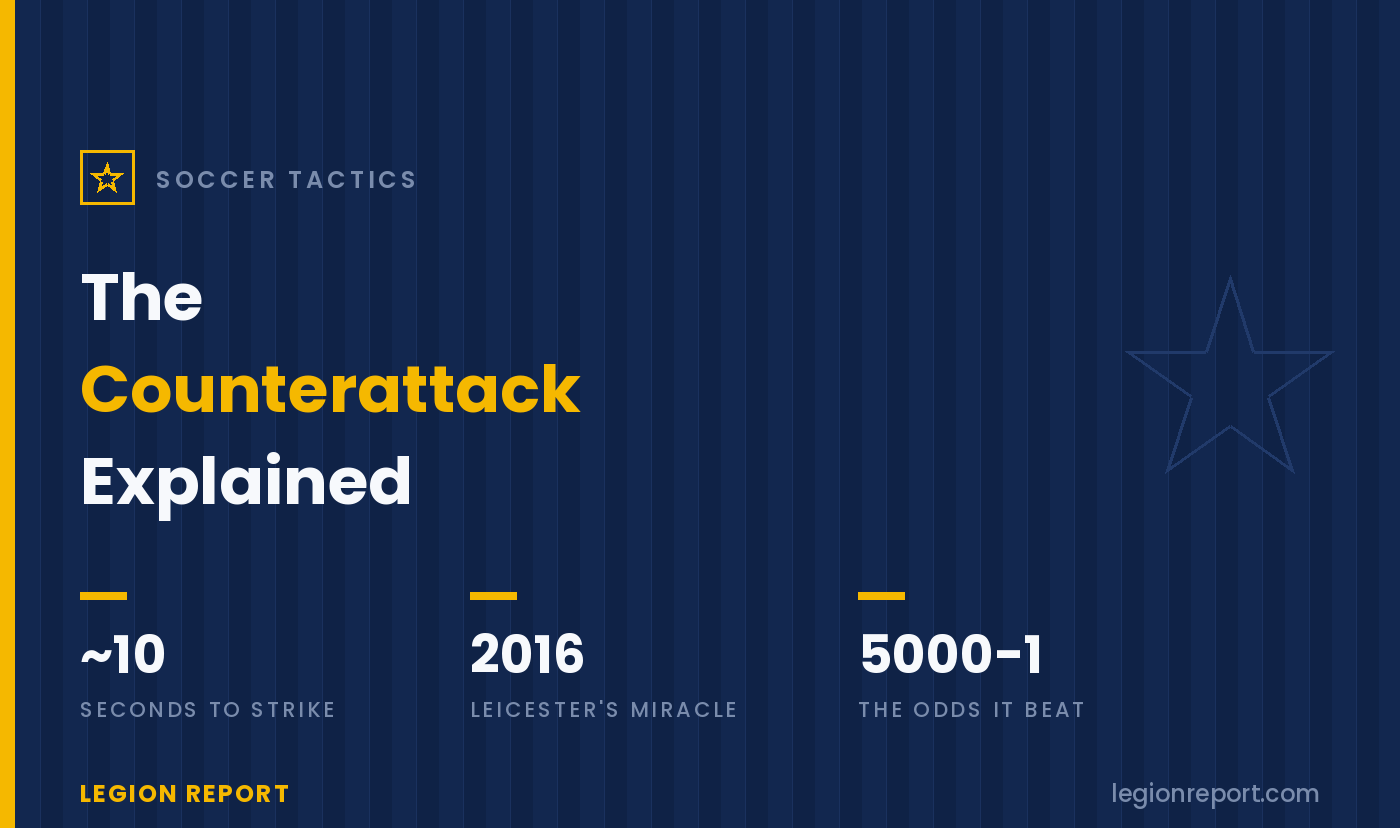

A counterattack is the art of turning defense into a goal before the opponent can turn attack back into defense. Win the ball, play forward instantly, sprint into the space the opponent left behind, and finish, ideally inside ten seconds, while their defenders are still facing the wrong way. It’s soccer’s fast break, its ambush, and pound for pound its most efficient way to score.
The counterattack’s power comes from a cruel piece of geometry: a team in full attack is a team out of position. Fullbacks pushed high, midfielders committed forward, center-backs alone on the halfway line, and the instant possession changes hands, all of that ambition becomes vulnerability. The counter doesn’t beat the opponent’s defense; it attacks the moment before their defense exists.
The chart below covers the whole weapon: the definition, the four-step anatomy of a counter, the legendary counterattacking teams, how the counter compares to possession soccer, and the dark arts teams use to stop it. Take a look, then we’ll break it all down.
What a counterattack is
A counterattack is an attack launched in the immediate aftermath of winning the ball, aimed at scoring before the opponent’s shape recovers from its own ambition. Coaches call the moment “transition”: the eight-to-twelve-second window between a turnover and a reorganized defense, when fullbacks are stranded upfield, midfielders are facing their own goal, and two center-backs are guarding half a pitch alone. The counter is a bet that a broken defense now is worth more than a set defense later, and the numbers back the bet: fast-break chances are consistently cleaner than anything patient buildup produces against eleven organized defenders. It is not defensive soccer wearing a disguise. It’s attacking soccer that lets the opponent build the runway.
Ten seconds, four steps
Every counter is the same short story. First, the regain: a tackle, an interception, a save spilled to a teammate. Second, and decisively, the first pass, played forward instantly; every touch sideways or backward hands recovery time to the retreating defense, and this is where the through ball becomes the counter’s signature weapon, one pass into space erasing half the opposing team. Third, the runners: sprinters flooding the lanes the opponent vacated, turning a 2v2 into a 4v2 in three seconds. Fourth, the strike, taken early, because a counter that slows down to think is just possession soccer with worse positioning. The whole art is speed of decision more than speed of foot; the great counter teams rehearse the first five seconds after a turnover more than any other moment in the game.
The masters of the ambush
The counterattack’s trophy cabinet is stocked with upsets and dynasties alike. Leicester City’s 2015-16 Premier League title, won at 5000-1 odds with bottom-half possession and an endless loop of regain, forward pass, Jamie Vardy sprint, remains the philosophy’s monument. Jose Mourinho’s 2010 Inter absorbed Guardiola’s great Barcelona and countered them out of the Champions League. Real Madrid’s 2014-2018 team turned transitions featuring Bale, Benzema, and Ronaldo into four European Cups, arguably the most lethal counterattacking unit ever assembled. Jurgen Klopp’s Liverpool added the modern twist, the counter-press, winning the ball back high so the “counter” starts 30 yards from goal, and Germany’s 7-1 in Brazil showed the weapon’s ceiling: five goals in 18 minutes against a host nation that kept running forward into the knife.
Killing the counter, legally and otherwise
Because the counter feeds on commitment, its antidotes all involve restraint or crime. The structural answer is “rest defense,” keeping two or three players positioned for the turnover even while attacking, insurance bought with attacking numbers. The aggressive answer is counter-pressing: swarm the ball-loser instantly and strangle the first pass before it exists. The passive answer is simply refusing the bait, keeping men behind the ball and concededing the counter no space. And the cynical answer is the tactical foul, dragging down the counter’s first runner and accepting the yellow card as a business expense, the exact behavior soccer’s SPA caution was written to punish, and which escalates to a DOGSO red when the foul arrives one pass too late against a clean break.
Final Word
A counterattack, explained: winning the ball and attacking within seconds, through a four-step sequence, regain, forward pass, runners, strike, that targets the temporary corpse of the opponent’s shape. It powered Leicester’s miracle, Mourinho’s Inter, Madrid’s European dynasty, and Klopp’s pressing machine, it duels eternally with possession soccer, and it has forced defenses into rest structures, counter-presses, and yellow-card economics just to survive it. Soccer’s most efficient goal is the one scored before the defense exists, and the counterattack is the science of arriving at exactly that moment.
Its supporting cast lives across our library: the pass that launches it in what is a through ball, the striker movement that stretches defenses in what is a false 9, and the price of stopping one illegally in DOGSO explained and how many yellow cards before a suspension.