
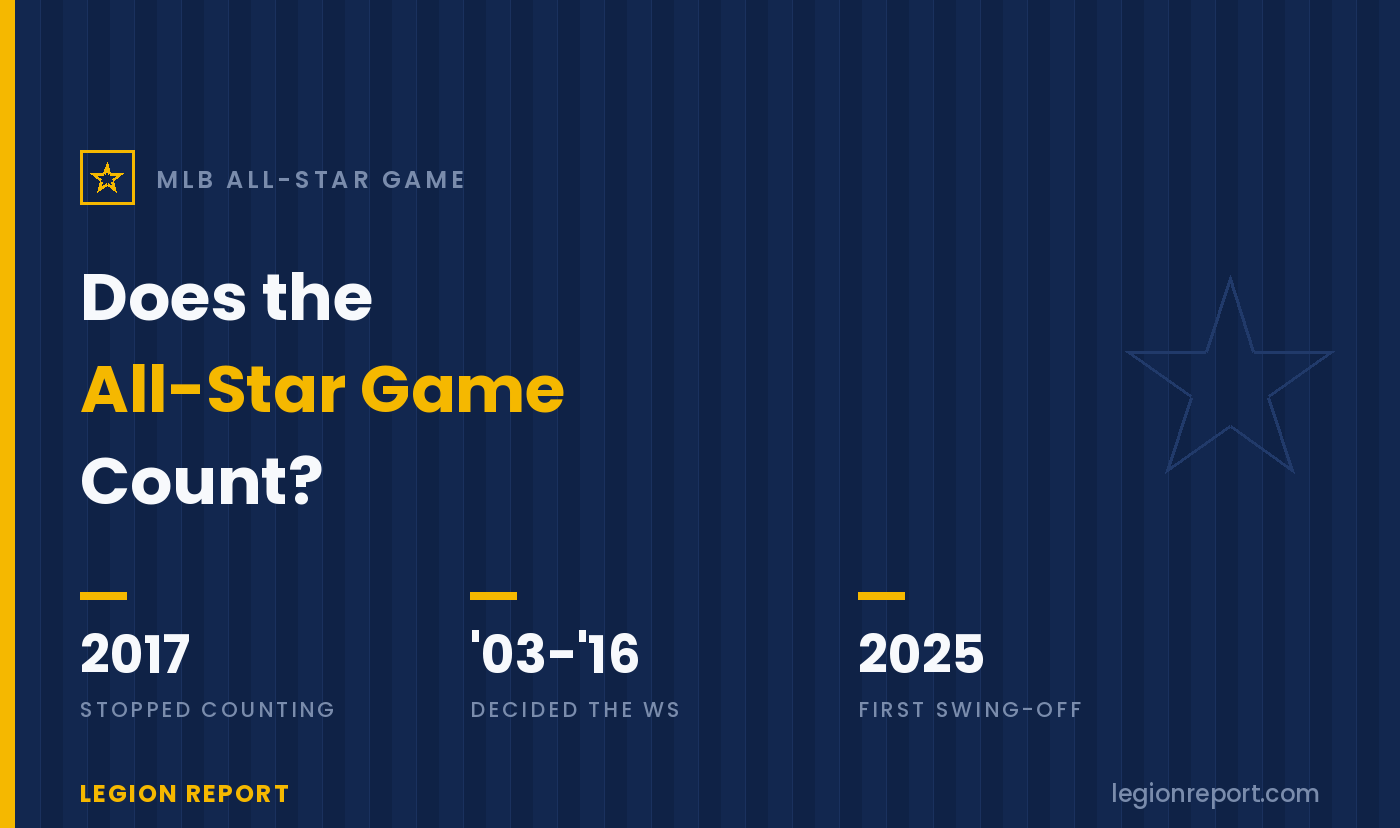

Does the MLB All-Star Game count for anything? The short answer: not anymore, not in the standings, not for playoff position, and, since 2017, not for World Series home-field advantage either. The Midsummer Classic is once again what it was born as in 1933: an exhibition. But the long answer is more interesting, because for fourteen strange seasons (2003-2016), this exhibition decided which league hosted Game 7 of the World Series, an era created by a single disastrous night in Milwaukee when the game ran out of pitchers and ended in a tie.
And “exhibition” undersells what’s actually on the line today: real money for the winning side, contract bonuses that trigger on selection, the Ted Williams MVP Award, and, since 2025, the most entertaining tiebreaker in American sports, the home run swing-off, which produced an MVP who never recorded a hit. With the 2026 game set for July 14 at Citizens Bank Park in Philadelphia, here’s how the whole thing works now.
The chart below covers it all: the counts/doesn’t-count timeline, what’s genuinely at stake today, how the rosters get picked, the game-day rules including the swing-off, and the 2002 tie that changed everything. Take a look, then we’ll break it all down.
The short answer, and the honest one
In the standings sense, the All-Star Game counts for nothing, and hasn’t since 2017. No playoff implications, no seeding, and no World Series home-field advantage, which since the 2016 labor agreement goes simply to the pennant winner with the better regular-season record.
But “meaningless exhibition” misses where the meaning actually lives: players on the winning side collect a cash bonus (reported around $25,000 a man in recent years), the game crowns the Ted Williams MVP, and, most materially, the selection itself is worth real money, All-Star bonuses are written into countless contracts, and selections get cited in salary arbitration for years afterward. The precise truth is that making the team counts more than winning the game, which is exactly how an exhibition should work, and exactly what baseball spent fourteen years pretending wasn’t true.
The counts era: how a tie hijacked the World Series
The strange middle chapter began on July 9, 2002, in Milwaukee: 7-7 after eleven innings, both managers literally out of pitchers after trying to play everyone, and Commissioner Bud Selig, standing in his own home ballpark, declaring a tie while the crowd chanted for refunds. No MVP was awarded, the only time in the award’s history, and the embarrassment was so total that MLB responded with the most drastic stakes an exhibition has ever carried: from 2003 through 2016, the league that won the All-Star Game received home-field advantage in the World Series.
“This Time It Counts,” the marketing said, and it did, Game 7s were hosted on the strength of a July exhibition staffed by every-team-represented rosters and pitchers on strict usage limits. The experiment was retired in the 2016 CBA with minimal mourning, but its ghost wrote the modern rulebook: expanded 32-man rosters, automatic replacements for Sunday starting pitchers, and a standing answer to the question that started it all, what happens if it’s tied?
The modern format: fan votes, the every-team rule, and the swing-off
Today’s game assembles its casts in layers: fans elect the starters through a two-phase vote (Phase 1 narrows each position to finalists, Phase 2 decides), players vote in the reserves and pitching staffs, the league office fills gaps, and the every-team rule guarantees at least one All-Star from every club, even the worst team in baseball. Game night runs nine normal innings with a universal DH, in the players’ own team uniforms again after the unloved league-wide jerseys of 2021-23 were retired.
And if it’s tied after nine, there are no extra innings: the game goes to a home run swing-off, three hitters per league, three swings each, most homers wins, a rule that sat dormant in the CBA until its spectacular 2025 debut, when Kyle Schwarber went a perfect 3-for-3, won the game for the National League, and became MVP without recording a hit. The 2002 problem, solved by turning the tiebreaker into the best five minutes of the summer. The 2026 edition arrives July 14 at Citizens Bank Park, where Schwarber, conveniently, plays his home games.
Final Word
Does the MLB All-Star Game count? Not in the standings, not since 2017, when World Series home field returned to the team with the better record, ending the fourteen-year “This Time It Counts” era born from the infamous 2002 tie. What it counts for now: a winner’s bonus, contract escalators and arbitration value attached to the selection itself, the Ted Williams MVP, and, if nine innings can’t settle it, a three-swing home run shootout that produced a hitless MVP in its 2025 debut. It’s an exhibition again, the most consequential one in sports, and it plays Philadelphia on July 14.
How the rosters get elected is in MLB All-Star voting explained, every winner of the game’s top honor is in All-Star Game MVP winners by year, and the night before’s spectacle is covered in Home Run Derby rules explained.