The fair catch is one of football’s oldest and simplest rules — a returner waves an arm overhead, catches the ball, and the play is dead where he caught it, with no contact allowed — and yet it has become one of the sport’s most consequential, because kickoff and punt rules have changed so much around it. Between the NFL’s 2024 “dynamic kickoff” overhaul, college football’s 2018 kickoff fair-catch rule, and the different penalty yardages and signal requirements at each level, the fair catch now behaves noticeably differently on Saturdays and Sundays.
The core is the same everywhere: a receiver on a kick or punt signals by extending one arm fully above the helmet and waving it side to side, the kicking team may not touch him, and he may not advance the ball. Where the levels diverge is what happens next — where the ball is spotted on kickoffs, whether a fair catch is even allowed on some kicks, how big the penalty is for interfering, and the near-forgotten fair-catch kick.
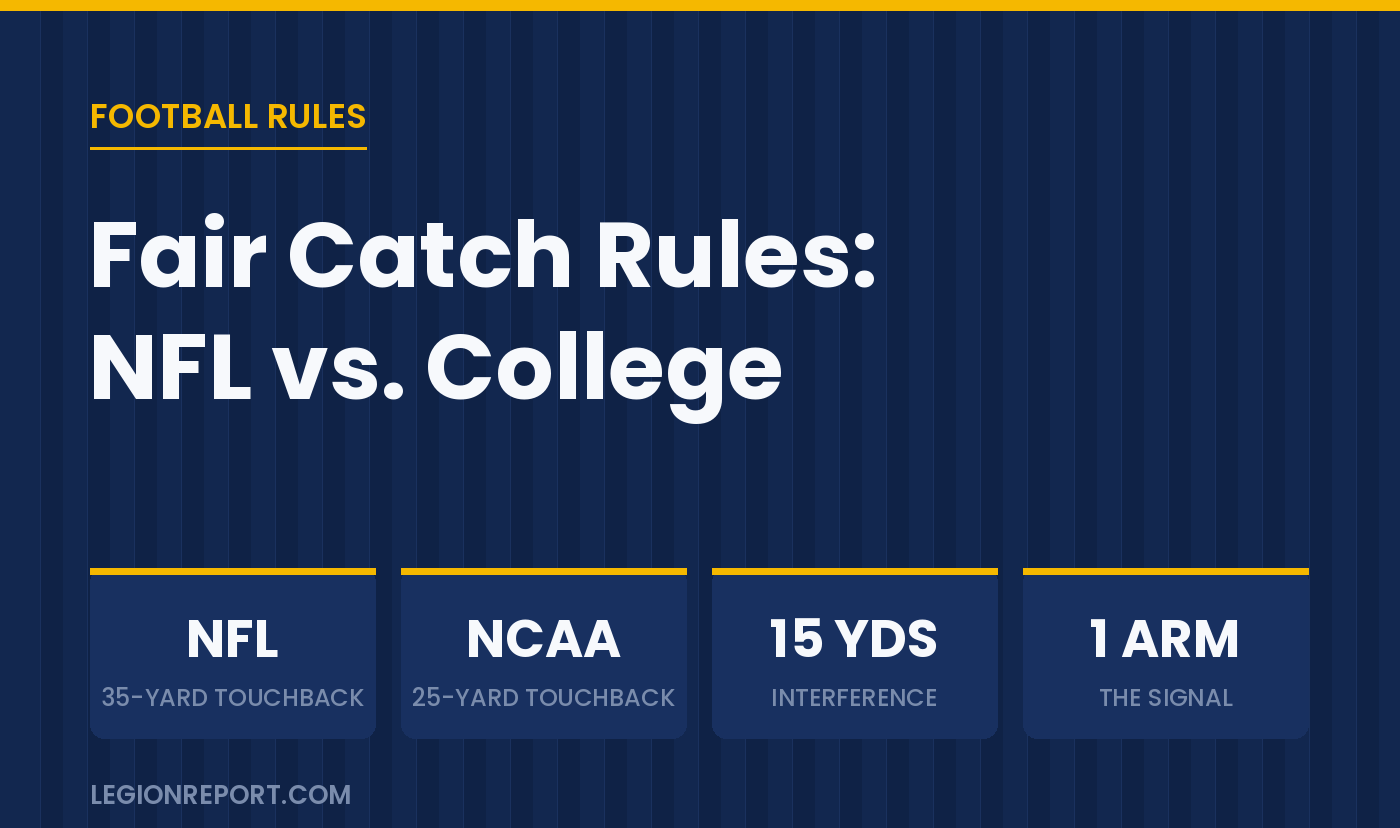
The chart below compares NFL and college fair catch rules point by point. Take a look, then we’ll get into how the kickoff changes turned a routine signal into a strategy.
FOOTBALL RULES
Fair Catch Rules: NFL vs. College Football
The signal, the protection, the touchback spot, and the penalties
SIGNAL
One arm
Waved above the helmet
NFL KICKOFF
35-yard line
Fair catch = touchback
CFB KICKOFF
25-yard line
If caught inside the 25
INTERFERENCE
15 yards
Both levels
Rule-by-rule comparison
Where the two levels agree and where they don’t
| Rule | NFL | College (NCAA) |
|---|
| The signal | One arm extended full length above the head, waved side to side; a half-hearted or ‘invalid’ signal still kills the return | Same — one hand extended and waved clearly above the head; anything else may be ruled invalid |
| Contact after signal | Kicking team may not touch or interfere; a receiver who signals cannot be hit | Same — receiver is fully protected once he signals |
| Kickoff fair catch | Under the dynamic kickoff (2024-), a fair catch anywhere in the landing zone or end zone is a touchback to the 35 (moved from 30 in 2025) | Fair catch of a kickoff caught inside the 25 is a touchback to the 25 (since 2018) |
| Punt fair catch | Ball dead at the spot of the catch; muffed fair catch is a live ball the kicking team can recover but not advance | Same spot rule; muff is live for recovery |
| Advancing after fair catch | Not allowed; the play is over on the catch | Not allowed |
| Blocking by kicking team | Kicking team may not block receivers before the ball is touched on a punt | Same |
| Fair-catch kick | Allowed: after a fair catch, the receiving team may attempt a free kick field goal from the spot, undefended (no rush) | Not allowed — no fair-catch kick in NCAA rules |
Penalties
What each foul costs
| Foul | NFL | College |
|---|
| Fair-catch interference (contact) | 15 yards from the spot of the foul; automatic if the receiver is hit | 15 yards from the spot; may also be targeting if the hit is high |
| Invalid fair-catch signal | 5 yards from the spot; the receiver may not advance | 5 yards from the spot; play is dead on the catch |
| Kicking team touches ball before receiver | Ball is dead; receiving team may take it at that spot | Same |
| Receiver muffs, kicking team recovers | Kicking team gets possession at the recovery spot; may not advance | Same |
When to fair catch
The decision under the current rules
| Situation | Best play |
|---|
| NFL kickoff, ball lands short of the goal line | Return it — a fair catch or letting it die gives the 35 only if it reaches the landing zone/end zone; short kicks must be returned or the ball is spotted at the 40 for the receiving team |
| NFL kickoff, ball caught in end zone | Take a knee or fair catch for the ball at the 35 |
| College kickoff, caught at the 3 | Fair catch — you get the 25 automatically |
| College kickoff, caught at the 20 | Fair catch still moves you to the 25; only return if you’re confident of getting past 25 |
| Punt, coverage on top of you | Fair catch — protection and the ball at that spot |
| Punt, coverage far away | Return |
FAIR CATCH FACTS
The fair-catch kick
An NFL-only relic: after a fair catch, the receiving team can attempt an undefended free kick field goal from that spot. It’s been successful only a handful of times in the modern era.
Why college added the kickoff rule
The 2018 change was a player-safety move — it lets returners take the touchback without fielding a kick at the 2 and running into full-speed coverage.
The dynamic kickoff changed the math
With NFL coverage teams starting at the 40 and no running start, returns are more common than they’ve been in a decade — but a fair catch or touchback still gets you the 35.
How the Kickoff Rewrite Changed the Fair Catch
For most of football history the fair catch on kickoffs was a footnote — you either returned it or took a knee. College changed that in 2018 by making any fair catch inside the 25 a touchback at the 25, which effectively ended short returns. The NFL went the other direction in 2024 with the dynamic kickoff: kickers kick from the 35, coverage lines up at the receiving 40, and a touchback (or fair catch in the landing zone/end zone) now gives the offense the ball at the 35, up from the 30. That extra five yards was designed to punish touchbacks and force returns, and it worked — return rates roughly doubled. The fair catch survived, but on kickoffs it’s now a field-position calculation rather than a reflex.
The Bottom Line
The fair catch works the same way at both levels — signal, catch, dead ball, full protection — but the payoff differs: an NFL kickoff fair catch is worth the 35, a college one worth the 25, and only the NFL still lets you attempt a fair-catch kick. Know the touchback spot for your level and the decision usually makes itself. For the companion rule that governs where the ball goes when nobody catches it, see our guide to touchback rules in the NFL and college, and for the other big NFL-vs-NCAA rulebook split, intentional grounding.