

When a nation heads to the World Cup, it does not just bring the eleven players who start each match. Behind that starting lineup is a full squad of players, backups, and specialists ready to step in over the course of a month-long tournament. So how many players are actually on a World Cup team? The answer has a few layers, from the full squad to the matchday group to the eleven on the pitch.
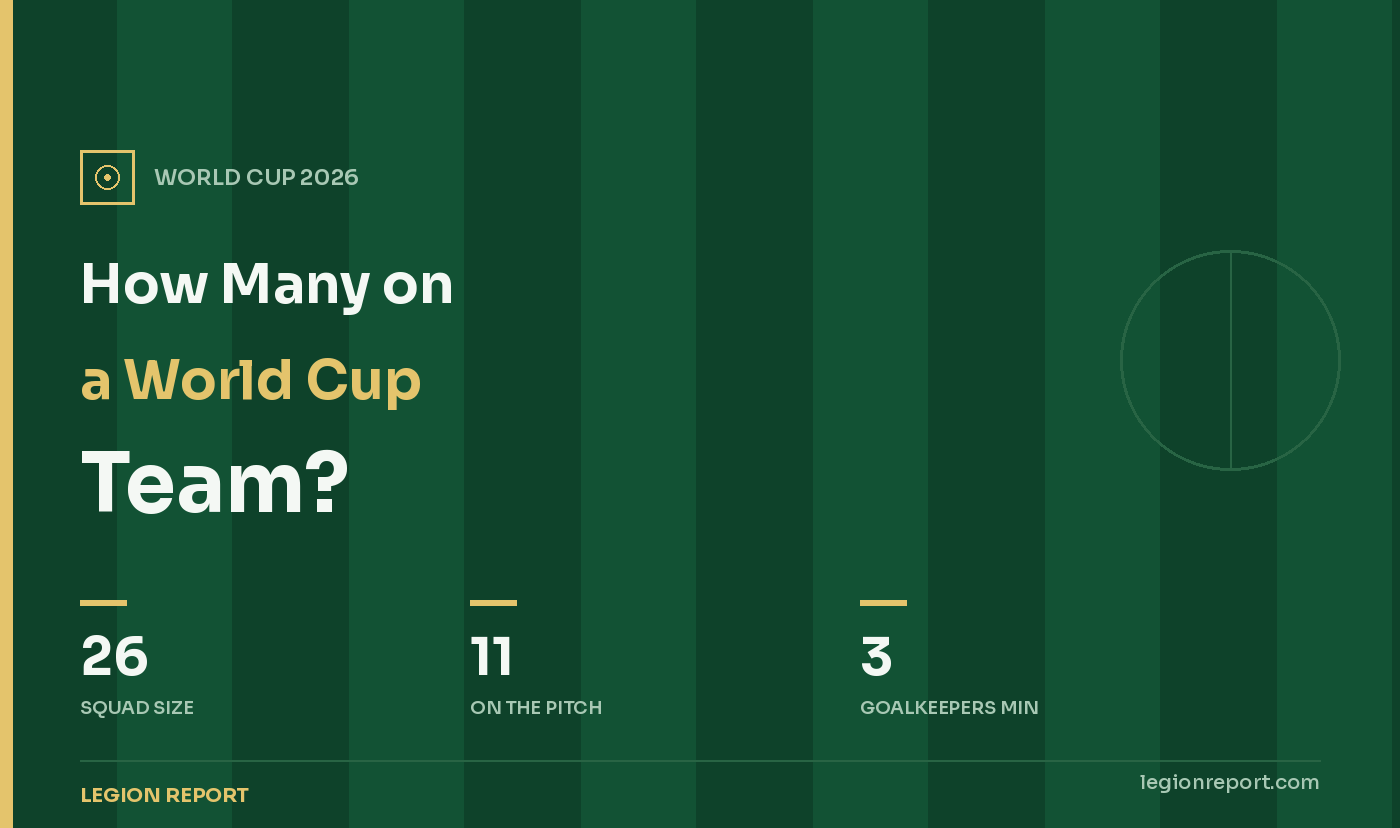
For the 2026 World Cup, each nation names a squad of 26 players, an expanded number that includes a minimum of three goalkeepers. Of those, eleven start each match, with the rest available as substitutes. Understanding the different numbers, squad size, matchday roster, and the players on the field, clears up a common point of confusion.
The chart below breaks down how many players are on a World Cup team: the full squad, the goalkeepers, the matchday group, and the players on the pitch. Take a look, then we’ll go through the details.
The full squad: 26 players
For the 2026 World Cup, each participating nation registers a squad of 26 players for the entire tournament. This is the complete pool a coach can select from across all of their team’s matches, and it must include a minimum of three goalkeepers, ensuring cover for that specialized position even if injuries or suspensions strike. The 26 players are the only ones eligible to feature for that nation throughout the World Cup.
Naming the squad is one of the biggest decisions a national team coach makes, balancing experience, form, versatility, and squad harmony. Because the tournament stretches over roughly a month and can involve up to eight matches for a team that reaches the final, depth is essential: injuries, suspensions, and fatigue all take their toll, so having 26 quality options rather than just a starting eleven is a significant advantage.
Eleven on the pitch
Of the 26-player squad, only eleven players from each team are on the field at any one time during a match, the same as in any game of soccer. This starting eleven always includes exactly one goalkeeper, plus ten outfield players. How those ten are arranged, how many defenders, midfielders, and forwards, depends entirely on the formation the coach chooses, such as 4-3-3, 4-4-2, or 3-5-2.
The coach picks the starting eleven for each individual match from the 26-player squad, and it typically changes from game to game based on tactics, opponents, form, and the need to manage players’ fitness and bookings. A player left out of the eleven for one match may well start the next, which is part of why a deep, flexible squad matters so much over the course of a tournament.
The matchday squad and substitutes
On any given matchday, the eleven starters are joined by a group of substitutes named on the bench, drawn from the rest of the 26-player squad. During the match, each team is permitted to make up to five substitutions (made within three stoppages in play), a change from the traditional three subs, now standard across top-level football. If a match goes to extra time in the knockout rounds, teams are allowed a sixth substitution.
There is also a separate provision for concussion substitutes: if a player suffers a suspected head injury, they can be replaced by a concussion substitute that does not count toward the team’s normal five changes. A match cannot continue if a team is reduced to fewer than seven players on the field (through red cards or injuries with no subs left), at which point it would be abandoned, though this is extremely rare at the World Cup.
How squad sizes have grown
The 26-player squad is a relatively recent expansion. For decades, World Cup squads were smaller: 22 players through the 1980s and early 1990s, then 23 players from the 1998 tournament onward, a number that held for over two decades. The increase to 26 was first introduced at the 2022 World Cup in Qatar, partly to give teams more flexibility amid a congested calendar and the physical demands of the tournament.
The larger squad has been retained for the expanded 2026 World Cup, which features 48 teams (up from 32). With 48 nations each naming 26 players, a total of 1,248 players are registered for the tournament, more than ever before. The bigger squads help teams cope with the extra matches and travel involved in the new, larger format across three host countries.
Final Word
A World Cup team is made up of a 26-player squad for the 2026 tournament, including at least three goalkeepers, from which eleven players start each match and up to five substitutes are used. That is a step up from the 23-player squads used from 1998 to 2018, with the expansion to 26 first introduced in 2022 and retained for the 48-team 2026 event.
So while eleven players represent each nation on the pitch, it takes a full squad of 26 to navigate a month-long World Cup. For more on how those players line up, see our explainer on soccer positions explained.