
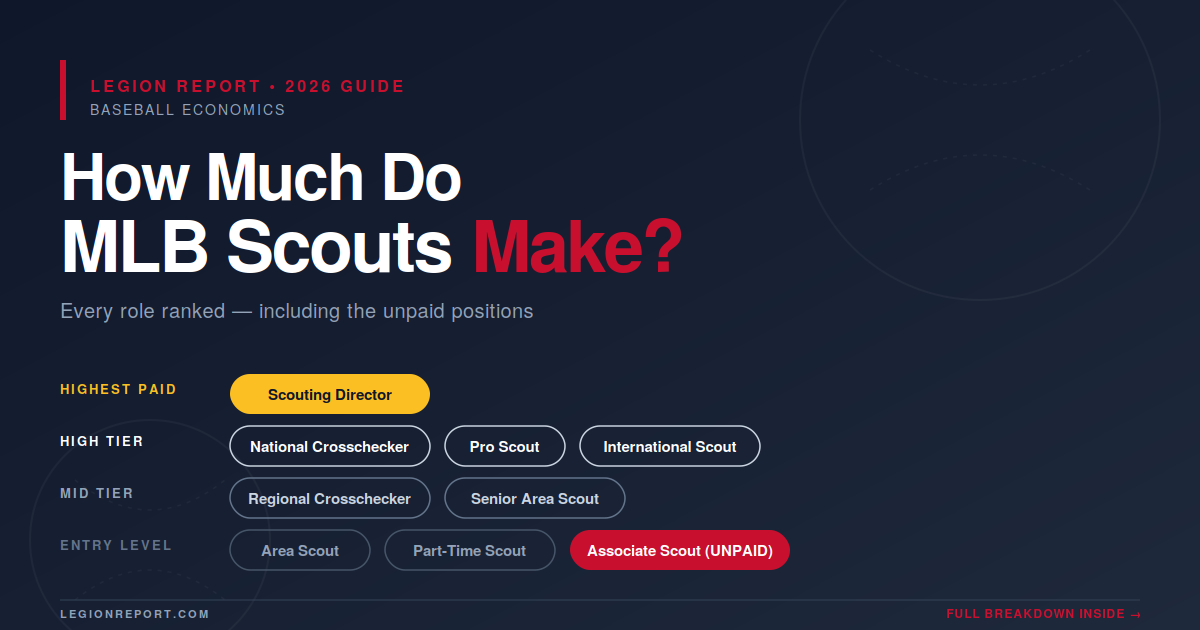

MLB scout salaries vary dramatically by role and seniority. The average MLB scout earns approximately $41,000-$67,000 per year, with entry-level area scouts starting around $30,000-$50,000 and senior scouting directors earning $150,000-$500,000+. The lowest-paid tier is the “associate scout” (also called a “bird dog”) — these positions are completely unpaid, filled by volunteers trying to break into MLB scouting departments.
Each MLB team operates with a scouting budget of $800,000 to $900,000 annually, used to fund 20-30 scouts plus their travel, hotels, and equipment. Compared to MLB coaches ($90K-$8M) and players ($780K-$60M+), scouts are dramatically underpaid relative to their long-term impact on a franchise — a single area scout who discovers a future All-Star adds tens of millions of dollars in surplus value to the team. Here’s the complete breakdown of MLB scout salaries by role, the career path from unpaid associate to scouting director, and why scouting pay lags despite the position’s strategic importance.
What actually drives MLB scout salaries
The most striking thing about MLB scouting compensation is the gap between value created and salary paid. An area scout earning $40,000-$60,000 might discover a player who goes on to earn $300 million in MLB contracts and produce 50+ WAR over a career — that’s a return on salary investment of literally 5,000-to-1. Yet area scout pay has remained relatively flat since the early 2000s while player salaries have tripled and managerial pay has nearly doubled. The reason: scout supply outweighs demand. There are roughly 600-900 total MLB scouting positions across the league, but tens of thousands of former players and baseball lifers would happily take those jobs. The associate scout (unpaid bird dog) system specifically exists because so many people want to break in that teams can demand free labor as the entry point.
The scouting hierarchy creates significant pay variance even within the same organization. Area scouts (responsible for evaluating amateur and professional players in a defined geographic region) earn $40,000-$100,000 depending on experience, with most clustered around the $50,000-$70,000 range. Regional crosscheckers (who travel to verify area scouts’ reports on top prospects) earn $65,000-$80,000. National crosscheckers (who evaluate the top prospects nationally before draft day) earn $125,000+. Pro scouts (who evaluate other MLB teams’ players for potential trades) typically earn $80,000-$150,000. At the top, scouting directors who manage the entire department and have final say on draft picks earn $150,000-$500,000+, depending on the team. Top scouting directors at the Dodgers, Yankees, and Cardinals likely exceed $400,000 annually.
International scouting has become increasingly specialized and increasingly well-paid. The Dominican Republic alone produces roughly 11% of all MLB players, so international scouts based in Latin America command premium salaries. International crosscheckers covering multiple countries can earn $100,000-$200,000+, especially if they speak Spanish fluently and have established networks across Dominican, Venezuelan, and Cuban academies. The same logic applies to Pacific Rim scouts covering Japan, Korea, and Taiwan — those positions are limited (maybe 10-15 across all 30 teams) and require unique language and cultural skills, so they pay better than typical area scouts. Teams with major international investment programs (Dodgers, Padres, Mets, Yankees) lead this market.
The analytics revolution disrupted scouting compensation in a way that’s still playing out. After Moneyball’s 2003 publication, several teams reduced their traditional scouting departments in favor of data analysts and quantitative scouts. The Astros famously cut scouting staff before their 2017 championship run. But the pendulum has swung back — most modern front offices now combine analytics with traditional eye-test scouting, and teams that completely abandoned scouts (briefly, the Astros and Yankees) have since rebuilt those departments. This means scout demand is stable but not growing rapidly, while requirements have shifted: modern scouts need to combine traditional player evaluation with data interpretation skills, which has slightly raised the bar (and pay) for entry-level positions.
For current MLB scout job postings and verified salary data by region and experience level, ZipRecruiter’s MLB Scout Salary Report tracks live job listings and recent hire data across all 30 MLB markets. For deep coverage of MLB scouting departments, scouting director hires, and the inside baseball of how teams evaluate amateur talent, Baseball America is the industry gold standard — they publish team scouting rankings and detailed draft coverage that scouts themselves reference.
The honest takeaway on MLB scout salaries in 2026: this is the lowest-paid role in major league baseball relative to its impact on team success. An area scout earning $50,000 is making less than the average elementary school teacher in many states, despite holding direct influence over which players a team drafts and signs. The role attracts people who love baseball more than money — most scouts are former minor leaguers who never made the majors, college baseball coaches transitioning to the pro game, or longtime evaluators who came up through the associate scout pipeline. If you’re considering scouting as a career path, the math is clear: expect $30,000-$60,000 for the first decade, with the potential to climb to $150,000+ if you become a national crosschecker or scouting director after 15-20 years. It’s a labor of love, not a wealth-builder.
— Drew, Legion Report