
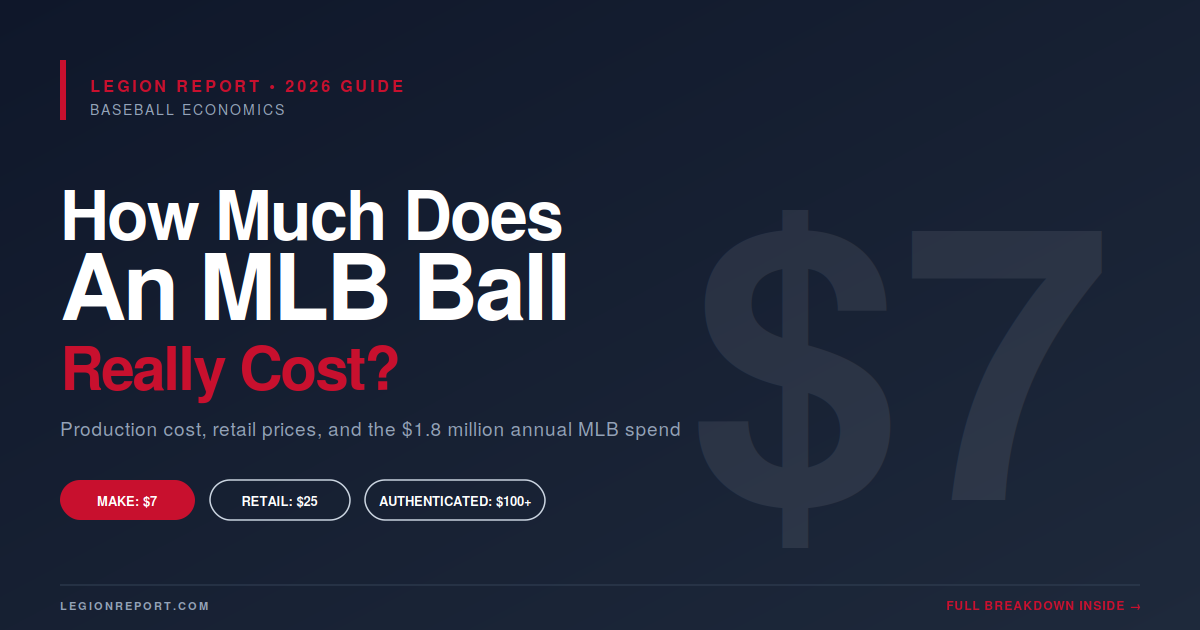
An official MLB baseball costs approximately $7 to produce at the Rawlings factory in Costa Rica. At retail, the same Rawlings ROMLB sells for $19.95 directly from Rawlings, $25 from most major retailers, and $30-$50 at ballparks. MLB uses approximately 108 baseballs per game (9 dozen average), which adds up to roughly 262,000 baseballs across the 2,430-game regular season — a production cost of approximately $1.8 million per year just for regular-season game balls.
Total annual MLB ball spending including spring training, postseason, and minor league affiliates is estimated at over $10 million. Here’s the complete breakdown of what each MLB baseball costs to make, what retail buyers pay, and the game-used authenticated baseball market that turns $7 production into $100+ collectibles.
Contents
The $7 production cost breakdown
Every official MLB baseball is manufactured at the Rawlings factory in Turrialba, Costa Rica. The $7 production cost covers a cushioned cork-and-rubber core, layers of tightly-wound wool yarn (gray, white, and gray again), cowhide leather hand-stitched together with 108 red waxed-thread stitches, and a final quality-control inspection. The hand-stitching is the most labor-intensive part of the process — each ball takes a skilled worker about 15 minutes to stitch by hand. Rawlings employs approximately 500 workers at the Costa Rica facility producing roughly 2.4 million baseballs per year for MLB, Minor League Baseball, and retail distribution.
The cowhide leather is sourced primarily from American cattle (specifically Holstein cows from the Midwest), then shipped to Costa Rica for assembly. The wool yarn comes from Vermont. The cork-and-rubber core is precision-manufactured to weigh exactly 0.5 ounces. Every finished baseball must weigh between 5.0 and 5.25 ounces, measure 9.0 to 9.25 inches in circumference, and pass a coefficient-of-restitution (COR) test that measures how “lively” the ball is. Rawlings has been the exclusive supplier of MLB baseballs for over 40 years — the current contract runs through at least 2027.
Cost per game and the $1.8 million annual MLB spend
MLB games use baseballs at a rate that surprises most fans. The average is about 108 balls per game (9 dozen), driven by aggressive umpire replacement — any ball that hits the dirt, scuffs against equipment, gets fouled into the stands, hit for a home run, or thrown into the crowd by a player is immediately removed from play. At the $7 production cost, each MLB game costs roughly $756 in baseballs alone.
Across the 2,430-game regular season, that’s 262,440 baseballs and approximately $1.8 million in production cost. Add spring training (1,200+ exhibition games), postseason (40+ games), and the Minor League affiliate system (10,000+ games annually), and total MLB-system ball spending exceeds $10 million per year.
MLB doesn’t pay anywhere near retail prices for these balls. The exact wholesale rate paid to Rawlings isn’t public, but industry estimates put it at $6-$8 per ball — essentially production cost plus a thin margin. The 2018 Atlantic League experimental partnership documents (a useful comparable, since the Atlantic League uses similar Rawlings balls) listed wholesale ball cost at $6.50. Compared to retail prices of $19.95 direct from Rawlings or $25-$50 at ballparks, MLB is getting roughly a 75% discount through volume contracts and exclusive supplier status. The 156 balls “rubbed up” with Lena Blackburne mud before each game (per MLB Rule 4.01(c)) are stored in marked totes and buckets for the umpire crew, with extras held over for the next game in the series.
The game-used authenticated baseball market
The most interesting cost question isn’t what MLB pays for new baseballs — it’s what fans pay for used ones. Any baseball that’s hit, pitched, or otherwise used in an MLB game can be authenticated through the MLB Authentication Program. Every game has on-site authenticators who hologram-tag used balls with a unique serial number and document the specific game situation. A standard game-used MLB baseball with authentication typically sells for $75-$150 on MLBshop.com. A home run ball from a star player can sell for $500-$2,000+. Historic home run balls (Aaron Judge’s 62nd in 2022, Barry Bonds’ 73rd in 2001) have sold for tens of thousands to millions.
The math of game-used balls is staggering: a $7 production cost ball becomes a $100 authenticated collectible the moment it’s used in an MLB game. The MLB Authentication Program tags roughly 500,000 items per year (including bats, jerseys, bases, etc.), with game-used balls being the highest-volume category. For collectors interested in the card-and-memorabilia market, authenticated game-used balls offer one of the lowest-cost entry points compared to game-worn jerseys ($1,000+) or game-used bats ($300+). For more on the authentication and grading market, see our guides on PSA grading and whether PSA grading is worth it.
Where to buy and how to save
For fans, players, and coaches looking to buy authentic MLB baseballs, here’s the price comparison: Rawlings.com direct sells individual ROMLB balls at $19.95 and dozens at approximately $239 (effectively $19.92 per ball). Major sporting goods retailers (Dick’s, Academy) charge $24.99-$29.99 per ball. MLB ballpark team stores charge $30-$50 per ball with team logos. Amazon and eBay vary widely from $15-$45 depending on seller and condition. The cheapest legitimate option is Rawlings Educational Partnerships — schools and youth leagues can register and access Tier 2 pricing at $15.95-$16.83 per ball with free shipping on volume orders. American Legion Posts, Little Leagues, and high school programs are eligible.
The most cost-effective way for individual fans to get an authentic game-used MLB ball is the old-fashioned way: go to a game early, sit in the outfield bleachers during batting practice, and wait. The average MLB team gives away dozens of balls per game between batting practice, foul balls, home runs, and players tossing balls into the stands at the end of innings. Many fans take home balls without paying anything beyond the cost of their ticket. Minor League games are even better odds — smaller crowds and the same Rawlings balls. Bring a glove, get to the stadium an hour before first pitch, and you’ll likely come home with at least one ball.
For continuously updated MLB baseball pricing and procurement information for schools and youth leagues, Rawlings’ official MLB baseballs page is the authoritative source — they publish current retail pricing and the requirements for educational and youth-league discount tiers. For collectors interested in game-used and authenticated baseballs, MLBshop.com’s game-used collection publishes current authenticated baseball pricing across all 30 teams with full game-context documentation.
The honest summary on MLB baseball costs: each Rawlings ROMLB baseball costs approximately $7 to produce and sells at retail for $19.95-$50 depending on where you buy. MLB itself pays close to production cost through their exclusive supplier contract. The 108-balls-per-game usage rate adds up to roughly 262,000 baseballs and $1.8 million per regular season. The most valuable balls are game-used authenticated baseballs ($100+ for standard games, much more for milestone homers). For fans, the cheapest way to get an authentic MLB ball is to catch one at the game — bring a glove, get there early, and sit in the outfield bleachers. For coaches and schools, Rawlings Educational Partnerships offer the best pricing at $15.95-$16.83 per ball through volume contracts.
— Drew, Legion Report