
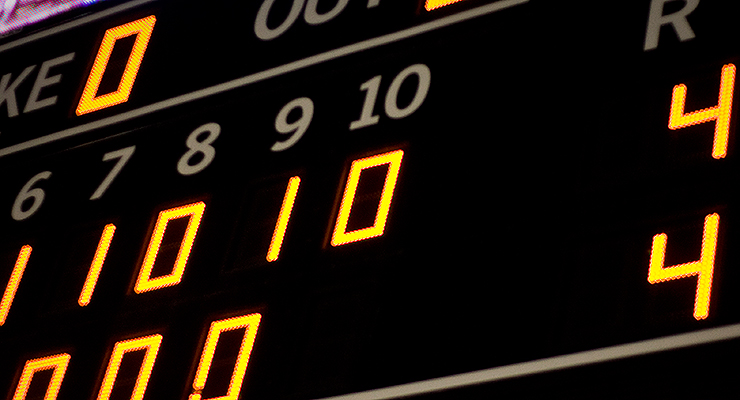

Baseball does not have overtime; it has extra innings. If a game is tied after nine innings, the teams keep playing full innings until one team is ahead at the end of an inning. In MLB regular season games since 2020, each extra inning begins with a runner already on second base, a rule made permanent in 2023. In the postseason there is no automatic runner, so games follow traditional rules until someone wins.
How Extra Innings Work
Each extra inning is a normal inning: the visiting team bats in the top half and the home team in the bottom half. If the visitors score and the home team fails to match it, the game ends. If the home team takes the lead in the bottom half, the game ends immediately, a walk off. There is no limit on the number of extra innings, and a game can only end in a tie in rare cases, such as weather, when it may be suspended and finished later.
The Automatic Runner Rule
MLB introduced the automatic runner, also called the ghost runner or Manfred runner, in 2020 to shorten long extra inning games during the pandemic season. It was used again in 2021 and 2022 and became permanent for the regular season in 2023. The runner is the player in the batting order just before the inning’s leadoff hitter. The rule has made extra inning marathons rare, since a sacrifice bunt and a fly ball can score a run. Our full explainer on the ghost runner rule covers the strategy and statistics behind it.
Extra Innings in the Playoffs
The automatic runner is not used in the postseason. That keeps the traditional rules for the biggest games, and it is why the playoffs still produce long games, including the 18 inning Game 3 of the 2018 World Series between the Red Sox and Dodgers, which lasted more than seven hours. The 2025 World Series ended in extra innings too, when the Dodgers won Game 7 in 11 innings in Toronto.
The Longest Games Ever
The longest MLB game by innings was a 26 inning, 1 to 1 tie between the Brooklyn Robins and Boston Braves on May 1, 1920, called because of darkness. The longest by time was a 25 inning game between the White Sox and Brewers in 1984 that took 8 hours and 6 minutes over two days. The longest professional game of all was a Triple A game between the Pawtucket Red Sox and Rochester Red Wings that started in April 1981, was suspended after 32 innings and was finished in June, when Pawtucket won in the 33rd.
The Bottom Line
Baseball has no overtime and no time limit: tied games go to extra innings until there is a winner. In the MLB regular season each extra inning starts with a runner on second, while the playoffs use traditional extra innings. Official definitions are in the MLB glossary, and game records are kept by Baseball Reference.
More baseball rules: how long are baseball games · what is a walk off · MLB rainout rules