
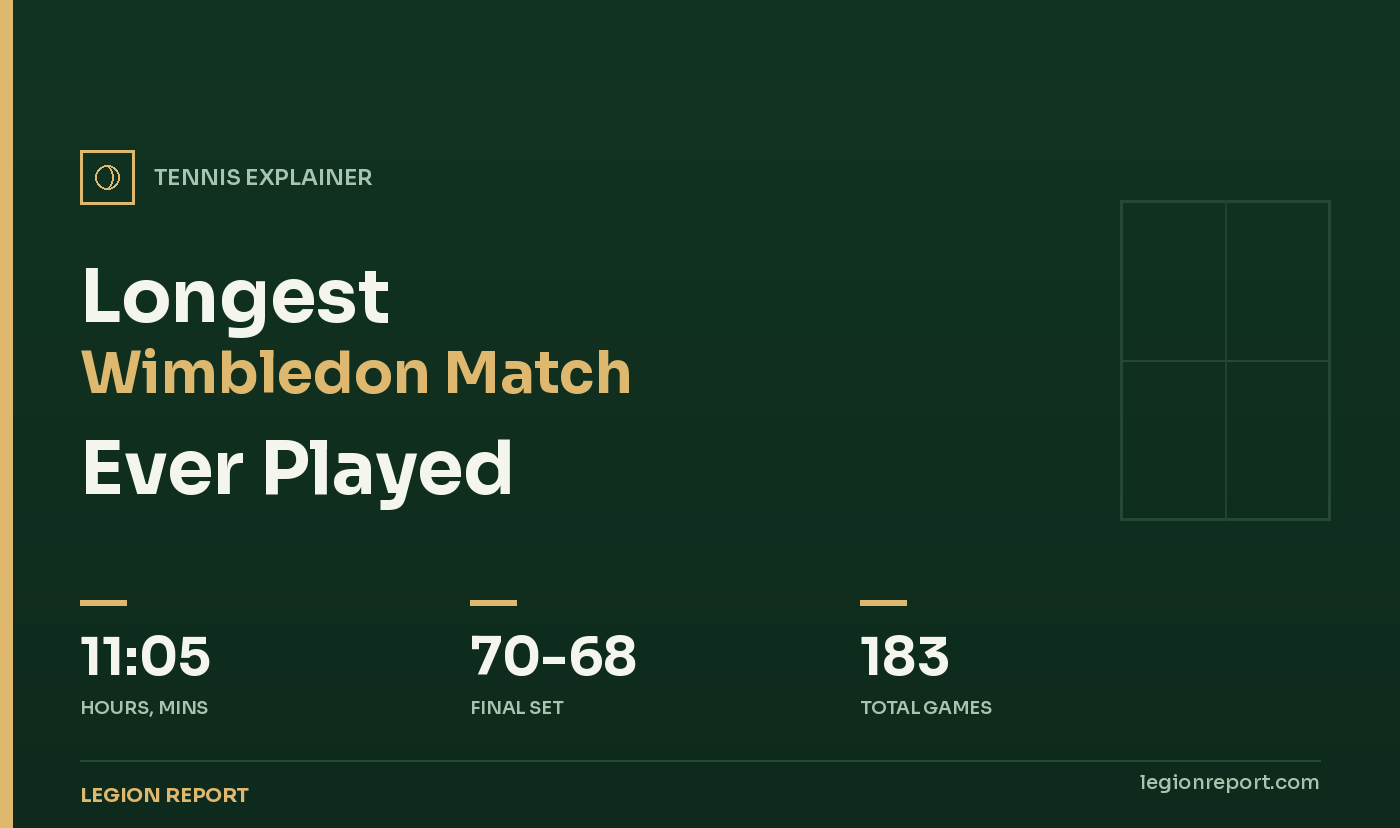

Every June, Wimbledon delivers drama on its famous grass courts, but no match in the tournament’s long history compares to what happened on Court 18 in 2010. Over three days, American John Isner and French qualifier Nicolas Mahut played the longest tennis match ever, an 11-hour, 5-minute marathon that shattered records, broke the scoreboard, and became a global sensation. It is a record that, thanks to rule changes, may now stand forever.
What began as a forgettable first-round match turned into one of the most extraordinary sporting events of all time. The fifth set alone lasted 8 hours and 11 minutes, longer than any complete match ever played, and ended with an almost unbelievable score of 70 games to 68. The two players combined for over 200 aces and held serve 168 times in a row before Isner finally broke through.
The chart below breaks down the longest Wimbledon match ever, the staggering numbers, how it unfolded over three days, and the other longest matches in tennis history. Take a look, then we’ll relive how it happened.
An ordinary match that became history
When John Isner and Nicolas Mahut walked onto Court 18 on Tuesday, June 22, 2010, no one expected anything memorable. Isner was the 23rd seed, Mahut a French qualifier, and it was a routine first-round match on an outside court. The two split the first four sets, with Isner taking the first and fourth and Mahut the second and third, the third and fourth both decided by tiebreaks. With the match level at two sets all and darkness falling over the All England Club, play was suspended for the night. The real story had not even begun.
The reason the match could stretch so far comes down to the rules of the era. In 2010, Wimbledon did not use a tiebreak in the final set, meaning the fifth set had to be won by two clear games, no matter how long that took. With two big servers locked in combat, neither man could break the other, and the set simply kept going, and going, and going, into territory no tennis match had ever entered.
The endless fifth set
When play resumed on Wednesday, June 23, the fifth set turned into a phenomenon. Isner and Mahut traded service holds relentlessly, neither able to gain the crucial break. The games piled up, past 20-all, past 30-all, past 40-all, and a global audience began to tune in, drawn by the sheer absurdity of what was happening. The electronic scoreboard, which had only been programmed to display scores up to 47-47, simply gave up and malfunctioned, a detail that perfectly captured how far beyond all precedent the match had gone.
By the time darkness forced another suspension on Wednesday night, the fifth set stood at an almost incomprehensible 59 games all. The players had been holding serve for what felt like an eternity, eventually reaching 168 consecutive service holds. More than seven hours of tennis had been played on that second day alone, itself longer than any previous complete match in history. Both men were running on fumes, yet neither would yield.
The finish on day three
On Thursday, June 24, the two exhausted players returned for a third day to settle it. After more holds, the breakthrough finally came at 68-68. Mahut, who had fought so heroically, faltered just slightly on his serve, and Isner pounced, sealing the win with a down-the-line backhand pass on his fourth match point. The American collapsed to the grass in celebration and exhaustion. The fifth set had lasted 8 hours and 11 minutes; the entire match, 11 hours and 5 minutes over three days, with a final score of 6-4, 3-6, 6-7(7-9), 7-6(7-3), 70-68.
The numbers remain staggering. The match featured 183 total games and 980 points, with 711 of those points coming in the fifth set alone. Isner served 113 aces and Mahut 103, a combined 216 that obliterated the previous single-match record of 78. In a final twist of irony, the depleted Isner lost his next match, the second round, in just 74 minutes, the shortest men’s match of that entire tournament.
The record that may never be broken
What makes the Isner-Mahut match truly unique is that it almost certainly cannot be surpassed, because the rules that allowed it have since been changed. Fittingly, it was Isner himself who triggered the change: after he lost another marathon, the 2018 Wimbledon semifinal to Kevin Anderson by a fifth set of 26-24, the All England Club ended over a century of tradition and introduced a final-set tiebreak at 12-12 in 2019.
Then, in 2022, all four Grand Slams adopted a uniform rule: a 10-point tiebreak is now played if the final set reaches 6-6. Under these rules, a 70-68 fifth set is mathematically impossible. That means the Isner-Mahut match stands not just as the longest match ever played, but very likely the longest that will ever be played. It was so culturally significant that it inspired an HBO mockumentary, “7 Days in Hell,” and earned a commemorative plaque on Court 18.
Final Word
The longest Wimbledon match ever, and the longest in all of tennis, is the 2010 first-round battle between John Isner and Nicolas Mahut, an 11-hour, 5-minute epic spread across three days and decided by a fifth set of 70-68. With 183 games, 216 aces, and a scoreboard that literally could not keep up, it transformed two relatively unheralded players into legends and produced a record that rule changes have very likely made permanent.
It remains one of the most remarkable feats of endurance in sports history, a reminder that even an ordinary first-round match can become something unforgettable. For more on the sport’s biggest stage, see our breakdown of Wimbledon prize money.