
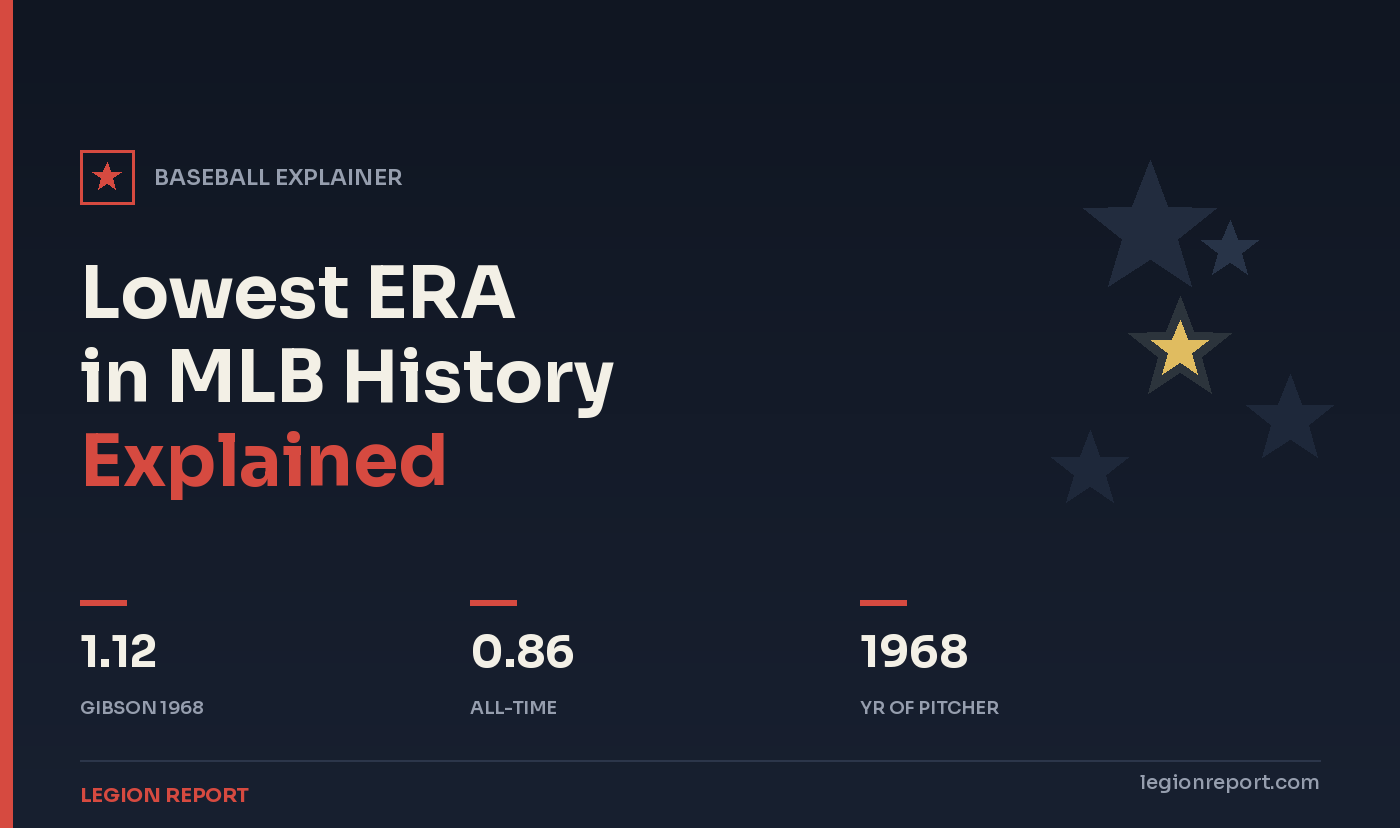

Earned run average, or ERA, is the classic measure of a pitcher’s dominance: the average number of earned runs they allow per nine innings. The lower the number, the better, and the lowest figures in baseball history belong to some of the most legendary arms the game has ever seen. But asking for the “lowest ERA in MLB history” actually has two answers, and the difference between them is the key to understanding the whole topic.
The raw all-time record belongs to the dead-ball era, when the entire sport was low-scoring: Tim Keefe posted a microscopic 0.86 ERA back in 1880. But the number most fans really mean is the modern, live-ball-era record, and that belongs to Bob Gibson, whose 1.12 ERA in 1968 was so dominant it helped force baseball to change its rules. Understanding both, and why they are so different, is what this guide is about.
The chart below breaks down the lowest ERAs in baseball history: the all-time single-season list, the live-ball-era record, the best marks since the mound was lowered, the career leaders, and the era context behind the numbers. Take a look, then we’ll get into the details.
The two answers to “lowest ERA ever”
When someone asks for the lowest ERA in MLB history, the honest answer is that it depends on the era. The raw, all-time single-season record is Tim Keefe’s 0.86 ERA from 1880, a number that looks almost impossible today. But Keefe pitched in the dead-ball era, a time when home runs were rare, the baseball itself was soft and often used for entire games, and scoring across the whole league was minimal. In that environment, tiny ERAs were far more achievable, and most of the all-time leaderboard comes from this period.
That is why the more meaningful number for modern fans is the live-ball-era record, the lowest ERA since offense returned to the game around 1920. That record belongs to Bob Gibson and his legendary 1.12 ERA in 1968. Comparing Gibson’s 1.12 to Keefe’s 0.86 is not quite fair, because they pitched in completely different versions of baseball, which is exactly why the records are tracked separately.
Bob Gibson and the Year of the Pitcher
Bob Gibson’s 1968 season is the gold standard of modern pitching dominance. The St. Louis Cardinals ace posted a 1.12 ERA over 304.2 innings, going 22-9 with 13 shutouts, 268 strikeouts, and 28 complete games in 34 starts. His 1.12 mark was the lowest in the major leagues since Dutch Leonard’s 0.96 in 1914, a gap of 54 years, and both his ERA and his 13 shutouts remain live-ball-era records. For one stretch in June and July, Gibson allowed just six earned runs across 108 innings, an absurd 0.50 ERA.
So thorough was the pitching dominance of 1968, remembered as the “Year of the Pitcher,” that the league-wide ERA fell to 2.98 and offense cratered across baseball. Gibson won a unanimous Cy Young Award and the National League MVP. The response from Major League Baseball was historic: to restore balance, the league lowered the pitching mound and shrank the strike zone for 1969. In other words, Gibson pitched so well that baseball changed its rules, the ultimate compliment to a single season.
The dead-ball era greats
The reason the all-time leaderboard is dominated by names like Tim Keefe, Dutch Leonard, Mordecai Brown, and Christy Mathewson is the unique nature of the dead-ball era, roughly 1904 to 1919, when the league-average ERA was just 2.82, the lowest in baseball history. With so little offense leaguewide, the best pitchers could post sub-1.50 and even sub-1.00 ERAs over full seasons. Mordecai “Three Finger” Brown, who famously lost parts of two fingers in a childhood farm accident and used the resulting grip to devastating effect, ran off six straight 20-win seasons and a 1.04 ERA in 1906.
A notable recent addition to these records came in 2024, when Major League Baseball officially incorporated Negro League statistics. That brought new names onto the leaderboard, including Satchel Paige’s 1.01 ERA from 1944, recognized alongside the established marks. These additions reflect that the talent in the Negro Leagues was on par with the segregated white major leagues of the time.
The best of the modern game
Since the mound was lowered in 1969, no pitcher has come especially close to Gibson’s 1.12. The lowest qualified ERA of the post-1969 era belongs to Dwight Gooden, whose 1.53 in 1985 powered one of the great seasons by a young pitcher. Greg Maddux was nearly untouchable in the mid-1990s with a 1.56 in 1994 and 1.63 in 1995, and more recently Jacob deGrom’s 1.70 in 2018 ranked among the best marks since the change. Ron Guidry’s 1.74 in 1978 set the American League standard for the modern era, matched by Pedro Martinez’s 1.74 in 2000.
Relief pitchers, working far fewer innings, have occasionally gone even lower. Rollie Fingers posted a 1.04 ERA in the strike-shortened 1981 season on his way to winning both the Cy Young and MVP awards. But for a starting pitcher carrying a full workload, anything under 2.00 is now considered historically elite, a testament to how much harder it is to suppress runs in the modern, higher-scoring game.
The lowest career ERAs
Single seasons aside, the lowest career ERA in MLB history belongs to Ed Walsh, the spitball master who finished with a 1.82 ERA over a career spent almost entirely in the dead-ball era. Right behind him is Addie Joss at 1.89, another dead-ball star whose career was tragically cut short. The career list, like the single-season one, is dominated by pitchers from that low-scoring period, since maintaining a sub-2.00 ERA across thousands of innings is essentially impossible in the modern game.
To put it in perspective, the best modern starters, the Greg Madduxes and Clayton Kershaws of the world, finish their careers with ERAs in the low-to-mid 2.00s and are considered all-time greats for it. The gap between those numbers and Walsh’s 1.82 is almost entirely a product of the era each pitched in, which is the recurring theme of every ERA record: context is everything.
Final Word
The lowest ERA in MLB history is Tim Keefe’s 0.86 from 1880, but that dead-ball-era number comes with an asterisk of context. The record most fans mean, and the one that resonates today, is Bob Gibson’s 1.12 in 1968, the live-ball-era record and a season so dominant it prompted baseball to lower the mound. For career marks, Ed Walsh’s 1.82 stands above all others. Each of these numbers tells the story of a different era of the game.
ERA records are a reminder that baseball statistics can never be read without their context: a 1.12 in 1968 and a 1.70 today represent similarly otherworldly dominance, even though the numbers differ. For more on the game’s greatest pitching feats, see our breakdown of the most strikeouts in one game.