

“He was optioned to Triple-A.” “He’s out of options.” “They can’t send him down without waivers.” No piece of baseball jargon confuses more fans than the option system, and none explains more roster moves. Options are the invisible currency that determines which struggling young player gets sent to the minors overnight and which one a team is forced to keep, trade, or lose, and misunderstanding them is why fans are perpetually baffled that the worse player stayed.
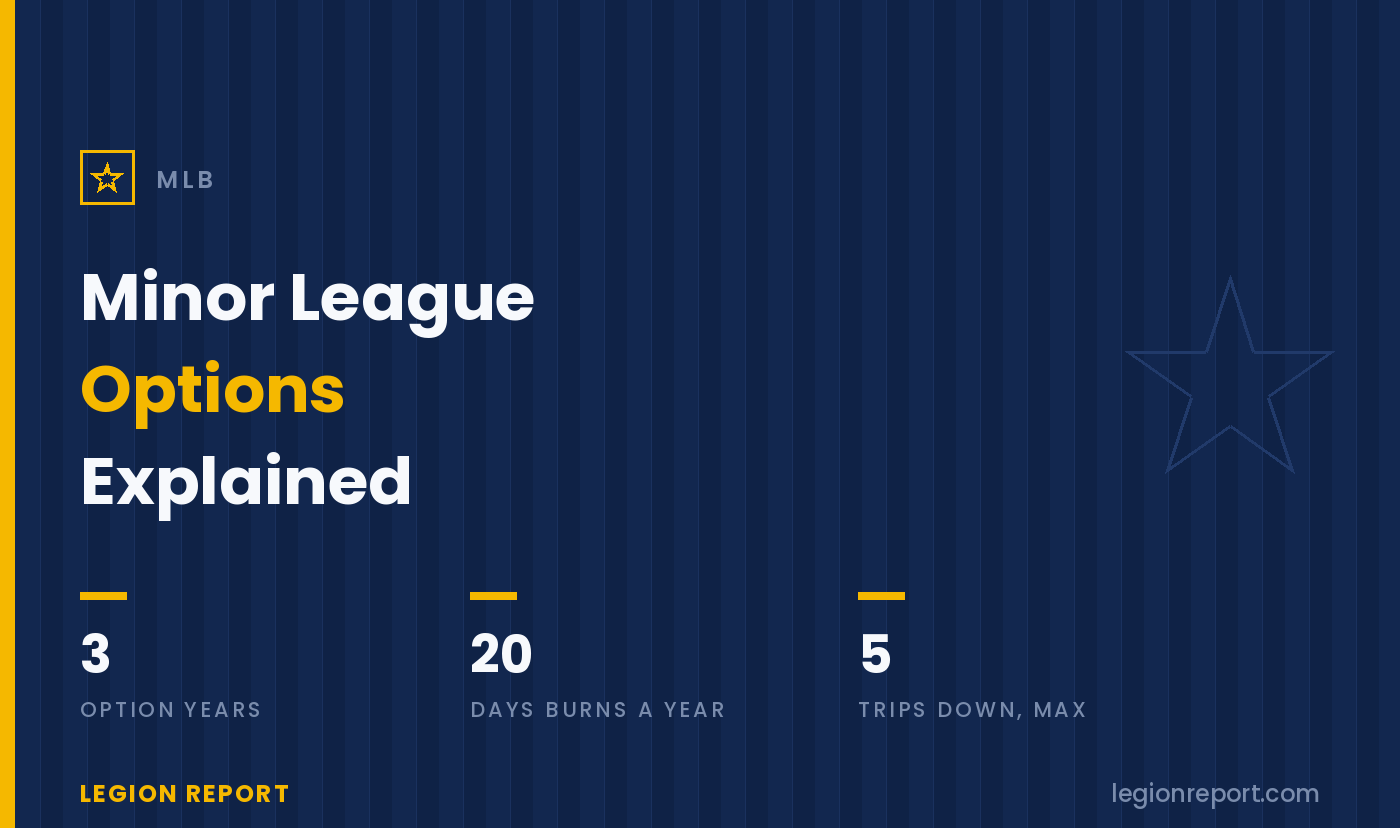
The rules are genuinely simple once stated plainly: three option years per player, each one burned by spending 20+ days in the minors in a season, unlimited shuttling within a year (up to a cap), and, when the options run out, a one-way door guarded by the waiver wire.
The chart below covers what an option actually is, how option years get used, the shuttle rules and limits, what “out of options” really means, and how teams weaponize all of it. Take a look, then we’ll break it all down.
The right to send a player down
An option, formally an “optional assignment”, is a team’s right to move a player from the 40-man roster to the minor leagues without offering him to the other 29 clubs. That last clause is the entire point: baseball’s default rule is that big-leaguers can’t simply be stashed in Triple-A, so options are the exemption that makes player development possible, and every player receives exactly three of them (with a fourth granted to those who used their third before completing five professional seasons). The crucial subtlety is that an option is a year, not a trip: spending 20 or more total days in the minors during a season burns that season’s option, after which the player can shuttle up and down freely for the rest of the year, subject to two modern guardrails, no more than five option assignments per season, and minimum stays of 15 days for pitchers and 10 for position players before recall (injury replacements excepted). Both limits were 2022 CBA reforms targeting the “fresh arm shuttle” that had turned Triple-A bullpens into conveyor belts.
The cliff, and why the worse player made the team
“Out of options” is where the system grows teeth. Once a player’s three (or four) option years are gone, the frictionless elevator closes: sending him down now requires passing him through waivers first, where any team can claim him and his contract for nothing, and five-plus-year veterans can refuse minor-league assignments entirely. This single rule solves spring training’s most reliable mystery, why the demonstrably worse player made the roster over the shiny prospect. The prospect has options: he can be stashed in Triple-A at zero risk and recalled in May. The out-of-options journeyman cannot: cutting him means losing him for free. So the 26th roster spot goes, rationally and almost every March, not to the most talented candidate but to the least keepable one, while the better player “loses” the battle and opens the year a phone call away. It looks like a mistake; it’s inventory management.
Options as currency
Front offices track option status the way they track velocity, because it converts directly to value. A reliever with two options remaining is a different asset than his identical twin without them: one can ride the shuttle for two more seasons of flexible depth, the other is a waiver claim waiting to happen, and “he still has options” is a genuine line item in trade negotiations league-wide. The system also explains the transaction wire’s grimmer vocabulary: a player who is out of options and squeezed off the roster gets designated for assignment, the seven-day limbo of trade-waive-or-release, and the option-status column quietly drives most of the DFAs you’ll read about this summer. For fans, the practical takeaway is a decoder ring: when a roster move seems inexplicable, the young star sent down in April, the mediocre veteran protected in March, the reliever recalled for one game, check the option math before questioning the manager. In baseball’s roster economy, talent proposes, but options dispose.
Final Word
Minor league options, explained: three option years per player (a fourth for the youngest), each burned by 20-plus days in the minors, allowing free shuttling within a season up to five trips, with 15-day pitcher and 10-day hitter minimums; exhaust them and the player is “out of options”, unmovable without waivers, which is why March rosters keep the least-keepable over the most talented, why option status is trade currency, and why half the confusing transactions in any given week are just this system doing arithmetic in public.
The roster these rules govern is mapped in the 40-man vs. 26-man roster, where out-of-options players end up is covered in the trade deadline, explained, and how players enter the system is in the MLB Draft, explained.