
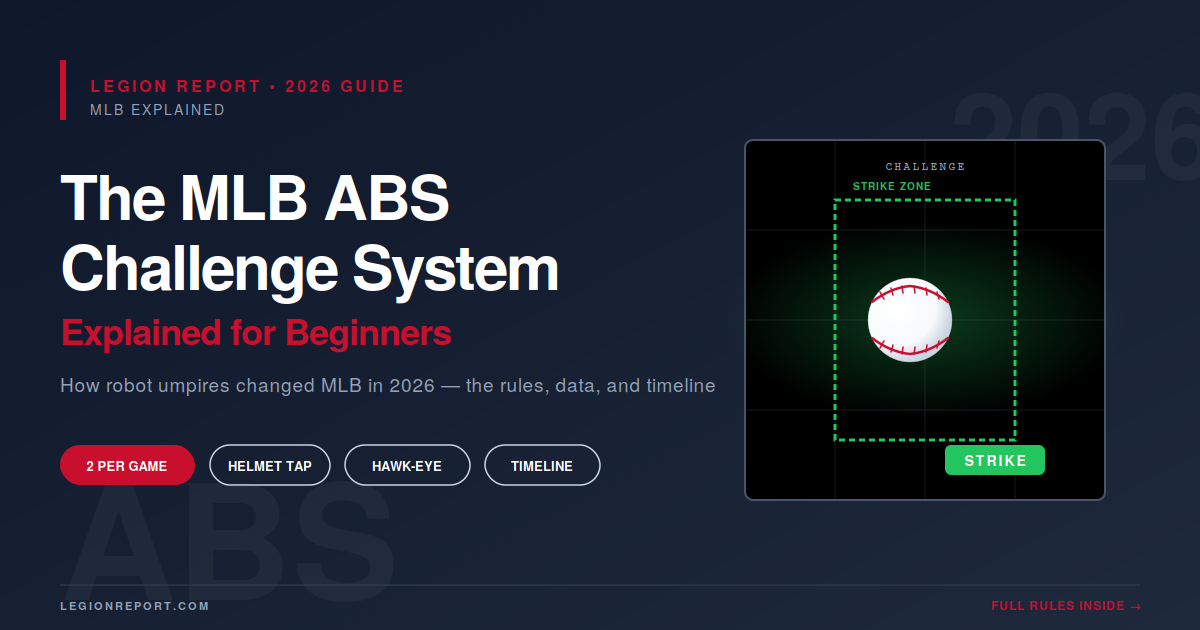

The MLB Automated Ball-Strike (ABS) Challenge System lets pitchers, catchers, and batters challenge ball and strike calls by tapping their helmet immediately after a pitch. Each team gets two challenges per game and keeps successful ones. Introduced league-wide in the 2026 season, ABS uses 12 Hawk-Eye cameras and T-Mobile’s 5G network to review pitches against a player-specific strike zone in about 15 seconds. Here’s exactly how it works, when it started, and what the early 2026 data shows.
How the ABS challenge works (step by step)
The ABS challenge process is intentionally fast and simple. Immediately after a pitch — before the next pitch is delivered — a pitcher, catcher, or batter can challenge the call by tapping their helmet or hat. No one in the dugout can signal whether to challenge; the decision has to come from the player on the field, in real time. The home plate umpire acknowledges the challenge by signaling to the crowd, and the pitch is then replayed via animation on the stadium videoboard and the TV broadcast. The animation shows the ball’s exact trajectory passing through the strike zone (or missing it), and the umpire’s call is either confirmed or overturned. The entire process takes about 15 seconds — significantly faster than a traditional replay review, which can take 2-4 minutes.
The strike zone used by ABS is player-specific. Before the season, each MLB player has their strike zone measured based on their actual height — the top of the strike zone is set at 53.5% of the player’s height, and the bottom is set at 27%. The width is the standard 17 inches plus the diameter of the baseball on each side. If any part of the ball touches any part of this 3D strike zone box, it’s ruled a strike. This is different from how umpires call pitches subjectively — they account for catcher framing, the count, and the situation. ABS doesn’t care about any of that. The data on this is striking: MLB umpires call about 94% of pitches correctly according to UmpScorecards, meaning roughly 6% of pitches are misjudged — which is exactly the gap ABS is designed to close on the most important pitches.
When did the ABS system start in MLB
The ABS Challenge System officially debuted in MLB on March 25, 2026 — Opening Night, with the New York Yankees facing the San Francisco Giants in the first-ever live MLB broadcast on Netflix. But like the pitch clock, ABS had been in development for years before its MLB rollout. The Atlantic League (an independent professional league) tested fully-automated ball-strike calling starting in 2019-2021, providing the first real data on how the technology performed in actual games. MLB began Triple-A testing in 2022, initially using ABS to call every single pitch (the “robot umpire” version). After player feedback indicated they preferred limited challenges over fully automated calls, MLB shifted to testing the challenge format in 2024. In 2025, ABS was used during MLB spring training games and the 2025 All-Star Game, generating the data and player buy-in needed for full implementation. On September 23, 2025, the Joint Competition Committee (six owners, four players, one umpire) officially approved ABS for 2026.
Spring training 2026 data showed the system working as intended. Across 1,844 challenges in spring games, 53% were successful (overturning the umpire’s call). Defensive challenges (initiated by pitchers and catchers) succeeded 60% of the time, while batter-initiated challenges succeeded only 45% of the time. The average was 4.32 challenges per game, with 2.28 successful. Team-by-team data revealed strategic differences: the Chicago Cubs led MLB hitters with a 65% overturn rate, while the St. Louis Cardinals led the defense at 75% successful. On the other end, the Kansas City Royals’ batters were right only 31% of the time on their challenges. This suggests that ABS rewards teams that train their catchers to recognize the exact edges of the strike zone better than hitters can in real time.
ABS strategy and edge cases worth knowing
Several restrictions and edge cases are worth understanding. First, you cannot challenge a pitch when a position player is pitching (rare, but it happens in blowout games). Second, both an ABS challenge and a traditional replay review can occur on the same play — the ball/strike call is settled first via ABS, then any other play (like a tag at home) is reviewed via traditional replay. Third, the extra-innings rule: if a team enters an extra inning with zero challenges remaining, they’re awarded one additional challenge for that inning. If they don’t use it, it doesn’t carry forward; the challenge resets each extra inning. Teams that still have one or both of their original challenges going into extras don’t get a bonus challenge.
For continuously updated ABS challenge data, leaderboards, and team-by-team success rates throughout the 2026 season, MLB.com’s official ABS rules page is the authoritative source. For deeper statistical analysis of umpire accuracy and how ABS is changing the strike zone, Baseball Savant publishes the most comprehensive pitch tracking and challenge data with daily updates.
The honest summary on the MLB ABS Challenge System: it’s the biggest officiating change in baseball history, but its impact on the average game is smaller than the controversy suggested. Most challenges happen on borderline pitches in high-leverage situations — full counts, runners in scoring position, or critical at-bats. The 15-second resolution means challenges don’t drag the game out. The 53% spring training success rate suggests umpires are still getting most calls right; ABS is more of a safety net than a replacement. For fans, the most visible change is the helmet-tap and scoreboard animation — both quick enough that the game keeps moving. Combined with the pitch clock (introduced in 2023), the 2026 MLB game is faster AND more accurate than the version played as recently as 2022. The robot umpire era hasn’t fully arrived, but its influence is now on the field.
— Drew, Legion Report