
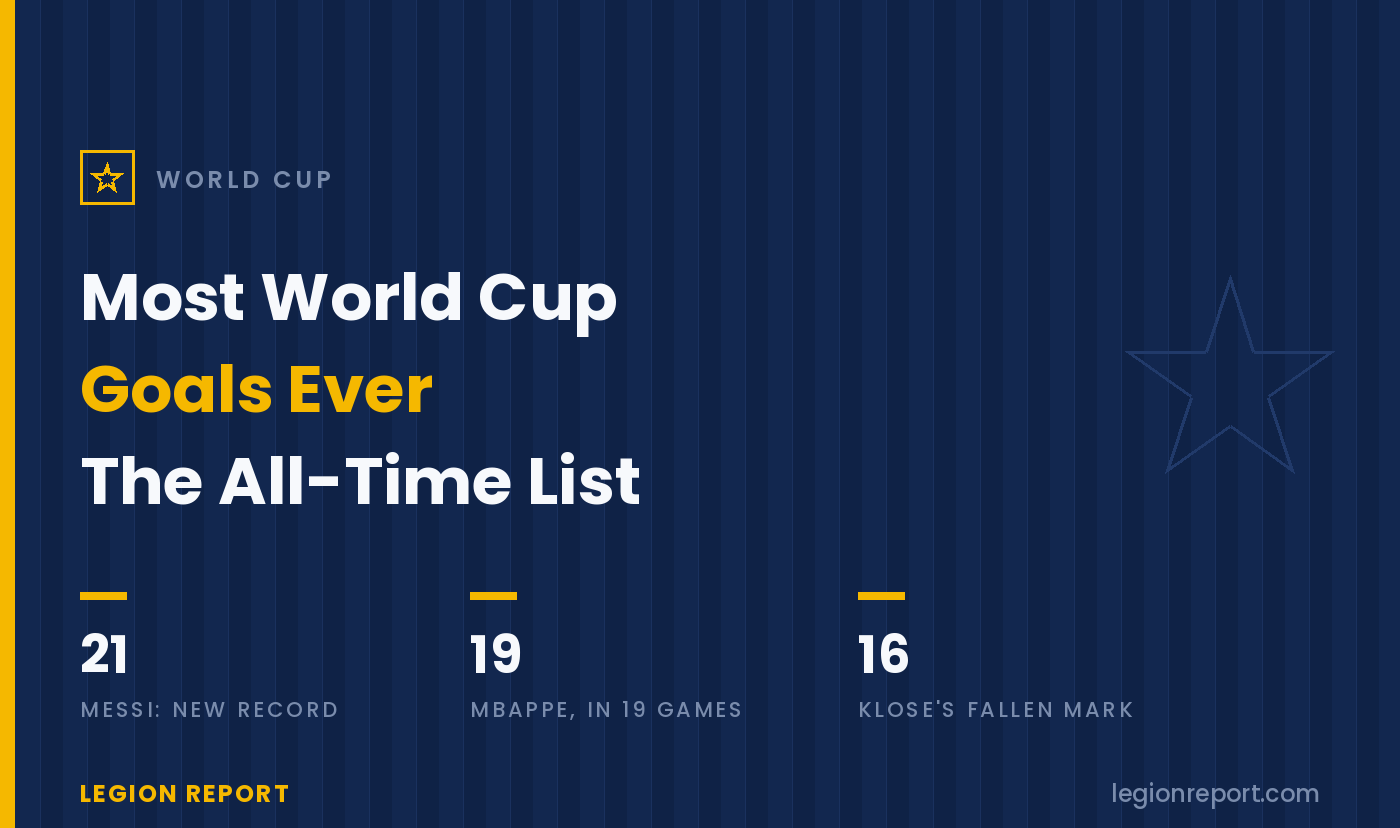

For twelve years, the answer to “who has scored the most goals in World Cup history?” was Miroslav Klose, the German poacher whose 16 goals across four tournaments looked like one of football’s more durable records. Then the 2026 World Cup arrived, and in the space of three weeks the record did not just fall, it was left behind, with the two men responsible still on the pitch and still scoring, and now a third legend climbing the list behind them.
Lionel Messi is the all-time leading scorer in World Cup history with 21 goals, having blown past Klose’s mark with a staggering 2026 run: eight goals and counting, capped by a round-of-16 strike against Egypt that extended his own record scoring streak to nine straight World Cup matches. He is being chased in real time: Kylian Mbappé sits second on 20 goals in a scarcely believable 20 matches, one behind after scoring against Morocco in Thursday’s quarterfinal, and Harry Kane has quietly surged to 14, tying the legendary Gerd Müller for fifth all-time, with all three still alive in this weekend’s quarterfinals.
The chart below covers the most World Cup goals ever: the full all-time rankings, how the record has changed hands, Messi’s 2026 rampage game by game, and the records within the record. Take a look, then we’ll get into it.
The record that fell, then kept falling
Klose’s 16 stood for twelve years because World Cup scoring records are uniquely hard to build: a player gets at most seven matches every four years, and even generational scorers need four healthy tournaments and deep national-team runs to compile a total. Which is what makes 2026’s demolition so absurd. Messi arrived on 13, drew level with Klose via the oldest hat-trick in World Cup history in the opener (38 years, 356 days), passed him with a brace against Austria on June 22, and has simply continued, a free kick against Jordan, the R32 opener against Cabo Verde, and the round-of-16 goal against Egypt on July 7 that made it 21 and stretched his own record to nine consecutive World Cup matches scored in, a streak alive since the 2022 final. Eight goals in six games, in his record sixth World Cup and record 31st appearance, at an age when every previous great was a decade retired. He entered the tournament as the consensus greatest player ever; he’ll leave it holding the tournament’s biggest number, still growing.
The chasers: a goal a game, and a quiet Englishman
What makes this record era different from Müller’s, Ronaldo’s, or Klose’s is that the new mark is under threat while it’s being set. Mbappé’s 20 goals have come in 20 matches, a goal-per-game pace across three tournaments no one in the list’s history approaches, built on four goals as a teenager in France’s 2018 title run, eight in 2022 (including a final hat-trick, part of his untouchable record four goals in World Cup finals), and eight this summer, the latest arriving Thursday against Morocco, minutes after a saved penalty, to pull him within ONE goal of Messi’s record. He is 27; the arithmetic writes itself. And beneath the headline duel, Harry Kane has staged the list’s stealth climb: six goals this tournament (many from his record six career World Cup penalties) have lifted him to 14, level with Gerd Müller for fifth all-time, in only 16 matches, meaning England’s quarterfinal against Norway on Saturday doubles as a record chase inside a record chase, with Haaland’s seven-goal debut on the opposite team sheet. Even Cristiano Ronaldo joined the rewriting, reaching 11 (tied with Kocsis and Klinsmann) while becoming the only player ever to score in six World Cup editions and the oldest knockout-stage scorer in history at 41.
Where the race goes from here
The list is live through at least this weekend, and possibly through July 19. Mbappé struck first in Thursday’s quarterfinal against Morocco in Boston to reach 20, one behind; Argentina meets Switzerland in Kansas City and England faces Norway in Miami on Saturday (Messi extending, Kane climbing); and because Argentina and France sit in opposite halves of the bracket, the only place the top two scorers in World Cup history can meet is the final at MetLife, a rematch of 2022’s epic, with the all-time record potentially changing hands or being padded live on the sport’s biggest stage. The long view favors the chaser: Messi, in what is widely expected to be his final World Cup, is setting a number; Mbappé, with two or three more tournaments in his prime, is being handed a target that, on his current pace, sits roughly one good group stage away. This page updates after every Argentina, France, and England match, which this month means constantly.
Final Word
The most World Cup goals ever, as of right now: Lionel Messi, 21 and counting, the record seized from Miroslav Klose’s 16 on June 22 and padded through the oldest hat-trick in tournament history, a nine-game scoring streak, and a record 31 appearances, with Kylian Mbappé second at 20 goals in 20 matches, one back after scoring against Morocco, and closing, Harry Kane newly tied with Gerd Müller for fifth at 14, and Cristiano Ronaldo at 11 having scored in six straight editions. Three of the top six play quarterfinals this week, the top two can only meet in the final, and a leaderboard that froze for twelve years is being rewritten game by game. Check back after every whistle.
This tournament’s scoring race is tracked in World Cup Golden Boot winners by year, Fontaine’s untouchable single-tournament mark is explored in most goals in a World Cup tournament, and the leader’s full ledger lives in Messi’s career goals by year.