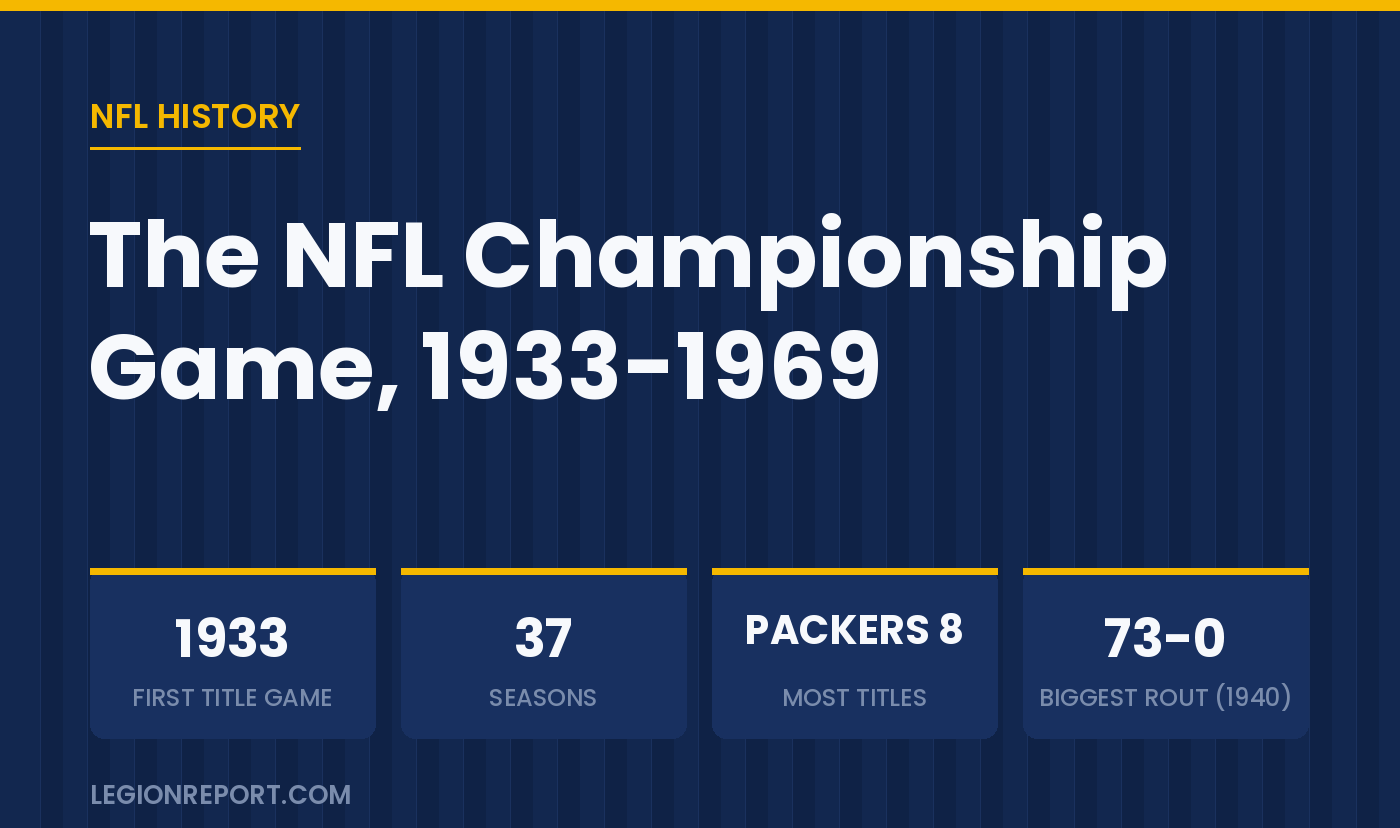
Before the Super Bowl, there was the NFL Championship Game — the league’s title game from 1933 through 1969, played by the two division (later conference) winners for the right to be called world champions. It produced some of the sport’s most mythologized moments: the Bears’ 73-0 rout of Washington in 1940, the Colts’ overtime win over the Giants in 1958 that’s still called “the greatest game ever played,” and the Ice Bowl in Green Bay in 1967. When the AFL and NFL merged, the game became the NFC Championship, and its AFL counterpart became the AFC Championship — which is why the Super Bowl era’s conference title games are direct descendants of it.
For the first 13 seasons of its existence (1920-1932), the NFL had no playoff at all; the champion was simply the team with the best record, and ties and disputes were common. A 1932 tiebreaker game between the Bears and Portsmouth Spartans, moved indoors to Chicago Stadium by a blizzard and played on an 80-yard field, was so popular that the league split into two divisions the next year and made the championship game permanent. It ran 37 seasons.
The chart below has every NFL Championship Game from 1933 to 1969, the dynasties that dominated it, and how it evolved into the modern conference championships. Take a look, then we’ll get into the game’s legacy.
NFL HISTORY
The NFL Championship Game, 1933-1969
Every title game before the Super Bowl era — and how it became the conference championships
FIRST
1933
Bears 23, Giants 21
LAST
1969
Vikings 27, Browns 7
MOST TITLES
Packers, 8
Bears 6, Browns 4
BIGGEST ROUT
73-0
Bears over Washington, 1940
Every NFL Championship Game
37 seasons, newest first
| Season | Champion | Score | Runner-up | Note |
|---|
| 1969 | Vikings | 27-7 | Browns | Last NFL Championship before the merger; Vikings lost Super Bowl IV |
| 1968 | Colts | 34-0 | Browns | Colts then lost Super Bowl III to Namath’s Jets |
| 1967 | Packers | 21-17 | Cowboys | The Ice Bowl, -13 F at Lambeau; Starr’s QB sneak |
| 1966 | Packers | 34-27 | Cowboys | Winner played in the first Super Bowl |
| 1965 | Packers | 23-12 | Browns | Jim Brown’s final game |
| 1964 | Browns | 27-0 | Colts | Cleveland’s last title |
| 1963 | Bears | 14-10 | Giants | Halas’s last championship |
| 1962 | Packers | 16-7 | Giants | Second of Lombardi’s five |
| 1961 | Packers | 37-0 | Giants | Lombardi’s first title, at Green Bay |
| 1960 | Eagles | 17-13 | Packers | Lombardi’s only playoff loss |
| 1959 | Colts | 31-16 | Giants | Rematch of 1958 |
| 1958 | Colts | 23-17 (OT) | Giants | ‘The Greatest Game Ever Played’; first sudden-death title game |
| 1957 | Lions | 59-14 | Browns | Detroit’s last championship |
| 1956 | Giants | 47-7 | Bears | At Yankee Stadium |
| 1955 | Browns | 38-14 | Rams | Otto Graham’s final game |
| 1954 | Browns | 56-10 | Lions | |
| 1953 | Lions | 17-16 | Browns | |
| 1952 | Lions | 17-7 | Browns | |
| 1951 | Rams | 24-17 | Browns | Rams’ only L.A. NFL title until 1999 |
| 1950 | Browns | 30-28 | Rams | Browns won the title in their first NFL season after joining from the AAFC |
| 1949 | Eagles | 14-0 | Rams | In a Los Angeles rainstorm |
| 1948 | Eagles | 7-0 | Cardinals | In a Philadelphia blizzard |
| 1947 | Cardinals | 28-21 | Eagles | Chicago Cardinals’ only NFL title |
| 1946 | Bears | 24-14 | Giants | |
| 1945 | Rams | 15-14 | Washington | Cleveland Rams; moved to L.A. weeks later |
| 1944 | Packers | 14-7 | Giants | |
| 1943 | Bears | 41-21 | Washington | Sid Luckman 5 TD passes |
| 1942 | Washington | 14-6 | Bears | Ended the Bears’ 18-game win streak |
| 1941 | Bears | 37-9 | Giants | Two weeks after Pearl Harbor |
| 1940 | Bears | 73-0 | Washington | Most lopsided game in NFL history; the T-formation’s coming-out party |
| 1939 | Packers | 27-0 | Giants | |
| 1938 | Giants | 23-17 | Packers | |
| 1937 | Washington | 28-21 | Bears | Sammy Baugh’s rookie season |
| 1936 | Packers | 21-6 | Boston Redskins | Played at the Polo Grounds, N.Y. |
| 1935 | Lions | 26-7 | Giants | |
| 1934 | Giants | 30-13 | Bears | ‘The Sneakers Game’ — Giants changed to basketball shoes on a frozen field |
| 1933 | Bears | 23-21 | Giants | First NFL Championship Game, Wrigley Field |
Pro Football Reference; scores as officially recorded.
Dynasties of the era
Titles and appearances, 1933-1969
| Team | Titles (1933-69) | Appearances | Note |
|---|
| Green Bay Packers | 8 | 10 | Five under Lombardi in seven years (1961-67) |
| Chicago Bears | 6 | 10 | Four in the 1940s; the T-formation dynasty |
| Cleveland Browns | 4 | 11 | Seven straight title games 1950-55 (plus four AAFC titles) |
| Detroit Lions | 4 | 5 | Three in the 1950s; last in 1957 |
| New York Giants | 3 | 14 | Most appearances, most losses (11) |
| Baltimore Colts | 3 | 4 | 1958, 1959, 1968 |
| Philadelphia Eagles | 3 | 4 | 1948, 1949, 1960 |
| Washington | 2 | 6 | 1937, 1942 |
| Rams (Cleveland/L.A.) | 2 | 5 | 1945, 1951 |
| Chicago Cardinals | 1 | 2 | 1947 |
| Minnesota Vikings | 1 | 1 | 1969 |
How the format evolved
From no playoff to the Super Bowl
| Era | Format |
|---|
| 1920-1932 | No championship game — title awarded to the best record; disputes common |
| 1932 | One-off playoff: Bears 9, Portsmouth 0, indoors at Chicago Stadium after a blizzard |
| 1933-1966 | Eastern Division champion vs. Western Division champion; site alternated |
| 1967-1969 | Four divisions (Capitol, Century, Coastal, Central); two conference playoff games fed the Championship Game |
| 1966-1969 | NFL champion met the AFL champion in the AFL-NFL World Championship Game (Super Bowls I-IV) |
| 1970-present | Post-merger: the game became the NFC Championship; the AFL title game became the AFC Championship; both feed the Super Bowl |
CHAMPIONSHIP GAME FACTS
The Colts’ overtime win changed television
The 1958 game drew about 45 million viewers on NBC and is credited with turning pro football into a TV product — sudden death had never decided a title before.
Pre-1966 champions are still ‘world champions’
The NFL counts these titles equally with Super Bowls in franchise championship totals — the Packers’ 13 championships include 9 from this era (2 pre-1933).
The Ice Bowl was the last true one
The 1967 game was played for the NFL title, but its winner then had to face the AFL champion — the last stand-alone championship was 1965.
How the Championship Game Became the NFC and AFC Championships
When the merger took full effect in 1970, the NFL didn’t discard its championship game — it renamed it. The 16 old-line NFL teams (minus Baltimore, Cleveland, and Pittsburgh, who moved over) became the NFC, and the NFC Championship Game is the direct continuation of the 1933-69 series, with the same trophy lineage now honored by the George Halas Trophy. The 10 AFL teams plus the three movers became the AFC, and the AFL Championship Game (1960-69) became the AFC Championship, with the Lamar Hunt Trophy. Both winners advance to the Super Bowl, which absorbed the ‘world championship’ label. That’s why the conference title games still feel bigger than semifinals — for 37 years, one of them was the whole thing.
The Bottom Line
The NFL Championship Game decided the league’s title from 1933 through 1969, produced the sport’s founding legends — the 73-0 game, the 1958 overtime, the Ice Bowl — and was won most often by the Packers (8), Bears (6), and Browns and Lions (4 each). It didn’t end with the merger; it became the NFC Championship, with the AFL title game becoming its AFC twin. For the deal that made that happen, see our companion piece on the AFL-NFL merger, and for the exhibition that still opens every season in Canton, the Hall of Fame Game.