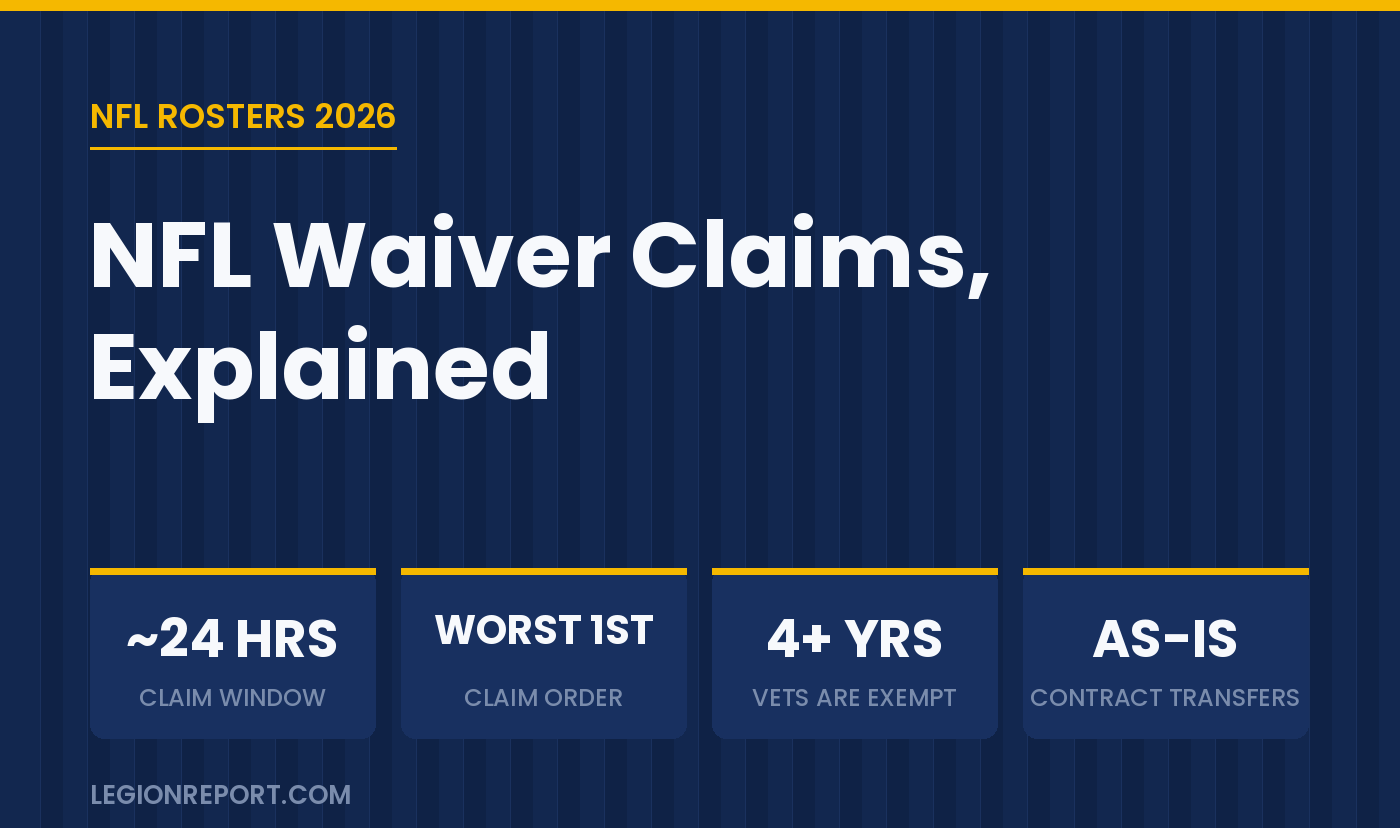
When roughly 1,180 players hit the street at the NFL’s roster cutdown on August 30, most of them don’t simply become free agents. Players with fewer than four accrued seasons pass through waivers — a roughly 24-hour window in which all 31 other teams can put in a claim, with the player awarded to the club highest in a strict priority order. It’s the league’s version of a silent auction where the price is fixed (the player’s existing contract) and only position in line matters.
The claim order is the whole game. From the start of the league year through Week 3 of the regular season, waiver priority runs in reverse order of the previous season’s standings — the team that picked first in the draft claims first. From Week 4 on, priority resets to the current season’s standings, recalculated weekly. That means cut weekend is the one moment when last year’s worst teams get first crack at every other roster’s final cuts.
The chart below covers the process step by step, the claim order rules, and what happens when multiple teams want the same player. Take a look, then we’ll get into strategy.
NFL ROSTERS 2026
NFL Waiver Claims After Final Cuts
The process, the claim order, and who gets whom
WINDOW
~24 hrs
Claims due Mon noon
PRIORITY
Worst first
Draft order thru Wk 3
EXEMPT
Vested vets
4+ accrued seasons
CONTRACT
Transfers
As-is to the claiming team
The waiver process
Six steps from cut to claimed
| Step | What happens |
|---|
| 1. Player is waived | A non-vested player (under 4 accrued seasons) is cut and placed on the waiver wire; the league notifies all clubs |
| 2. The window | Roughly 24 hours; after cut day, claims are due around noon ET Monday, Aug. 31 |
| 3. Claims submitted | Any team may claim any waived player; claiming means taking his existing contract onto your 53 |
| 4. Awarding | The team with the highest waiver priority wins; the league announces awards early afternoon |
| 5. Roster move | A claiming team must clear a spot on its 53 — often by waiving someone else, restarting the cycle |
| 6. Clearing | Unclaimed players ‘clear waivers’ and become free agents, eligible for any practice squad |
The claim order
Who picks first and when it changes
| Period | Claim priority based on |
|---|
| League year start through Week 3 | Reverse order of previous season’s standings (same as draft order) — worst record claims first |
| Week 4 through season’s end | Reverse order of current standings, recalculated each week using the same tiebreakers as draft order |
| Ties | Broken by strength of schedule, then the divisional and conference tiebreakers |
| Vested veterans (4+ seasons) | Exempt from waivers until the trade deadline — cut vets are immediate free agents; after the deadline, even vets pass through waivers |
| Multiple claims by one team | A team may claim several players but only receives those it has priority and roster room for |
Common scenarios
How claims actually play out
| Scenario | Outcome |
|---|
| Two teams claim the same rookie | The team higher in the claim order (worse record) gets him; the other gets nothing |
| Claimed player’s contract | Transfers as-is — remaining salary, no signing-bonus obligations (those stay as dead money with the cutting team) |
| Team claims a player, then cuts him a week later | Legal and common; he goes back on waivers |
| Player wants to pick his team | He has no say in a claim — only if he clears can he choose where to sign |
| Cut player with an injury settlement | Reaches free agency after the settlement; can’t re-sign with the cutting team until the settlement window passes |
| Practice squad poaching | Not a waiver process — any team can sign another club’s practice squad player directly to its 53 at any time |
WAIVER FACTS
Claims are all-or-nothing
There’s no partial claim or trade of a claim spot — you take the contract and clear a roster space, or you pass.
The wire is public knowledge fast
Claim awards leak within minutes on cut Monday; teams plan Tuesday practice squads around who they lost.
Dead money stays behind
Remaining signing-bonus proration counts against the cutting team’s cap, which is why claiming a young player on a rookie deal is nearly free.
How the NFL waiver wire and claim order work after roster cuts.
How Smart Teams Play the Wire
For rebuilding clubs, cut weekend is a second draft: with top priority through Week 3, they can claim the best young players squeezed off contenders’ rosters at no cost beyond a roster spot. Contenders play the opposite game — disguising which cuts they want back on the practice squad, timing cuts of vested veterans so they don’t hit the guarantee trigger, and occasionally trading a seventh-round pick for a bubble player rather than risking the wire. And every front office tracks the other 31 rosters’ positional logjams, because the best predictor of who gets cut — and who’s claimable — is a depth chart with one too many good players at the same spot.
The Bottom Line
Waiver claims are the NFL’s ordered redistribution of cut players: non-vested players pass through a 24-hour wire, the worst teams from last season claim first through Week 3, and claimed contracts transfer as-is. Vested veterans skip the line entirely until the trade deadline. For the cutdown that feeds the wire, see our guide to the 2026 roster cuts, and for where unclaimed players land, practice squad salaries.