
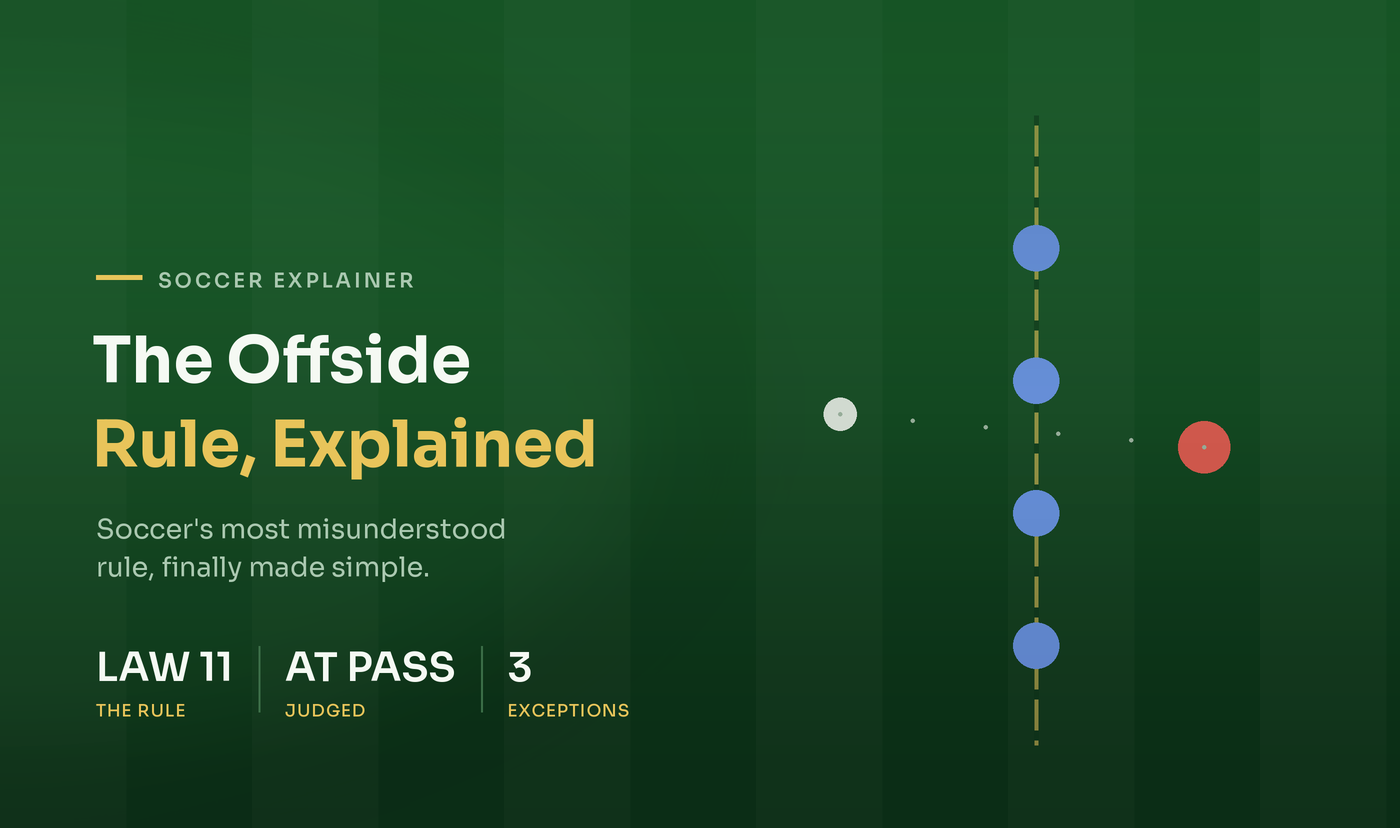

The offside rule is famously the most confusing rule in soccer, the one that sparks the most arguments and the one new fans struggle with the most. It is also one of the most important, shaping how teams attack and defend on every play. The good news is that once you separate two ideas that often get tangled together, the rule becomes much simpler than it seems. So what is the offside rule, when does it apply, and why does standing in an offside position not always mean a whistle?
With the 2026 World Cup putting soccer in front of a huge new audience, plenty of people are trying to make sense of offside for the first time. Here is a clear, complete breakdown of how it actually works.
The chart below explains the offside rule: the conditions, the key distinction, the exceptions, and the common myths. Take a look, then we’ll walk through each part.
What Is the Offside Rule?
The offside rule, written as Law 11 in the official Laws of the Game, is designed to stop attackers from gaining an unfair advantage by lurking near the opponent’s goal. In simple terms, an attacking player cannot be ahead of the ball and the defense when a teammate passes to them. The rule keeps the game spread out and forces teams to create chances through skill and timing rather than just parking a player by the goal. It is judged at the precise moment a teammate plays the ball, which is one of the details that makes it tricky to follow in real time.
Offside Position vs Offside Offense
Here is the single most important thing to understand, and the source of nearly all the confusion: being in an offside position is not against the rules. A player is in an offside position if, at the moment a teammate plays the ball, any part of their head, body, or feet is in the opponents’ half and is nearer to the opponents’ goal line than both the ball and the second-to-last defender. But that position only becomes an offense if the player then becomes involved in active play. In other words, a player can stand in an offside position all day, and as long as they do not get involved, there is no foul. The whistle only comes when both halves of the test are met.
What Counts as “Getting Involved”
A player in an offside position is penalized only when they become involved in active play in one of three ways. The first is interfering with play, meaning they touch or play a ball passed by a teammate. The second is interfering with an opponent, such as blocking the goalkeeper’s line of sight or challenging them for the ball. The third is gaining an advantage by playing a ball that rebounds off the goalpost, the crossbar, an opponent, or a match official. If a player in an offside position does none of these things, they are not penalized, which is why you will sometimes see an attacker standing in an offside position while play continues around them.
When the Offside Rule Does Not Apply
There are several situations where offside simply cannot be called, and knowing them clears up a lot of confusion. First, a player can never be offside if they receive the ball directly from a goal kick, a corner kick, or a throw-in. This is why you see attackers crowding the goal at a corner with no flag raised. Second, a player is never offside in their own half of the field; they must be in the opponents’ half. And third, a ball passed backward to a teammate cannot create an offside offense, since the receiving player is behind the ball, not ahead of it. These exceptions explain many of the moments that look like they should be offside but are not.
The Timing and the Body Parts That Count
Two technical details often trip people up. The first is timing: offside is judged at the exact instant the ball is played by the passing teammate, not when the ball arrives at the receiver. This means a fast attacker can start level with the defense, time their run, and collect the ball far ahead of the defenders, completely legally, because they were onside at the moment of the pass. The second detail is which body parts count. Only the head, body, and feet are used to judge offside, the parts a player could legally score a goal with. The arms and hands are never counted, for any player including the goalkeeper, which is why a protruding shoulder can decide a call but an outstretched arm cannot.
Why the Rule Exists and How VAR Changed It
The purpose of offside is to prevent “goal-hanging,” the tactic of leaving an attacker camped next to the opposing goal waiting for a long ball. Without the rule, soccer would devolve into hopeful long passes rather than the build-up play that defines the sport. In modern soccer, video review (VAR) has changed how offside is enforced, using precise lines drawn at the moment of the pass to judge extremely tight calls. This has made offside decisions more accurate, but also more controversial, as goals are now sometimes ruled out for a margin of just inches. The core rule, however, remains exactly the same as it has always been. If you enjoy these rule breakdowns, see our explainer on yellow and red card rules in soccer.
The Bottom Line
The offside rule is far simpler than its reputation once you grasp the key distinction: being in an offside position is legal, but becoming involved in active play from that position is an offense. A player is offside if they are in the opponents’ half and ahead of both the ball and the second-to-last defender when a teammate plays the ball, and then they touch it or interfere with the play. With the exceptions for set pieces, own-half positioning, and backward passes, the rule keeps soccer fair and flowing. Master that one core idea and the most confusing rule in the sport finally clicks.