
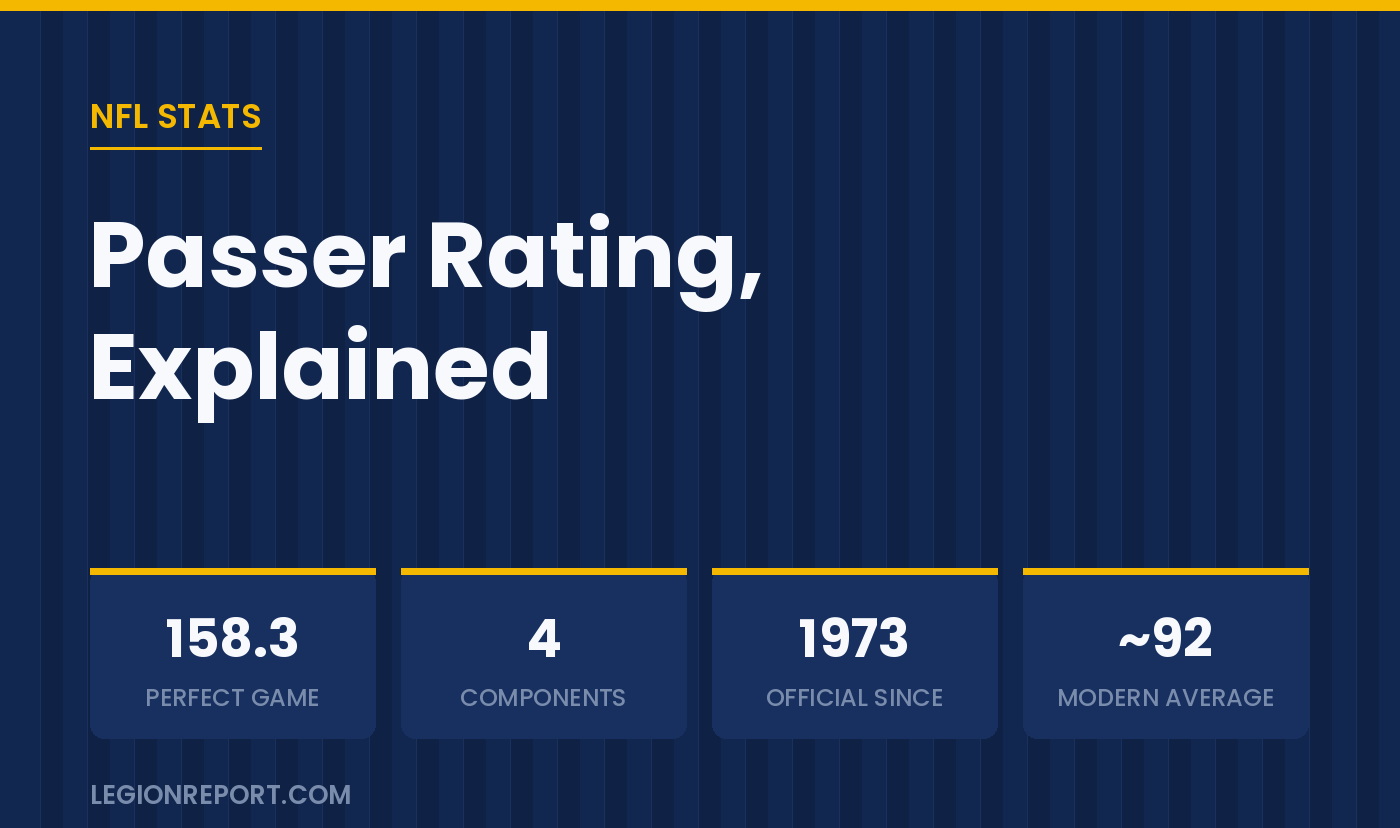

Passer rating is the NFL’s official quarterback statistic — the number that shows up in every box score, on every broadcast graphic, and next to “158.3” whenever someone has a perfect game. It has been the league’s standard since 1973, and it remains the most-cited single measure of passing efficiency even though nearly everyone agrees it’s imperfect. Understanding what it actually measures explains both why it’s still around and why analysts keep building alternatives.
The formula combines four things and nothing else: completion percentage, yards per attempt, touchdown percentage, and interception percentage. It ignores sacks, rushing, fumbles, drops, game situation, and opponent. Each of the four components is scaled so that an “average” 1970s performance scored 1.0 and an outstanding one scored 2.375, then the four are added, divided by six, and multiplied by 100 — which is how the maximum lands on the famous 158.3.
The chart below walks through the exact formula, what a good rating looks like today, and how passer rating compares with QBR and other modern metrics. Take a look, then we’ll get into what it misses.
What Passer Rating Misses
Because the formula only sees pass attempts, a sack — a negative play the quarterback often owns — counts for nothing. Neither does a 40-yard scramble for a first down, a lost fumble on a strip-sack, or a spike to stop the clock (which counts as an incompletion and hurts). Context is absent too: a 5-yard completion on third-and-12 helps the rating as much as one on third-and-4, and garbage-time stats against a prevent defense count the same as fourth-quarter comebacks. That’s why analysts lean on QBR, EPA, and ANY/A when they want to compare quarterbacks — and why passer rating still shows up on every broadcast: it’s simple, it’s official, and every fan can compute it from a stat line.
The Bottom Line
Passer rating measures four things — completion rate, yards per attempt, touchdown rate, and interception rate — on a 0-to-158.3 scale that’s been the NFL’s official standard since 1973. It’s a fair snapshot of passing efficiency and a poor measure of total quarterback play, which is why it’s best read alongside modern metrics. For the model ESPN built to fix its gaps, see our guide to what QBR is, and for another 50-year-old NFL formula that still governs the calendar, how the NFL schedule formula works.