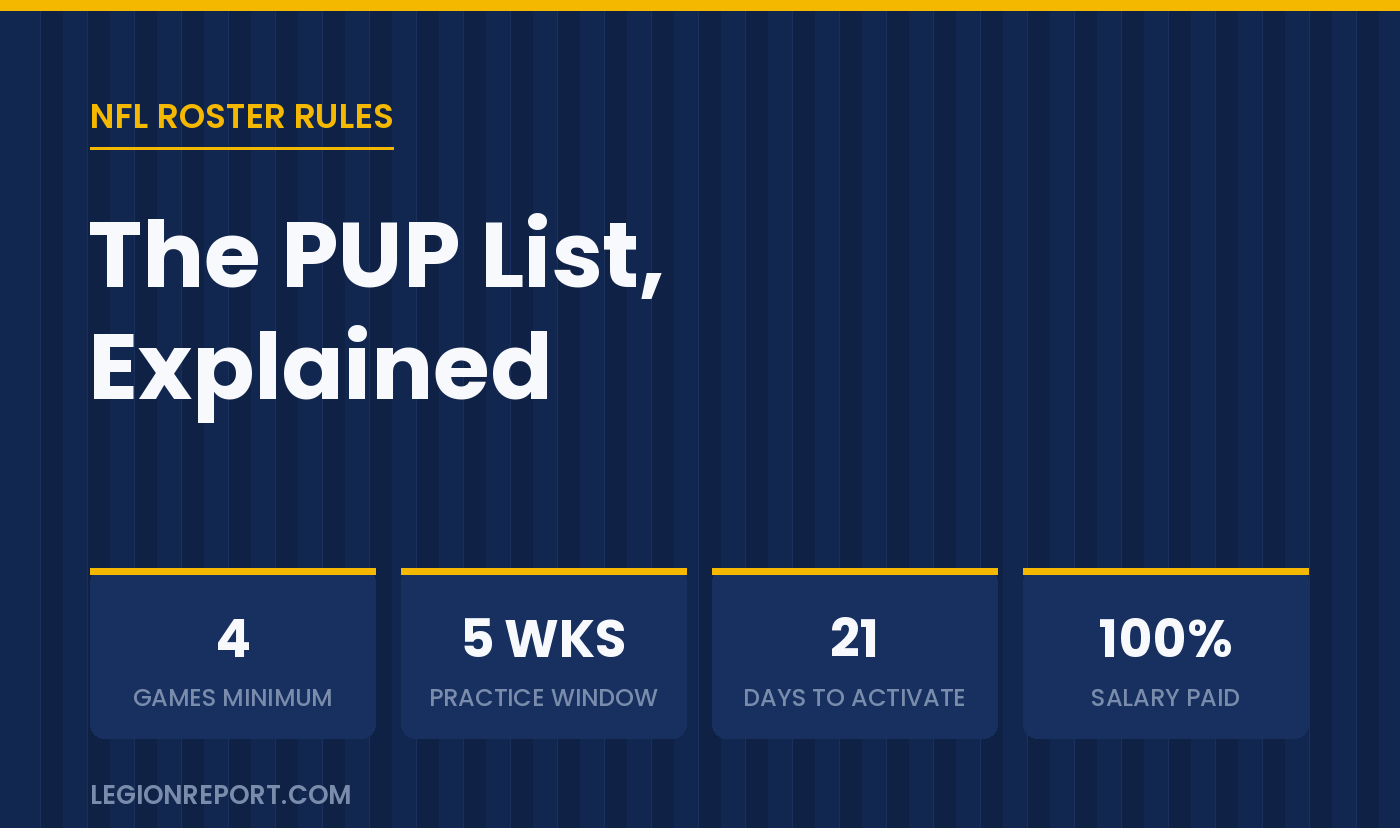
Every July, as NFL training camps open, the same three letters start appearing next to star players’ names: PUP. The Physically Unable to Perform list is one of the most-searched and least-understood roster designations in football — partly because “on the PUP list” in July and “on the PUP list” in September mean two very different things. One is often a precautionary move that costs a player nothing; the other guarantees he misses at least the first four games of the season.
The rules hinge on a single trigger: a player is only eligible for PUP if he arrives at camp still recovering from a football-related injury, and the moment he takes the field for even one practice, he becomes permanently ineligible for the list that season. From there, everything runs on a strict timeline of return windows — and through all of it, the player is paid 100 percent of his salary.
The chart below lays out both versions of the list, the full return timeline, and how PUP compares to injured reserve and the NFI list as of the 2026 season. Take a look, then we’ll cover what actually matters when your team’s star lands on it.
NFL ROSTER RULES
The PUP List, Explained
Active vs. Reserve, the return timeline, and PUP vs. IR vs. NFI
MANDATORY ABSENCE
4 GAMES
On Reserve/PUP, down from 6 pre-2022
PRACTICE WINDOW
5 WKS
To begin practicing after the 4 games
ACTIVATION WINDOW
21 DAYS
To join the 53 once practicing
SALARY
100%
Full base pay while on PUP
Active/PUP vs. Reserve/PUP
Same three letters, very different consequences
| |
Active/PUP (camp) |
Reserve/PUP (regular season) |
| When it applies |
Start of training camp |
Assigned at the 53-man cutdown |
| Roster count |
Counts against the 90-man roster |
Does not count against the 53 |
| Return |
Any time once medically cleared |
After a minimum of four games |
| Key catch |
Once removed, a player cannot go back on |
Miss the return windows and the season is over |
| Allowed activities |
Meetings, training and medical facilities — no practice |
Same — no practice or games until the window opens |
The Reserve/PUP return timeline
Three stages, unforgiving deadlines
| Stage |
What Happens |
| Games 1-4 |
Mandatory absence; activation is allowed as soon as the four games have passed |
| Five-week window |
The team has five weeks to clear the player to begin practicing |
| 21-day window |
Once he practices, the team has 21 days to activate him to the 53 |
| Deadline missed |
Either window lapses and the player stays on PUP for the rest of the season |
PUP vs. IR vs. NFI
The NFL’s three injury designations compared, 2026 rules
| List |
Injury Type |
Key Difference |
| PUP |
Football injury before camp |
Four-game minimum, then the five-week and 21-day windows |
| Injured reserve (IR) |
Football injury at any point |
Pre-cutdown IR ends the season unless designated to return; in-season IR is a four-game minimum with 8 team activations per year (10 with the postseason) |
| Non-football injury (NFI) |
Injury or illness outside NFL activity |
Mirrors PUP mechanics; often used for rookies rehabbing college injuries |
PUP LIST FACTS
One practice ends eligibility
A single snap of a single walkthrough makes a player permanently ineligible for PUP that season — his options narrow to IR or the roster.
The contract keeps running
Deals do not toll on PUP in most cases — the exception is a player in his final contract year who is never activated and still cannot perform by game six.
The rule got friendlier in 2022
The Reserve/PUP minimum dropped from six games to four, and players can now be activated immediately once the games have passed.
Why July PUP News Rarely Matters
Most Active/PUP stints are precautionary. A player rehabbing an offseason surgery gets parked on the list so the team controls his ramp-up, then comes off within weeks and starts Week 1 on time — no games missed, no roster consequence beyond his 90-man spot. The alarm bells only ring at the late-August cutdown to 53, when a team must choose: move him to Reserve/PUP and lose him for at least four games, carry him on the 53 while he heals, trade him, or release him. Any player designated Reserve/PUP after rosters trim to 80 faces the same four-game absence.
The Bottom Line
The PUP list is the NFL’s way of protecting teams and players through camp injuries: full pay, structured timelines, and a hard eligibility trigger — arrive hurt, never practice. Camp PUP is usually nothing; Reserve/PUP costs a month minimum and, if the five-week or 21-day windows lapse, the whole season. For the rest of the camp roster picture, see how the 2026 rookie contract scale pays the players fighting for those 53 spots, and what happens to the ones who land on the practice squad instead.