
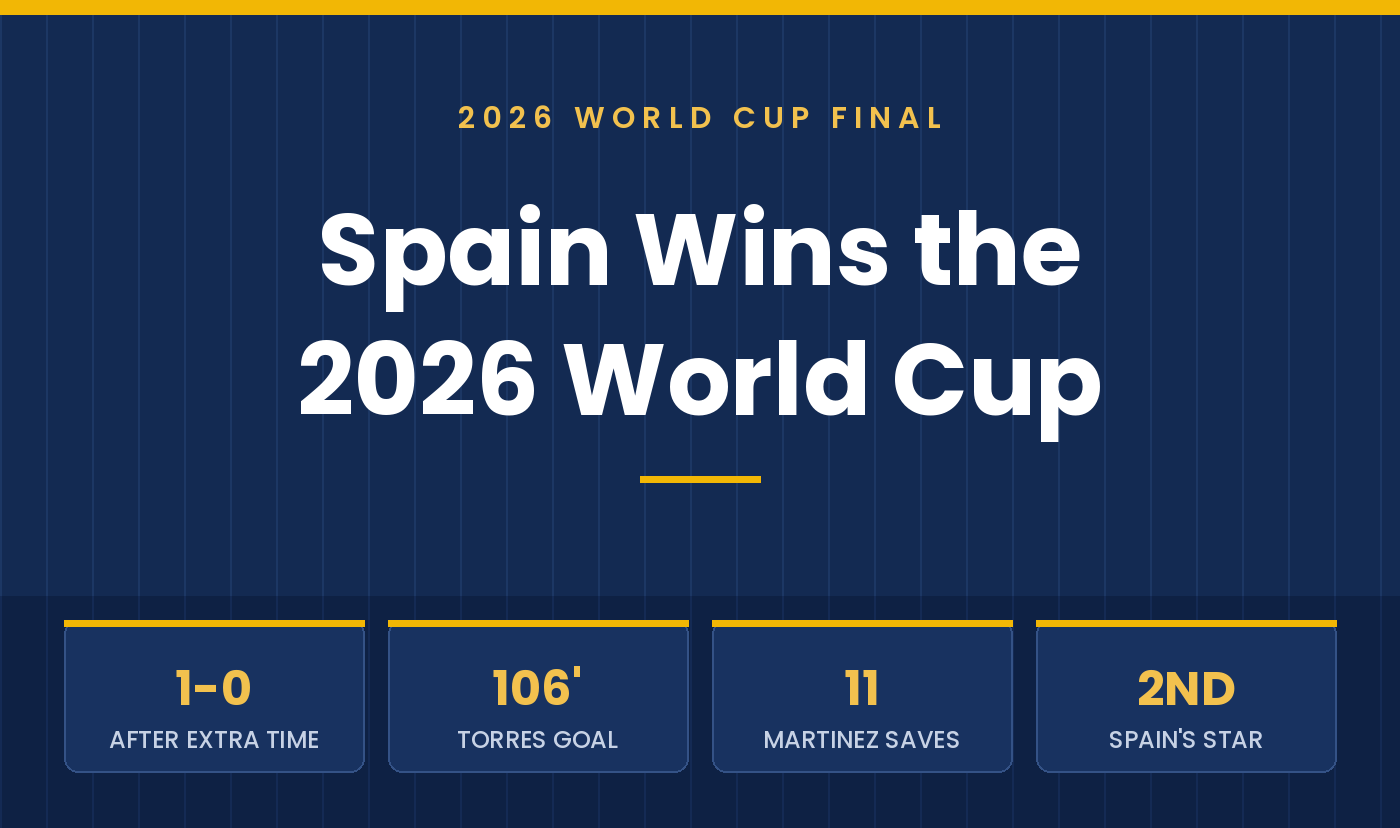

Spain won the 2026 World Cup, beating Argentina 1-0 after extra time at MetLife Stadium on Sunday, July 19, on Ferran Torres’ 106th-minute goal — a second star sixteen years after the first, sealed by the most suffocating tournament any champion has ever played. Spain finished unbeaten, conceded exactly one goal in eight matches, and in the final itself did not allow Argentina a single shot on target.
The match followed the script the whole tournament wrote: Spain controlled 65% of the ball and fired 20 shots at Emiliano Martínez, who answered with a World Cup final-record 11 saves to keep Argentina alive deep into the night. The dam held through 90 minutes — barely surviving Enzo Fernández’s second yellow card in stoppage time — but with Argentina down to 10 men, Torres finally broke through in the second period of extra time. He thought he had a second minutes later, finishing one-on-one before the offside flag intervened.
Argentina’s defiance produced the final’s most extraordinary image: its first shot of the entire match came in the 115th minute from Lionel Messi, and Mikel Merino blocked it with his face — staying down for treatment before leaving for a medical evaluation, having already helped seal history at the other end. The defeat ended Argentina’s bid to become the first repeat champion since Brazil in 1962, and almost certainly closed the greatest World Cup career ever played: Messi, at 39, walked off a runner-up in what is widely expected to be his final international match.
What It Means
Spain is a two-time world champion and the reigning European and world title-holder simultaneously — the crown it last held from 2010 to 2012 — with the youngest superstar in the sport and a coach, Luis de la Fuente, still unbeaten in World Cup and Euro matches. Argentina leaves with the richest runner-up prize ever, Martínez’s record, and a farewell that hurt: the repeat bid died one goal short. The weekend’s other history belonged to Kylian Mbappé, whose two goals in England’s wild 6-4 win over France in Saturday’s third-place match made him the World Cup’s all-time leading scorer with 22 — passing Messi at the last possible moment.
The Bottom Line
Spain 1, Argentina 0, after extra time — Torres in the 106th, a red card, a face-block for the ages, and the second star. The full arc is in Spain’s World Cup history and every World Cup winner by year, the money in Spain’s player bonuses and Argentina’s runner-up prize, and the era that closed in Messi’s World Cup finals record.