
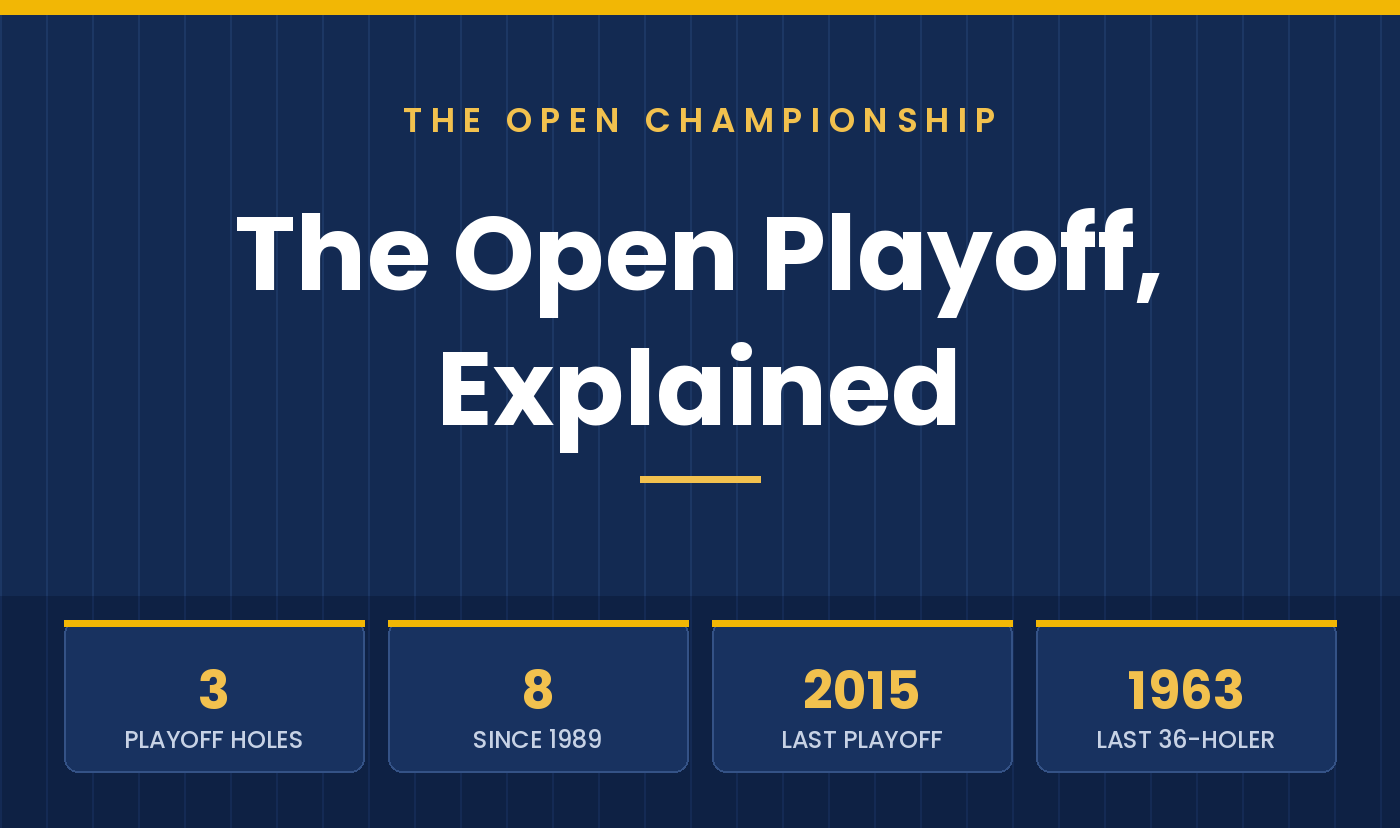

If The Open Championship ends in a tie after 72 holes, the Claret Jug is decided by a three-hole aggregate playoff: the tied players go back out, play three designated holes, and the lowest combined score wins. If they’re still level after those three, it goes to sudden death, hole by hole, until someone breaks the tie. There is no next-day return — the champion is crowned on Sunday evening, whatever it takes.
It hasn’t come to that in a while. The last Open playoff was in 2015, when Zach Johnson beat Louis Oosthuizen and Marc Leishman at St Andrews under the old four-hole aggregate format, which the R&A used from 1989 through 2018 before trimming it to three holes ahead of the 2019 Open. Before 1989, tied Opens were settled the hard way — a full 18-hole playoff the following day, and in the earliest era 36 holes; Bob Charles won the last of the 36-hole marathons in 1963.
Each major handles ties differently, and The Open’s three-hole format sits in the middle of the spectrum — more golf than the Masters’ sudden death, less than the U.S. Open once demanded. The comparison, and every aggregate-era Open playoff, is charted below.
How the Three Holes Work in Practice
The R&A designates the playoff holes in advance each year — typically a closing stretch that keeps the crowds around the 18th — and all tied players compete simultaneously as one group. Strategy changes with the math: unlike sudden death, a bogey doesn’t eliminate you, and unlike 18 holes, there’s no time to recover from a disaster, which is why aggregate playoffs tend to be won with three steady pars rather than heroics. If the group is still level after three, the format collapses into sudden death on a designated hole until the Champion Golfer of the Year is decided.
The Bottom Line
A tied Open goes to a three-hole aggregate playoff the same evening, with sudden death as the backstop — a format used since 2019, after three decades of four-hole playoffs and a century of next-day marathons before that. Eight men have won the Claret Jug this way since 1989, none since Zach Johnson in 2015, and if the 2026 Open at Royal Birkdale produces the ninth, it would be the venue’s first playoff since 1998. For the rest of the championship’s machinery, see how many golfers make the cut and our ranking of Open venues by difficulty.