
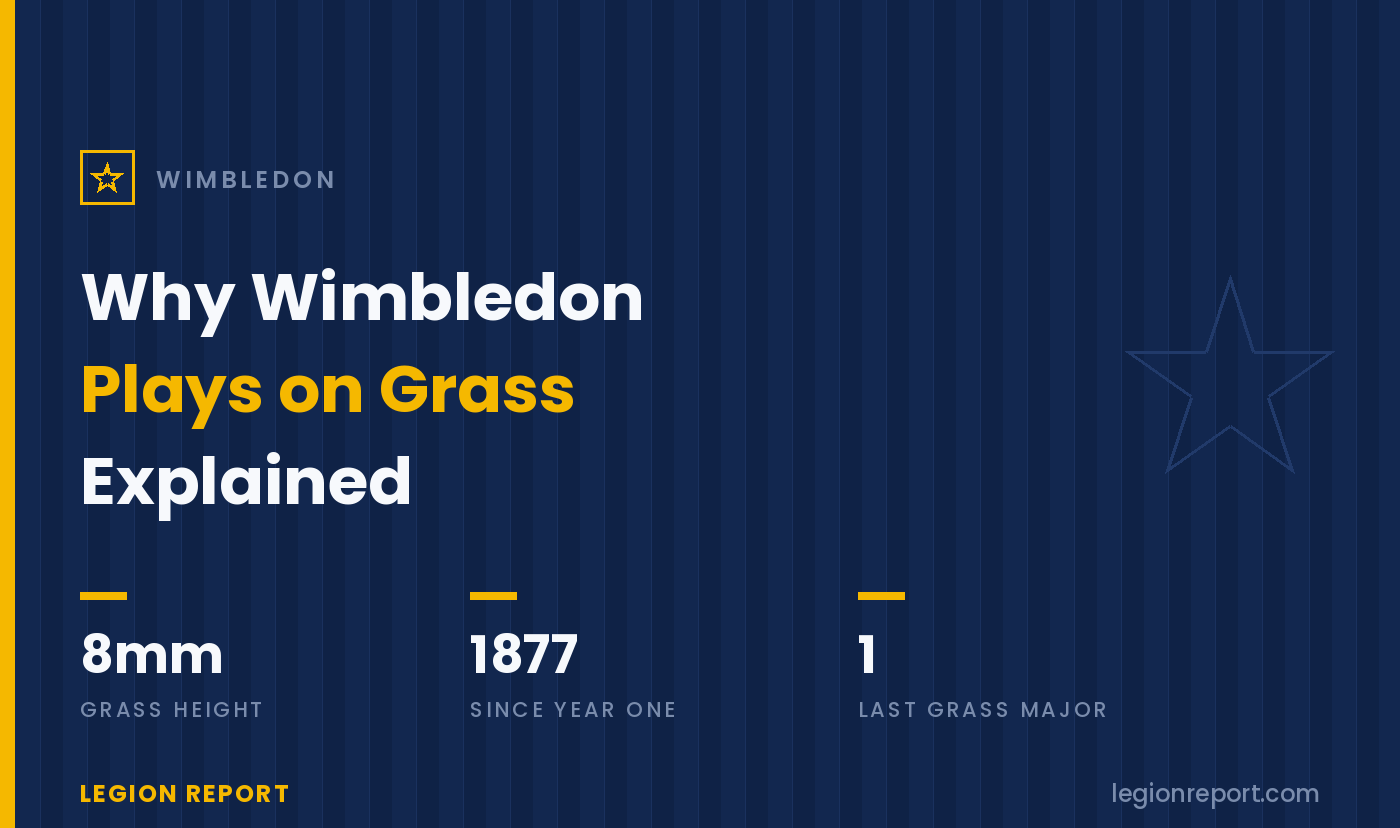

Wimbledon is the only Grand Slam still played on grass, and the reason is both simpler and stranger than most fans assume. Grass isn’t a quirky choice Wimbledon made; grass is what tennis is. The sport’s full, formal name is lawn tennis, it was invented on Victorian croquet lawns, and the All England Club that hosts Wimbledon was a croquet club that adopted the new lawn game in 1877. Every other surface, clay, hard court, carpet, is the deviation. Wimbledon just never deviated.
What was once universal is now nearly extinct: the US Open abandoned grass in the 1970s, the Australian Open in the 1980s, and today only a sliver of the professional calendar touches the sport’s original surface. That scarcity transformed Wimbledon’s lawns from a default into an identity, 8 millimeters of living playing surface that changes daily, rewards a vanishing style of tennis, and requires eleven months of preparation for two weeks of use.
The chart below covers the whole story: the historical answer, how the other majors left grass behind, how the surface actually plays, the obsessive science of the lawns, and why Wimbledon keeps it forever. Take a look, then we’ll break it all down.
The answer is in the sport’s name
Why is Wimbledon played on grass? Because tennis is a grass sport that mostly stopped playing on grass, and Wimbledon is the part that didn’t. The modern game was invented in the 1870s as lawn tennis, engineered specifically for the manicured croquet lawns of Victorian England, and the All England Croquet Club adopted it precisely because it already owned the lawns. When the club staged its first Championships in 1877, grass wasn’t a surface choice; it was the sport’s entire premise. Three of the four eventual majors began on grass (only the French was ever different), and the host’s full name today, the All England Lawn Tennis and Croquet Club, is the answer fossilized in letterhead.
The great abandonment, and the holdout
What changed is everyone else. The US Open left grass after 1974 (via a brief clay detour to hard courts in 1978); the Australian Open followed in 1988; and the professional tour shrank grass to a few midsummer weeks, because grass is the worst surface by every practical measure: expensive to maintain, fragile under professional footwork, weather-dependent, and inconsistent of bounce. Wimbledon looked at the same ledger and concluded the impracticality was the value. The lawns became the tournament’s identity, alongside the white clothing and the ad-free courts, and, more importantly for the sport, its insurance policy: the career Grand Slam requires mastering clay, hard courts, and grass, and the three-surface examination of greatness only exists because somebody kept the third surface alive. Wimbledon is less a tournament with old-fashioned courts than a working museum with a trophy attached.
Eight millimeters of living tennis
The grass itself is the most engineered “natural” surface in sports: 100% perennial ryegrass since 2001 (a durability-and-bounce upgrade that quietly slowed and truthened the skidding chaos of the 1990s), mown to exactly 8 millimeters daily, rolled, moisture-tested, and hardness-measured like laboratory equipment, with eleven months of cultivation buying a fortnight of play, and a working hawk on dawn patrol to keep pigeons off the seed. Its playing character survives all that engineering: the ball still skids low and fast, still rewards big serving, slice, and net instincts, still punishes clay-bred topspin grinding, and still changes daily, lush and slick in week one, worn honest by finals weekend. The baseline bald patches that appear by week two are the annual proof that the players changed and the lawns didn’t: courts that once wore out at the net now scar only where the modern game lives.
Final Word
Why is Wimbledon played on grass? Because grass is tennis’ original surface, the sport is formally lawn tennis, born on croquet lawns, first championed at Wimbledon in 1877, and while the US and Australian Opens defected to hard courts decades ago, the All England Club kept the lawns as identity, examination, and stewardship: 8mm of daily-mown ryegrass, eleven months of preparation for two weeks of skidding, serve-rewarding, baseline-scarring tennis. Every other major changed with the times. Wimbledon decided the times could adjust.
The dress code born of the same era is in why Wimbledon players wear white, the lids that protect the lawns are in the curfew and roof rules, and the dawn-patrol hawk has his own story in Rufus the Hawk.